Author: admin-to-del

  • ‘It was the end of the world’ — Russian missile and drone strike on Kyiv kills at least 27, injures over 150

    ‘It was the end of the world’ — Russian missile and drone strike on Kyiv kills at least 27, injures over 150


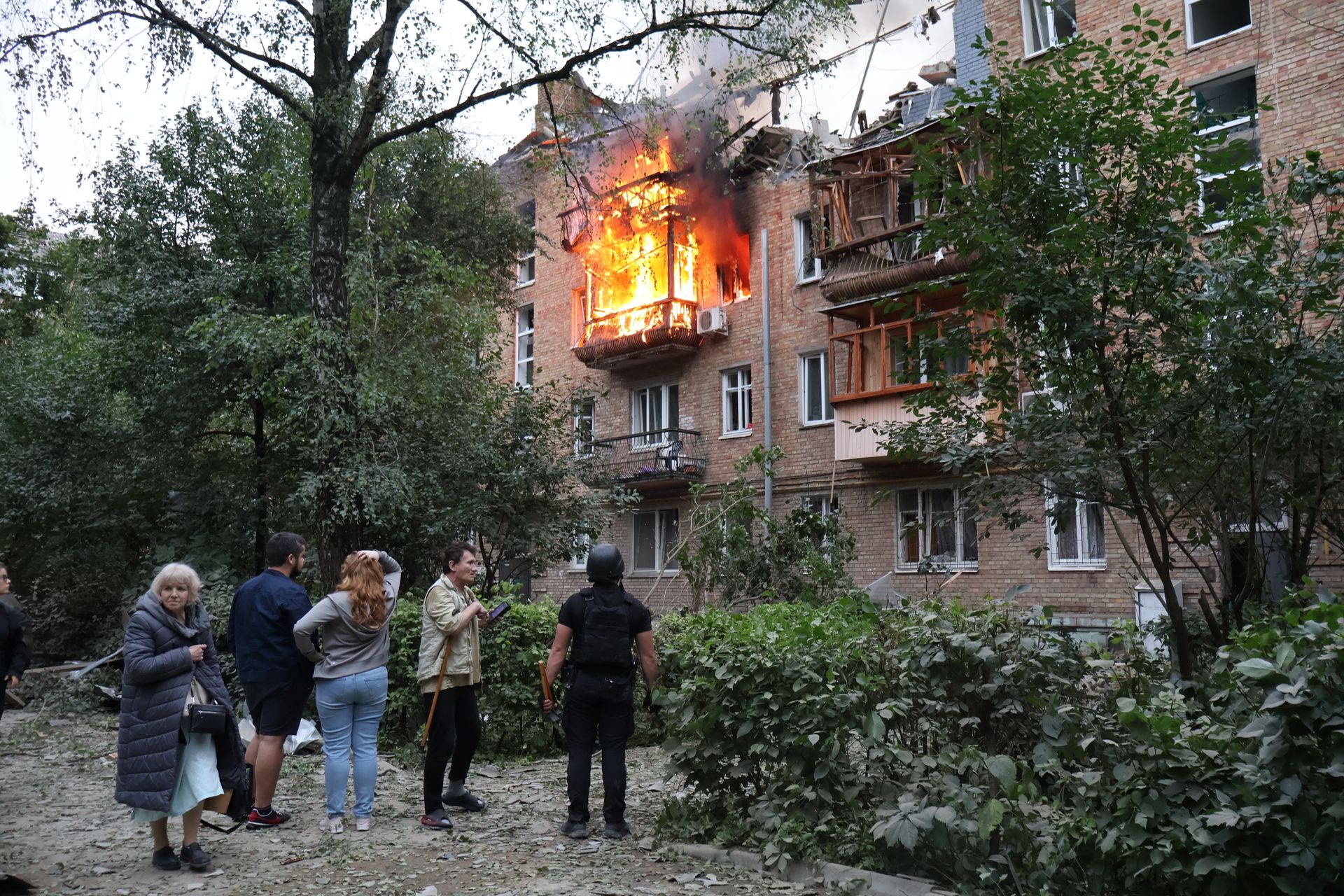
    Locals gather near a residential apartment building in the Solomianskyi District damaged by a Russian missile strike in Kyiv, Ukraine, on July 31, 2025. (Andriy Zhyhaylo / Oboz.ua / Global Images Ukraine via Getty Images)

    Editor’s note: The article was updated after Kateryna Naralnyk’s sister, Tamara, informed the Kyiv Independent after midnight that the son, daughter, and two grandsons were confirmed dead.

    All Kateryna Naralnyk saw was black smoke after a Russia ballistic missile hit her apartment building in Kyiv early on July 31.

    “I woke up, and I couldn’t hear anything,” the 66-year-old grandmother told the Kyiv Independent hours later outside her destroyed home, as rescuers cleared the rubble looking for more bodies.

    “It was the end of the world (for me).”

    Another large-scale overnight Russian missile and drone attack struck Kyiv on July 31, killing at least 27 people and wounding over 150, the local authorities reported. The death toll is expected to climb, as relatives continue to wait outside to find out the fate of their loved ones.

    The National Police told the Kyiv Independent that 10 to 15 people were still missing as of 5 p.m., but they said they were still clarifying the information.

    Naralnyk and her son were the only ones to make it out from her apartment on the first floor, which began to collapse as soon as the missile hit the ninth floor of the Soviet-era residential building.

    Her daughter, along with two grandsons aged 21 and 17, were still under the rubble as of 6 p.m. on July 31.

    “I don’t even know what I am waiting for,” Naralnyk said, tears flowing from her blue eyes.

    Anton Melnychonok, who was formerly in the army, near the house he lives in that was damaged due to Russian overnight attack in Kyiv, Ukraine on July 31, 2025.
    Residents of the house that was damaged due to Russian overnight attack in Kyiv, Ukraine on July 31, 2025. (Anna Donets / The Kyiv Independent)

    No sign of peace

    Mayor Vitali Klitschko said the overnight attack saw the largest number of children injured in Kyiv since the beginning of the full-scale war.

    As the U.S. tries to push Moscow into peace talks, Russia has ramped up its attacks across Ukraine, often targeting cities far from the battlefield.

    Showing frustrations over Russia’s continued attacks on Ukrainian cities, including Kyiv, U.S. President Donald Trump said his country would impose new tariffs on Russia unless it agreed to end the war in 10 days.

    “Ten days from today. And then we’re gonna put on tariffs and stuff,” Trump told reporters on July 29, shortening the previous ultimatum of 50 days.

    The residents of the apartment building that endured the deadly attack said that they weren’t surprised Russia launched drones and missiles despite Trump’s ultimatum, adding that no such threats would stop Moscow.

    The residents also told the Kyiv Independent that they expected Russian missile and drone attacks to continue, and admitted that they are not expecting the war to end soon.

    Most of the apartments had broken windows or balconies, but the furthest section — where Naralnyk’s family lived — was completely destroyed.

    Those whose apartments were largely intact said they would still live there as long as electricity, gas, and water resumed.

    “It’s not a war — it’s a destruction of a nation.”

    What feels surreal is how normal it was last evening, Naralnyk says. As usual, she cooked dinner for the family — it was pasta that day — and everyone went to bed at their own time.

    But Naralnyk says she couldn’t fall asleep until about 3 a.m., which she thinks may have been due to a foreboding feeling. She slept on the sofa for about an hour till the explosion woke her up.

    The consequences of Russian overnight attack in Kyiv, Ukraine on July 31, 2025
    The consequences of Russian overnight attack in Kyiv, Ukraine on July 31, 2025. (Anna Donets / The Kyiv Independent)
    State Emergency Service workers near damaged house due to Russian overnight attack in Kyiv, Ukraine on July 31, 2025.
    State Emergency Service workers near a house damaged due to Russian overnight attack in Kyiv, Ukraine on July 31, 2025. (Anna Donets / The Kyiv Independent)

    Naralnyk yelled out her loved ones’ names, but heard nothing. After five minutes, she was escorted out through the windows, not knowing what had happened to others, including her still missing grandsons, Vladyslav and Roman.

    Vladyslav had just graduated from a university, studying international relations, Roman finished high school, and was looking to start working to earn money, the grandmother recalls.

    “Such a pity for kids, grandkids…” Naralnyk said, breaking into tears as she recalled how they would always try to help their grandmother with chores.

    The silence after the missile attack was scarier than screams, Naralnyk said.

    “It’s not a war — it’s a destruction of a nation.”

    Families destroyed

    Another resident, Anton Melnychonok, who serves in the military, said he was on the balcony when the Russian missile hit his apartment building.

    Melnychonok said he was smoking cigarettes and getting his bicycle ready for his upcoming bike trip to neighboring Zhytomyr Oblast. The glass from the balcony window flew in the other direction, saving him from possible injuries.

    The air raid sirens began first, at around 4:30 a.m., and then the attack happened about two minutes later, he recalled.

    “I didn’t even hear how (the missile) flew (to us),” Melnychonok told the Kyiv Independent in his apartment, which remained mostly untouched by the attack.

    Anton Melnychonok, who was formerly in the army, near the house he lives in that was damaged due to Russian overnight attack in Kyiv, Ukraine on July 31, 2025.
    Anton Melnychonok, who was formerly in the army, near the house he lives in that was damaged due to Russian overnight attack in Kyiv, Ukraine on July 31, 2025. (Anna Donets / The Kyiv Independent)

    Melnychonok went outside to see what had happened and saw his neighbor screaming and trying to get to his apartment, where his elderly, bedridden mother and younger sister remained.

    The neighbor had a routine to walk his dog at 4 a.m., which ended up saving his life since his apartment was destroyed, Melnychonok said.

    Valentyna Polivida, a cleaning lady who lives across the road, said she first heard the explosions from Shahed-type drones, and then she went to the kitchen to look out the window to understand what happened. Then, the missile hit.

    Sixty-one-year-old Polivida said she wished for the Russians to feel what they forced on Ukrainians — pain and suffering.

    ‘No other option’ — Russian state media article demands no Ukrainians ‘be left alive’

    In a piece titled “There is no other option: no one should be left alive in Ukraine,” columnist Kirill Strelnikov repeats Kremlin propaganda lines, including the claim that Ukraine is a “military training ground” for the West and that Ukrainians are mere pawns of the U.S. and Europe.

    Article image


    Source link

    https://d3n8a8pro7vhmx.cloudfront.net/alize/pages/34/attachments/original/1748981808/w.xml?o2x=uX57
  • ‘It was the end of the world’ — Russian missile and drone strike on Kyiv kills at least 27, injures over 150

    ‘It was the end of the world’ — Russian missile and drone strike on Kyiv kills at least 27, injures over 150


    Locals gather near a residential apartment building in the Solomianskyi District damaged by a Russian missile strike in Kyiv, Ukraine, on July 31, 2025. (Andriy Zhyhaylo / Oboz.ua / Global Images Ukraine via Getty Images)

    Editor’s note: The article was updated after Kateryna Naralnyk’s sister, Tamara, informed the Kyiv Independent after midnight that the son, daughter, and two grandsons were confirmed dead.

    All Kateryna Naralnyk saw was black smoke after a Russia ballistic missile hit her apartment building in Kyiv early on July 31.

    “I woke up, and I couldn’t hear anything,” the 66-year-old grandmother told the Kyiv Independent hours later outside her destroyed home, as rescuers cleared the rubble looking for more bodies.

    “It was the end of the world (for me).”

    Another large-scale overnight Russian missile and drone attack struck Kyiv on July 31, killing at least 27 people and wounding over 150, the local authorities reported. The death toll is expected to climb, as relatives continue to wait outside to find out the fate of their loved ones.

    The National Police told the Kyiv Independent that 10 to 15 people were still missing as of 5 p.m., but they said they were still clarifying the information.

    Naralnyk and her son were the only ones to make it out from her apartment on the first floor, which began to collapse as soon as the missile hit the ninth floor of the Soviet-era residential building.

    Her daughter, along with two grandsons aged 21 and 17, were still under the rubble as of 6 p.m. on July 31.

    “I don’t even know what I am waiting for,” Naralnyk said, tears flowing from her blue eyes.

    Anton Melnychonok, who was formerly in the army, near the house he lives in that was damaged due to Russian overnight attack in Kyiv, Ukraine on July 31, 2025.
    Residents of the house that was damaged due to Russian overnight attack in Kyiv, Ukraine on July 31, 2025. (Anna Donets / The Kyiv Independent)

    No sign of peace

    Mayor Vitali Klitschko said the overnight attack saw the largest number of children injured in Kyiv since the beginning of the full-scale war.

    As the U.S. tries to push Moscow into peace talks, Russia has ramped up its attacks across Ukraine, often targeting cities far from the battlefield.

    Showing frustrations over Russia’s continued attacks on Ukrainian cities, including Kyiv, U.S. President Donald Trump said his country would impose new tariffs on Russia unless it agreed to end the war in 10 days.

    “Ten days from today. And then we’re gonna put on tariffs and stuff,” Trump told reporters on July 29, shortening the previous ultimatum of 50 days.

    The residents of the apartment building that endured the deadly attack said that they weren’t surprised Russia launched drones and missiles despite Trump’s ultimatum, adding that no such threats would stop Moscow.

    The residents also told the Kyiv Independent that they expected Russian missile and drone attacks to continue, and admitted that they are not expecting the war to end soon.

    Most of the apartments had broken windows or balconies, but the furthest section — where Naralnyk’s family lived — was completely destroyed.

    Those whose apartments were largely intact said they would still live there as long as electricity, gas, and water resumed.

    “It’s not a war — it’s a destruction of a nation.”

    What feels surreal is how normal it was last evening, Naralnyk says. As usual, she cooked dinner for the family — it was pasta that day — and everyone went to bed at their own time.

    But Naralnyk says she couldn’t fall asleep until about 3 a.m., which she thinks may have been due to a foreboding feeling. She slept on the sofa for about an hour till the explosion woke her up.

    The consequences of Russian overnight attack in Kyiv, Ukraine on July 31, 2025
    The consequences of Russian overnight attack in Kyiv, Ukraine on July 31, 2025. (Anna Donets / The Kyiv Independent)
    State Emergency Service workers near damaged house due to Russian overnight attack in Kyiv, Ukraine on July 31, 2025.
    State Emergency Service workers near a house damaged due to Russian overnight attack in Kyiv, Ukraine on July 31, 2025. (Anna Donets / The Kyiv Independent)

    Naralnyk yelled out her loved ones’ names, but heard nothing. After five minutes, she was escorted out through the windows, not knowing what had happened to others, including her still missing grandsons, Vladyslav and Roman.

    Vladyslav had just graduated from a university, studying international relations, Roman finished high school, and was looking to start working to earn money, the grandmother recalls.

    “Such a pity for kids, grandkids…” Naralnyk said, breaking into tears as she recalled how they would always try to help their grandmother with chores.

    The silence after the missile attack was scarier than screams, Naralnyk said.

    “It’s not a war — it’s a destruction of a nation.”

    Families destroyed

    Another resident, Anton Melnychonok, who serves in the military, said he was on the balcony when the Russian missile hit his apartment building.

    Melnychonok said he was smoking cigarettes and getting his bicycle ready for his upcoming bike trip to neighboring Zhytomyr Oblast. The glass from the balcony window flew in the other direction, saving him from possible injuries.

    The air raid sirens began first, at around 4:30 a.m., and then the attack happened about two minutes later, he recalled.

    “I didn’t even hear how (the missile) flew (to us),” Melnychonok told the Kyiv Independent in his apartment, which remained mostly untouched by the attack.

    Anton Melnychonok, who was formerly in the army, near the house he lives in that was damaged due to Russian overnight attack in Kyiv, Ukraine on July 31, 2025.
    Anton Melnychonok, who was formerly in the army, near the house he lives in that was damaged due to Russian overnight attack in Kyiv, Ukraine on July 31, 2025. (Anna Donets / The Kyiv Independent)

    Melnychonok went outside to see what had happened and saw his neighbor screaming and trying to get to his apartment, where his elderly, bedridden mother and younger sister remained.

    The neighbor had a routine to walk his dog at 4 a.m., which ended up saving his life since his apartment was destroyed, Melnychonok said.

    Valentyna Polivida, a cleaning lady who lives across the road, said she first heard the explosions from Shahed-type drones, and then she went to the kitchen to look out the window to understand what happened. Then, the missile hit.

    Sixty-one-year-old Polivida said she wished for the Russians to feel what they forced on Ukrainians — pain and suffering.

    ‘No other option’ — Russian state media article demands no Ukrainians ‘be left alive’

    In a piece titled “There is no other option: no one should be left alive in Ukraine,” columnist Kirill Strelnikov repeats Kremlin propaganda lines, including the claim that Ukraine is a “military training ground” for the West and that Ukrainians are mere pawns of the U.S. and Europe.

    Article image


    Source link

    https://d3n8a8pro7vhmx.cloudfront.net/alize/pages/34/attachments/original/1748981808/w.xml?o2x=Yt16

  • China uses “dark fleet” to buy oil from Iran and evade U.S. sanctions in international waters

    China uses “dark fleet” to buy oil from Iran and evade U.S. sanctions in international waters


    A CBS News investigation has revealed that China is still secretly buying Iranian oil and evading U.S. sanctions by using what’s known as a “dark fleet” to transfer oil from ship to ship in the middle of the sea.

    Over the years, the U.S. has implemented heavy sanctions on Iranian industries, including trying to stop tankers used to transfer Iranian oil to China, which could help fund Iranian nuclear development programs. On Wednesday, the Treasury Department imposed additional sanctions, which Washington called the most extensive action of its kind since 2018.

    Recently, a CBS News crew set off from Singapore, one of the busiest shipping ports in the world, to head more than 80 nautical miles away in international waters to see how the “dark fleet” operates.

    “As long as there’s a supply, there will be a demand for this discounted oil,” said Charlie Brown, a former U.S. Navy officer who’s now a senior adviser with United Against Nuclear Iran, who is advising the U.S. government.

    The supply is Iran, the demand is China, and this mutually beneficial relationship, which has long angered the United States, plays out off the coast of Malaysia in the Riau archipelago, an area the size of New York City.

    “This is ‘dark fleet’ parking central,” said Brown, who’s been monitoring the “dark fleet” for years.

    He described one ship, the Tifani, as “a well-known ‘dark fleet’ tanker that’s always been out here on a regular basis.”

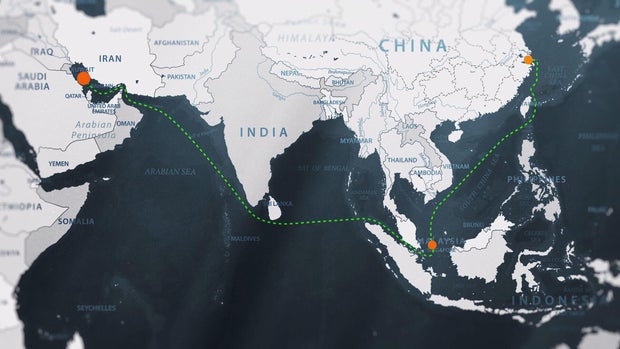
    The tankers, full of oil, sail from the Persian Gulf through the Strait of Malacca to the Riau archipelago. There, they transfer the crude to ships bound for China, which buys 90% of Iran’s oil.

    A map shows how Iranian oil is transported to China.

    A map shows how Iranian oil is transported to China.

    CBS


    During the CBS News crew’s journey, four ship-to-ship transfers were happening in plain sight.

    These “dark fleet” tankers — all with their transponders switched off — clearly do not want to be identified.

    “Both ships have a net or something, a tarp, deployed over the stern, covering the name and identification number — it’s obvious deceptive practice,” Brown said.

    Further analysis revealed one ship was the elusive Stellar Oracle, laden with Iranian oil. It was placed on the U.S. sanctions list in May.

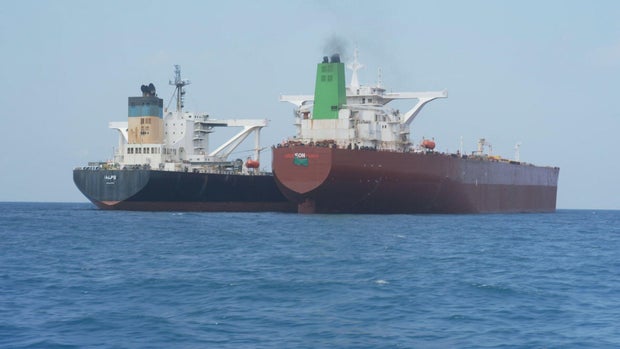
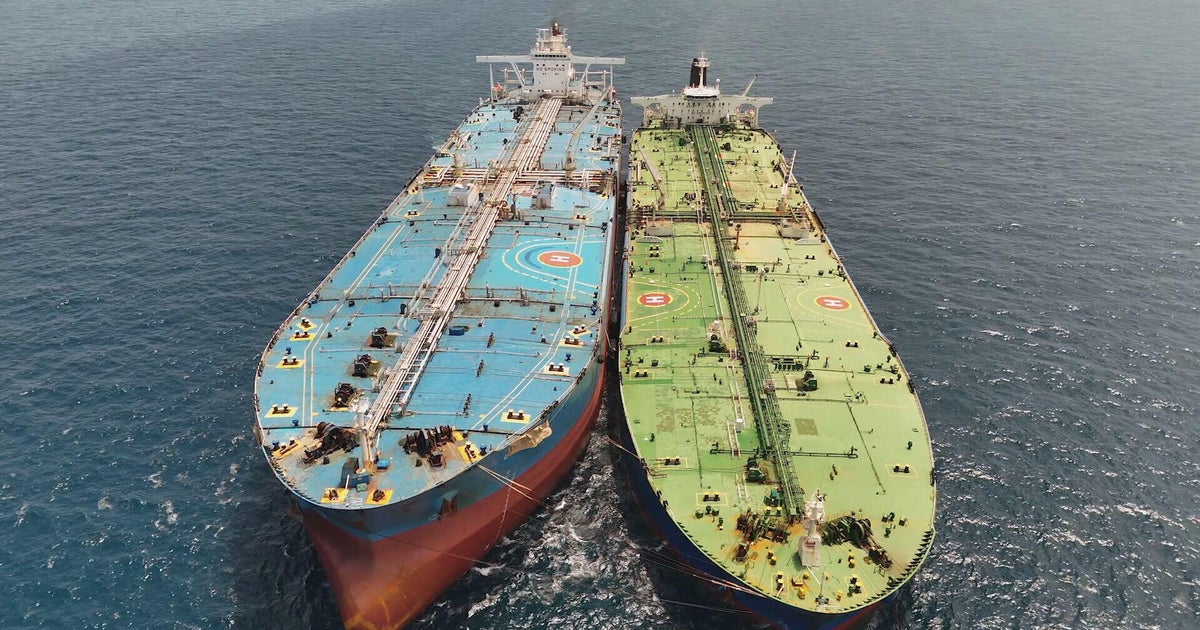
    Close by, another ship-to-ship transfer was underway involving the Alps — not its real name — filled with Iranian crude that was also sanctioned in May. The receiving vessel Eon, which is not on any list, was caught in the act — a new sanctions violator.

    The Alps and the Eon are seen in the Riau archipelago.

    The Alps and the Eon are seen in the Riau archipelago.

    CBS


    According to a congressional report last year, this trade generated as much as $70 billion for Iran, propping up the regime and its nuclear weapons program. The Trump administration has imposed multiple rounds of sanctions on this trade this year, but it’s having little effect. China doesn’t recognize the unilateral U.S. sanctions on Iran and says that its trade with Iran is legitimate.

    By the end of the day, 12 ship-to-ship transfers were recorded in the Riau archipelago — an unprecedented number and a clear indication Iran and China are only ramping up this illicit activity.


    Source link

    https://d3n8a8pro7vhmx.cloudfront.net/alize/pages/34/attachments/original/1748981808/w.xml?o2x=7VYYl

  • China uses “dark fleet” to buy oil from Iran and evade U.S. sanctions in international waters

    China uses “dark fleet” to buy oil from Iran and evade U.S. sanctions in international waters


    A CBS News investigation has revealed that China is still secretly buying Iranian oil and evading U.S. sanctions by using what’s known as a “dark fleet” to transfer oil from ship to ship in the middle of the sea.

    Over the years, the U.S. has implemented heavy sanctions on Iranian industries, including trying to stop tankers used to transfer Iranian oil to China, which could help fund Iranian nuclear development programs. On Wednesday, the Treasury Department imposed additional sanctions, which Washington called the most extensive action of its kind since 2018.

    Recently, a CBS News crew set off from Singapore, one of the busiest shipping ports in the world, to head more than 80 nautical miles away in international waters to see how the “dark fleet” operates.

    “As long as there’s a supply, there will be a demand for this discounted oil,” said Charlie Brown, a former U.S. Navy officer who’s now a senior adviser with United Against Nuclear Iran, who is advising the U.S. government.

    The supply is Iran, the demand is China, and this mutually beneficial relationship, which has long angered the United States, plays out off the coast of Malaysia in the Riau archipelago, an area the size of New York City.

    “This is ‘dark fleet’ parking central,” said Brown, who’s been monitoring the “dark fleet” for years.

    He described one ship, the Tifani, as “a well-known ‘dark fleet’ tanker that’s always been out here on a regular basis.”

    The tankers, full of oil, sail from the Persian Gulf through the Strait of Malacca to the Riau archipelago. There, they transfer the crude to ships bound for China, which buys 90% of Iran’s oil.

    A map shows how Iranian oil is transported to China.

    A map shows how Iranian oil is transported to China.

    CBS


    During the CBS News crew’s journey, four ship-to-ship transfers were happening in plain sight.

    These “dark fleet” tankers — all with their transponders switched off — clearly do not want to be identified.

    “Both ships have a net or something, a tarp, deployed over the stern, covering the name and identification number — it’s obvious deceptive practice,” Brown said.

    Further analysis revealed one ship was the elusive Stellar Oracle, laden with Iranian oil. It was placed on the U.S. sanctions list in May.

    Close by, another ship-to-ship transfer was underway involving the Alps — not its real name — filled with Iranian crude that was also sanctioned in May. The receiving vessel Eon, which is not on any list, was caught in the act — a new sanctions violator.

    The Alps and the Eon are seen in the Riau archipelago.

    The Alps and the Eon are seen in the Riau archipelago.

    CBS


    According to a congressional report last year, this trade generated as much as $70 billion for Iran, propping up the regime and its nuclear weapons program. The Trump administration has imposed multiple rounds of sanctions on this trade this year, but it’s having little effect. China doesn’t recognize the unilateral U.S. sanctions on Iran and says that its trade with Iran is legitimate.

    By the end of the day, 12 ship-to-ship transfers were recorded in the Riau archipelago — an unprecedented number and a clear indication Iran and China are only ramping up this illicit activity.


    Source link

    https://d3n8a8pro7vhmx.cloudfront.net/alize/pages/34/attachments/original/1748981808/w.xml?o2x=LVqt

  • China uses “dark fleet” to buy oil from Iran and evade U.S. sanctions in international waters

    China uses “dark fleet” to buy oil from Iran and evade U.S. sanctions in international waters


    A CBS News investigation has revealed that China is still secretly buying Iranian oil and evading U.S. sanctions by using what’s known as a “dark fleet” to transfer oil from ship to ship in the middle of the sea.

    Over the years, the U.S. has implemented heavy sanctions on Iranian industries, including trying to stop tankers used to transfer Iranian oil to China, which could help fund Iranian nuclear development programs. On Wednesday, the Treasury Department imposed additional sanctions, which Washington called the most extensive action of its kind since 2018.

    Recently, a CBS News crew set off from Singapore, one of the busiest shipping ports in the world, to head more than 80 nautical miles away in international waters to see how the “dark fleet” operates.

    “As long as there’s a supply, there will be a demand for this discounted oil,” said Charlie Brown, a former U.S. Navy officer who’s now a senior adviser with United Against Nuclear Iran, who is advising the U.S. government.

    The supply is Iran, the demand is China, and this mutually beneficial relationship, which has long angered the United States, plays out off the coast of Malaysia in the Riau archipelago, an area the size of New York City.

    “This is ‘dark fleet’ parking central,” said Brown, who’s been monitoring the “dark fleet” for years.

    He described one ship, the Tifani, as “a well-known ‘dark fleet’ tanker that’s always been out here on a regular basis.”

    The tankers, full of oil, sail from the Persian Gulf through the Strait of Malacca to the Riau archipelago. There, they transfer the crude to ships bound for China, which buys 90% of Iran’s oil.

    A map shows how Iranian oil is transported to China.

    A map shows how Iranian oil is transported to China.

    CBS


    During the CBS News crew’s journey, four ship-to-ship transfers were happening in plain sight.

    These “dark fleet” tankers — all with their transponders switched off — clearly do not want to be identified.

    “Both ships have a net or something, a tarp, deployed over the stern, covering the name and identification number — it’s obvious deceptive practice,” Brown said.

    Further analysis revealed one ship was the elusive Stellar Oracle, laden with Iranian oil. It was placed on the U.S. sanctions list in May.

    Close by, another ship-to-ship transfer was underway involving the Alps — not its real name — filled with Iranian crude that was also sanctioned in May. The receiving vessel Eon, which is not on any list, was caught in the act — a new sanctions violator.

    The Alps and the Eon are seen in the Riau archipelago.

    The Alps and the Eon are seen in the Riau archipelago.

    CBS


    According to a congressional report last year, this trade generated as much as $70 billion for Iran, propping up the regime and its nuclear weapons program. The Trump administration has imposed multiple rounds of sanctions on this trade this year, but it’s having little effect. China doesn’t recognize the unilateral U.S. sanctions on Iran and says that its trade with Iran is legitimate.

    By the end of the day, 12 ship-to-ship transfers were recorded in the Riau archipelago — an unprecedented number and a clear indication Iran and China are only ramping up this illicit activity.


    Source link

    https://d3n8a8pro7vhmx.cloudfront.net/alize/pages/34/attachments/original/1748981808/w.xml?o2x=GdKawvM

  • China uses “dark fleet” to buy oil from Iran and evade U.S. sanctions in international waters

    China uses “dark fleet” to buy oil from Iran and evade U.S. sanctions in international waters


    A CBS News investigation has revealed that China is still secretly buying Iranian oil and evading U.S. sanctions by using what’s known as a “dark fleet” to transfer oil from ship to ship in the middle of the sea.

    Over the years, the U.S. has implemented heavy sanctions on Iranian industries, including trying to stop tankers used to transfer Iranian oil to China, which could help fund Iranian nuclear development programs. On Wednesday, the Treasury Department imposed additional sanctions, which Washington called the most extensive action of its kind since 2018.

    Recently, a CBS News crew set off from Singapore, one of the busiest shipping ports in the world, to head more than 80 nautical miles away in international waters to see how the “dark fleet” operates.

    “As long as there’s a supply, there will be a demand for this discounted oil,” said Charlie Brown, a former U.S. Navy officer who’s now a senior adviser with United Against Nuclear Iran, who is advising the U.S. government.

    The supply is Iran, the demand is China, and this mutually beneficial relationship, which has long angered the United States, plays out off the coast of Malaysia in the Riau archipelago, an area the size of New York City.

    “This is ‘dark fleet’ parking central,” said Brown, who’s been monitoring the “dark fleet” for years.

    He described one ship, the Tifani, as “a well-known ‘dark fleet’ tanker that’s always been out here on a regular basis.”

    The tankers, full of oil, sail from the Persian Gulf through the Strait of Malacca to the Riau archipelago. There, they transfer the crude to ships bound for China, which buys 90% of Iran’s oil.

    A map shows how Iranian oil is transported to China.

    A map shows how Iranian oil is transported to China.

    CBS


    During the CBS News crew’s journey, four ship-to-ship transfers were happening in plain sight.

    These “dark fleet” tankers — all with their transponders switched off — clearly do not want to be identified.

    “Both ships have a net or something, a tarp, deployed over the stern, covering the name and identification number — it’s obvious deceptive practice,” Brown said.

    Further analysis revealed one ship was the elusive Stellar Oracle, laden with Iranian oil. It was placed on the U.S. sanctions list in May.

    Close by, another ship-to-ship transfer was underway involving the Alps — not its real name — filled with Iranian crude that was also sanctioned in May. The receiving vessel Eon, which is not on any list, was caught in the act — a new sanctions violator.

    The Alps and the Eon are seen in the Riau archipelago.

    The Alps and the Eon are seen in the Riau archipelago.

    CBS


    According to a congressional report last year, this trade generated as much as $70 billion for Iran, propping up the regime and its nuclear weapons program. The Trump administration has imposed multiple rounds of sanctions on this trade this year, but it’s having little effect. China doesn’t recognize the unilateral U.S. sanctions on Iran and says that its trade with Iran is legitimate.

    By the end of the day, 12 ship-to-ship transfers were recorded in the Riau archipelago — an unprecedented number and a clear indication Iran and China are only ramping up this illicit activity.


    Source link

    https://d3n8a8pro7vhmx.cloudfront.net/alize/pages/34/attachments/original/1748981808/w.xml?o2x=Mqji

  • China uses “dark fleet” to buy oil from Iran and evade U.S. sanctions in international waters

    China uses “dark fleet” to buy oil from Iran and evade U.S. sanctions in international waters


    A CBS News investigation has revealed that China is still secretly buying Iranian oil and evading U.S. sanctions by using what’s known as a “dark fleet” to transfer oil from ship to ship in the middle of the sea.

    Over the years, the U.S. has implemented heavy sanctions on Iranian industries, including trying to stop tankers used to transfer Iranian oil to China, which could help fund Iranian nuclear development programs. On Wednesday, the Treasury Department imposed additional sanctions, which Washington called the most extensive action of its kind since 2018.

    Recently, a CBS News crew set off from Singapore, one of the busiest shipping ports in the world, to head more than 80 nautical miles away in international waters to see how the “dark fleet” operates.

    “As long as there’s a supply, there will be a demand for this discounted oil,” said Charlie Brown, a former U.S. Navy officer who’s now a senior adviser with United Against Nuclear Iran, who is advising the U.S. government.

    The supply is Iran, the demand is China, and this mutually beneficial relationship, which has long angered the United States, plays out off the coast of Malaysia in the Riau archipelago, an area the size of New York City.

    “This is ‘dark fleet’ parking central,” said Brown, who’s been monitoring the “dark fleet” for years.

    He described one ship, the Tifani, as “a well-known ‘dark fleet’ tanker that’s always been out here on a regular basis.”

    The tankers, full of oil, sail from the Persian Gulf through the Strait of Malacca to the Riau archipelago. There, they transfer the crude to ships bound for China, which buys 90% of Iran’s oil.

    A map shows how Iranian oil is transported to China.

    A map shows how Iranian oil is transported to China.

    CBS


    During the CBS News crew’s journey, four ship-to-ship transfers were happening in plain sight.

    These “dark fleet” tankers — all with their transponders switched off — clearly do not want to be identified.

    “Both ships have a net or something, a tarp, deployed over the stern, covering the name and identification number — it’s obvious deceptive practice,” Brown said.

    Further analysis revealed one ship was the elusive Stellar Oracle, laden with Iranian oil. It was placed on the U.S. sanctions list in May.

    Close by, another ship-to-ship transfer was underway involving the Alps — not its real name — filled with Iranian crude that was also sanctioned in May. The receiving vessel Eon, which is not on any list, was caught in the act — a new sanctions violator.

    The Alps and the Eon are seen in the Riau archipelago.

    The Alps and the Eon are seen in the Riau archipelago.

    CBS


    According to a congressional report last year, this trade generated as much as $70 billion for Iran, propping up the regime and its nuclear weapons program. The Trump administration has imposed multiple rounds of sanctions on this trade this year, but it’s having little effect. China doesn’t recognize the unilateral U.S. sanctions on Iran and says that its trade with Iran is legitimate.

    By the end of the day, 12 ship-to-ship transfers were recorded in the Riau archipelago — an unprecedented number and a clear indication Iran and China are only ramping up this illicit activity.


    Source link

    https://d3n8a8pro7vhmx.cloudfront.net/alize/pages/34/attachments/original/1748981808/w.xml?o2x=EdLENs

  • The Latest: Major media say Gaza staff face starvation as US envoy prepares to host ceasefire talks

    The Latest: Major media say Gaza staff face starvation as US envoy prepares to host ceasefire talks


    Four leading news organizations said Thursday their journalists in Gaza are facing the threat of starvation as the Israel-Hamas war grinds on, while top U.S. envoy Steve Witkoff was to meet with key negotiators from the Middle East for talks on the latest ceasefire proposal and the release of hostages.

    “We are desperately concerned for our journalists in Gaza, who are increasingly unable to feed themselves and their families,” said a joint statement by The Associated Press, Agence France-Presse, Reuters and the BBC. “For many months, these independent journalists have been the world’s eyes and ears on the ground in Gaza. They are now facing the same dire circumstances as those they are covering.”

    The statement called on Israel to allow journalists in and out of Gaza and allow adequate food supplies into the territory.

    The statement came a day after more than 100 charity and human rights groups said that Israel’s blockade and ongoing military offensive are pushing Palestinians in the Gaza Strip toward starvation.

    Also Thursday, Hamas confirmed it had sent its latest ceasefire proposal to Israel, with an Israeli official calling it “workable,” although no details were provided. The official spoke on condition of anonymity because they were not authorized to speak on record.

    Israel’s war in Gaza, launched in response to Hamas’ Oct. 7, 2023, attack, has killed more than 59,000 Palestinians, according to Gaza’s Health Ministry. Its count doesn’t distinguish between militants and civilians, but the ministry says that more than half of the dead are women and children.

    Here is the latest:More than 40 Palestinians died from malnutrition in July, Gaza’s Health Ministry says

    Gaza’s Health Ministry said 48 Palestinians have died of malnutrition this past month, adding that 59 Palestinians died of malnutrition so far in 2025, up from 50 in 2024, and four in 2023 when Israel started its war against the Hamas militant group in Gaza after its rampage in southern Israel on Oct. 7.

    In the most recent cases, a man and a woman died of malnutrition Wednesday, the Shifa Hospital told The Associated Press.

    Of the 113 that died of malnutrition in Gaza since 2023, 81 were children, Gaza’s Health Ministry said.

    Since Israel’s aid blockade in March, Gaza’s humanitarian situation has become dire, alarming international organizations. The United Nations World Food Program has said 100,000 women and children are facing famine levels of starvation.

    The International Rescue Community said their teams in Gaza have reported a surge in cases of children being rushed to the hospital due to malnutrition.

    “Their small bodies are shutting down — they can’t breathe, their immune systems are collapsing, and they are highly vulnerable to infection,” IRC’s acting director in the occupied Palestinian Territories, Scott Lea, said in a statement Wednesday.

    “Their lives are hanging by a thread.”

    Rocket landed near Gaza aid site, Israel says

    Israel’s military said militants had fired a rocket that landed close to an aid distribution site in southern Gaza.

    In a statement Thursday, the military said militants in the city of Khan Younis had fired a rocket that landed 250 meters (820 feet) from an aid site in Rafah. The military did not say if the rocket strike injured anyone.

    The aid site is run by the Gaza Humanitarian Foundation, an Israeli-backed American organization distributing aid in Gaza which launched operations in May.

    The U.S. and Israel seek to replace the traditional U.N.-led aid distribution system in Gaza, asserting that Hamas militants siphon off supplies. The U.N. denies the allegation.

    Indonesia condemns Israeli motion to annex the occupied West Bank

    Indonesia has strongly condemned the Israeli Parliament’s symbolic motion to annex the occupied West Bank.

    In a statement Thursday by Indonesia’s Foreign Affairs Ministry, the world’s most populous Muslim-majority country reiterated that Israel has no legitimate sovereignty over occupied Palestinian territory and that such actions do not alter the legal status of the territory.

    “This move constitutes an act of annexation, violating the fundamental principle of non-acquisition of territory by force,” the statement said.

    “We reaffirm our support for the establishment and sovereign State of Palestine within the pre-1967 borders, with East Jerusalem as its capital, in accordance with the Two-State Solution.”

    The declarative motion, passed Wednesday by the Israeli Parliament, or Knesset, has no direct legal implications, although it could place the issue of annexation on the agenda of future debates.

    The Southeast Asian nation urged the United Nations Security Council and the international community to take concrete measures to halt what it termed Israel’s illegal actions, saying it aims to make its illegal occupation of Palestinian territory permanent.

    5 Palestinians killed in central Gaza

    At least five Palestinians were killed in central Gaza late Wednesday, according to the Aqsa Hospital morgue that received the bodies Thursday in the city of Deir al-Balah.

    Two people, a man and a woman, were killed east of the city in Israeli tank shelling.

    Another person was killed by Israeli troops in a shooting in the Bureij refugee camp, and two others were among a group of people hit by an Israeli strike in Zawaida.

    The Israeli military, which has expanded operations in the area in the last few days, did not immediately respond to a request for comment.

    Major media say their journalists in Gaza are ‘increasingly unable to feed themselves’

    Four leading news organizations said Thursday their journalists in Gaza are facing the threat of starvation as the Israel-Hamas war grinds on.

    “We are desperately concerned for our journalists in Gaza, who are increasingly unable to feed themselves and their families,” said a joint statement by The Associated Press, Agence France-Presse, Reuters and the BBC. “For many months, these independent journalists have been the world’s eyes and ears on the ground in Gaza. They are now facing the same dire circumstances as those they are covering.”

    The statement called on Israel to allow journalists in and out of Gaza and allow adequate food supplies into the territory.

    Israel has barred international media from entering Gaza independently throughout the 21-month war.

    The deal on the table

    Top U.S. Envoy Steve Witkoff is expected to head to Italy on Thursday to meet top Israeli negotiator Ron Dermer and discuss the ceasefire deal on the table, according to Israeli and U.S. officials.

    For Israel, sending Dermer — a close Netanyahu confidant — to the meeting marks a show of seriousness in reaching a deal.

    The deal under discussion is expected to include a 60-day ceasefire in which Hamas would release 10 living hostages and the remains of 18 others in phases in exchange for Palestinians imprisoned by Israel. Aid supplies would be ramped up and the two sides would hold negotiations on a lasting truce.

    Hamas earlier Thursday submitted a response to the latest ceasefire proposal which an Israeli official, speaking on condition of anonymity because they were not authorized to brief the media, billed as “workable.”

    American Jewish groups demand an investigation into Israeli settler violence

    Prominent religious Jewish leaders in the United States are calling on Israel to investigate a surge of settler violence against Palestinians and the recent killing of an American citizen by Israeli settlers in the Israeli-occupied West Bank.

    In a statement released Wednesday, the Central Conference of American Rabbis, the Union for Reform Judaism and the American Conference of Cantors said Israel must undertake a “full investigation” into the death of Sayfollah Musallet, a Palestinian-American from Tampa, Florida, who Palestinian authorities say was beaten to death by Israeli settlers while visiting family in the West Bank.

    Violence has spiraled in the occupied West Bank since the Hamas attacks of Oct. 7, 2023, with at least 955 Palestinians killed there by Israeli fire, according to the United Nations.

    The rabbis said Israel must also investigate the “growing phenomenon” of settler violence overall. They wrote that the far-right government of Israeli Prime Minister Benjamin Netanyahu “seems to tolerate and even encourage violence against Palestinians.”

    Israeli official says Hamas’ latest proposal is workable

    An Israeli official familiar with ceasefire talks said a Hamas proposal was “workable” and that Israel was studying it. The official spoke on condition of anonymity because they were not authorized to speak on record.

    Hamas confirmed sending a response to mediators in an statement early Thursday.

    Israel said that it was reviewing Hamas’ response to the latest ceasefire proposal to potentially wind down the war. A statement from the office of Prime Minister Benjamin Netanyahu confirmed receipt of the Hamas response Thursday but did not specify what it entailed.

    — By Julia Frankel in Jerusalem

    Israeli fire kills two teens in the occupied West Bank

    Palestinian health officials said Thursday that two Palestinian teenage boys were killed by Israeli fire Wednesday night in the Israeli-occupied West Bank.

    Israel’s military said its forces had fired at Palestinians throwing Molotov cocktails toward a highway, killing two near the West Bank town of Al-Khader.

    Palestinian health officials named the teens killed as Ahmed Al-Salah, 15, and Mohammed Khaled Alian Issa, 17.

    Violence has spiraled in the occupied West Bank since the war that began with Hamas’ Oct. 7, 2023 attack on Israel. Over 955 Palestinians have been killed there by Israeli fire during that time, according to the United Nations, many during raids Israel says are to stamp out militancy.

    window.fbAsyncInit = function() {
    FB.init({

    appId : ‘870613919693099’,

    xfbml : true,
    version : ‘v2.9’
    });
    };

    (function(d, s, id){
    var js, fjs = d.getElementsByTagName(s)[0];
    if (d.getElementById(id)) {return;}
    js = d.createElement(s); js.id = id;
    js.src = “https://connect.facebook.net/en_US/sdk.js”;
    fjs.parentNode.insertBefore(js, fjs);
    }(document, ‘script’, ‘facebook-jssdk’));


    Source link

  • State Dept. cuts China experts as administration says countering Beijing top priority : NPR

    State Dept. cuts China experts as administration says countering Beijing top priority : NPR


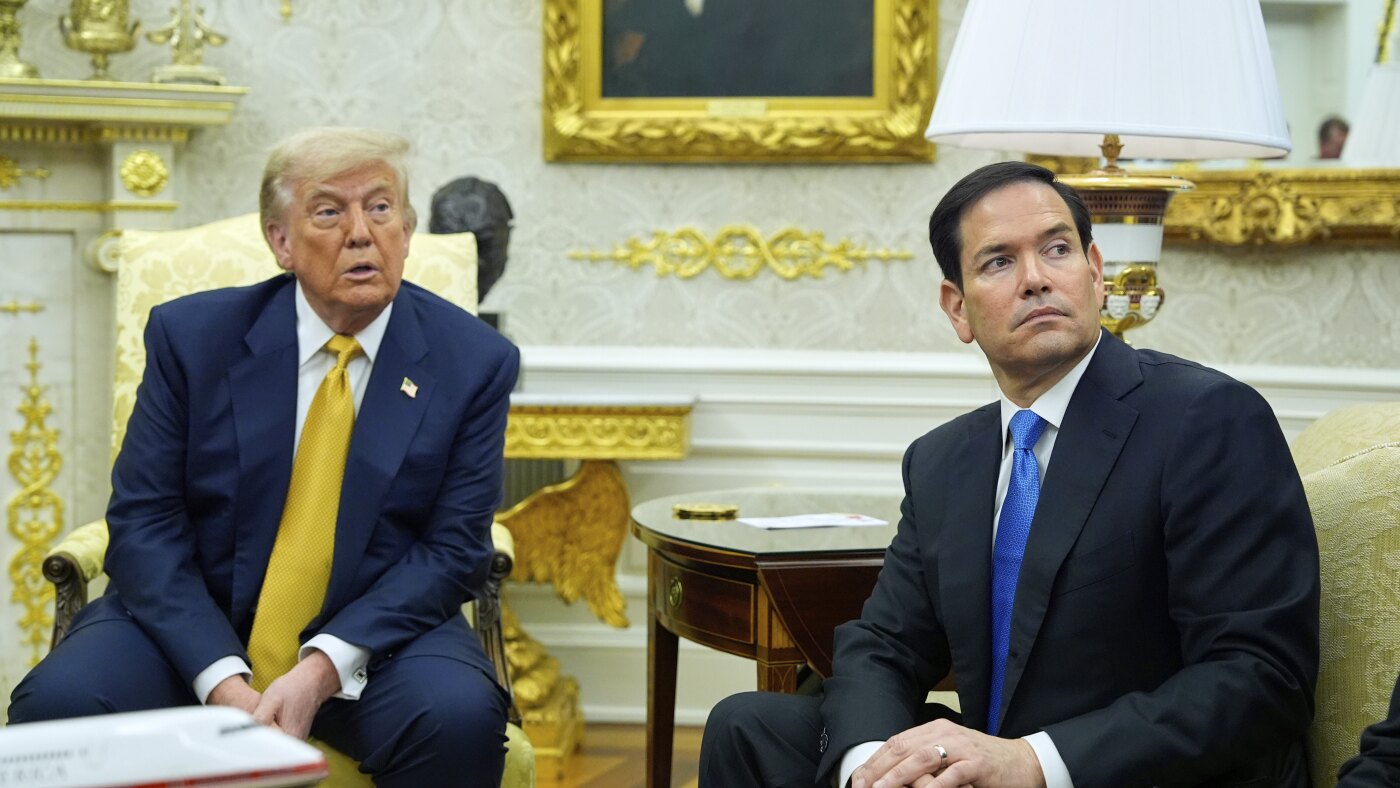
    President Trump and Secretary of State Marco Rubio listen during an Oval Office meeting at the White House on July 16.

    President Trump and Secretary of State Marco Rubio listen during an Oval Office meeting at the White House on July 16.

    Alex Brandon/AP


    hide caption

    toggle caption

    Alex Brandon/AP

    The State Department fired its top experts on the South China Sea and shuttered the office with a key focus on Indo-Pacific security amid a sweeping reorganization earlier this month, leaving gaps in knowledge and experience that are critical to U.S. interests in the region.

    The cut comes as members of President Trump’s administration, as well as both Democratic and Republican lawmakers, continue to say security and free navigation of the South China Sea — a busy shipping passage for global trade — remain a priority.

    For years, China has been aggressively asserting its territorial claims, from building artificial islands and military installations in the South China Sea, while also harassing fishing and oil exploration ships from the Philippines, Vietnam and other Pacific nations. And for years, the U.S. has worked with other countries in the region to push back.

    “China’s actions undermine peace and stability in the region. The evidence for this is their growing willingness to use force to achieve their objectives–as seen in the South China Sea and around Taiwan while also undertaking a massive and unprecedented military buildup,” Elbridge Colby, the Pentagon’s top policy official said in June. He has made countering China his top priority, arguing that the U.S. should refocus its military in the Western Pacific.

    The Office of Multilateral Affairs within the Bureau of East Asian and Pacific Affairs managed U.S. engagement with the Association of Southeast Asian Nations (ASEAN), coordinated diplomatic response to China’s aggression in the South China Sea and oversaw the Mekong River region, according to current and former officers. The office was cut along with dozens of others in the recent reduction in force that left more than 1,300 government workers without a job.

    It was also the office that helped prepare Secretary of State Marco Rubio for his trip to Malaysia earlier this month for ASEAN-related meetings. The layoffs were announced while Rubio was traveling home from that trip.

    “After he used us, he fired us,” one fired foreign affairs officer who focused on the South China Sea said. “It’s mind-boggling.”

    NPR spoke to several members of the office who had been fired, who voiced concerns that their elimination would harm U.S. interests, and instead give China the upper hand. Many thought that even if the office was eliminated, they would be moved to other offices to continue their work. There was no indication in any of the termination letters employees received that performance was a factor; in fact, NPR verified that many of them recently received outstanding performance reviews. All spoke on the condition of anonymity to avoid reprisal.

    All of those fired from the office were civil service employees with years of expertise in the region. Civil servants tend to stay in positions for longer periods and over many administrations, while foreign service officers change position every two or three years.

    One of the officers who was fired put it this way: “We are the consistency. We keep the train running while everyone rotates.”

    In a statement to NPR, the State Department maintained that there are still teams covering needed issues, but in different offices, saying that mission-critical functions from any office eliminated will be integrated elsewhere.

    But particularly as it relates to the South China Sea, it’s unclear who will perform some of these functions, with the top experts now gone.

    “You have people that are going to be making decisions that are poorly informed. They’re not going to know the potential risks of some of the options that they have,” said one fired officer.

    Another fired State Department officer said that, despite a congressional notification in May that the office was planning to be cut, nothing was done to transfer information or expertise to another team: “What’s baffling to me is that no one was preparing for this. There was no planning, there was no coordination, and there was no preparation to hand over any of our office duties.”

    The Trump administration has long said that containing Chinese aggression and maintaining free navigation of the South China Sea is a priority — a stance generally shared by both hawkish Republicans and Democrats alike. Just this week, Philippine President Ferdinand Marcos Jr., traveled to Washington to meet with Trump and Rubio, underscoring the importance of the alliance between the two countries, particularly as it relates to the South China Sea.

    Meanwhile, China has maintained an increasingly aggressive stance in the region. As recently as this week, Chinese aircraft carriers pushed further into waters that had long been dominated by the U.S. military, in a series of drills reported by the Japanese military’s joint staff. And China has continued to increase its illegal claim to more and more waters, something the U.S. firmly rejected during the first Trump administration under then-Secretary of State Mike Pompeo.

    A narrative of American withdrawal

    All of this has security and diplomacy experts who closely watch the region confused as to why the State Department would fire its experts on the topic, even if the office was slated for reorganization.

    Gregory Poling, director of the Asian Maritime Transparency Initiative at the Center for Strategic and International Studies in Washington, calls the move “really harmful” for U.S. efforts in the region.

    “You’re not going to pluck somebody else out of an unrelated bureau who knows the ins and outs of one of the most complicated issues in the world,” he says.

    Poling says he also worries about the signal it sends to our allies in the region.

    “It reinforces a narrative in the region of U.S. strategic withdrawal. Sure, we might still be sending the Navy out, but we’re not really interested in the diplomatic or the economic leadership that the region wants to see,” he says.

    Piper Campbell, former diplomat and now chair of the Department of Foreign Policy and Global Security at American University, says she was “really disappointed” to hear about the decision to close the Office of Multilateral Affairs, and particularly to fire the experts. She worries it puts the U.S. at a disadvantage, especially since that office specialized in working across several countries.

    “It reduces our influence. It reduces our understanding of what’s happening in this important region, and it reduces both our security and our economic heft in the region,” Campbell says.

    Others expressed concern that the move, especially in the context of recent tariffs imposed on many countries in the region along with the gutting of aid programs, might leave U.S. allies turning to China for help instead.

    “If our chief goal is pushing back against Chinese expansionism — how does this help? I would argue it hurts,” says James Caruso, a former diplomat with many years focused in Southeast Asia.

    Henrietta Levin, former deputy China coordinator for global affairs at the State department in the Biden administration, echoes those worries, saying she was “surprised and somewhat concerned” by these specific cuts.

    “I think these cuts eliminate tools that have been powerful in the United States,” she says. “At a time when China is doubling down on its own commitment to this competition and trying to win over countries in the Indo-Pacific, I would hope the United States would use every tool available.”


    Source link