Author: admin-to-del

  • 7 password managers to help keep your apps safe

    7 password managers to help keep your apps safe


    Passwords still seem to be the most popular method of ensuring that the right person is using the right app or service, despite the slow adoption of passkeys, which are considered more secure. And because we should be using different ones for each device and/or app, the best way to track all of them is to use a password manager.

    Some apps and operating systems come with their own password managers. For example, if you’re part of the Apple ecosystem, you can use iCloud Keychain; Google users have Google Password Manager, and Microsoft devices store passwords through its Edge browser and Credential Manager. Some apps that offer their own password managers (although at least one, Dropbox, recently announced that it was shutting down that service).

    There are advantages to using an independent password manager. You aren’t limited to a single operating system or browser, and most of these apps offer a variety of other services. They not only save your passwords and drop them into apps when needed, but they generate new (and safer) passwords; save data such as credit card, contact info, and important files; share passwords with friends and family members; and alert you if a password has been part of a breach.

    So, if you’d rather use an independent password manager, here are a few that are currently available.

    Bitwarden’s vault interfaces for mobile, desktop, and tablet.

    Bitwarden offers a solid range of features and is completely free.
    Image: Bitwarden

    Bitwarden is a well-known open-source password manager that offers a solid selection of features, including saving unlimited items, syncing across devices, and password generation. Unlike most of the other services listed here, almost all of its features are free. There are vaults for a variety of other data, such as credit cards, identity data, and SSH keys. You can also share files and data using end-to-end encryption. For no-cost day-to-day password usage, Bitwarden is a good choice.

    You can find information on its security strategies here.

    Other pricing: For $10 a year, a Premium account gives you access to an integrated authenticator, the ability to add file attachments, and receive security reports. For $40 a year, the Family account lets you share vault items with up to five other users (rather than one), share passwords and other data with an unlimited number of people, and store unlimited collections.

    Dashlane web page that has a form to add a new login.

    Dashlane’s limited free version lets you store and autofill up to 25 passwords.
    Image: Dashlane

    Dashlane, like Bitwarden, offers password generation, along with the ability to save credit card and other personal information, notes, and IDs. It also provides features such as secure sharing, phishing alerts, and includes a VPN. There is a limited free version that lets you store and autofill up to 25 passwords, but since most of us have more passwords than that, the best way to try it is to take advantage of the 30-day free trial.

    You can find information on its security strategies here.

    Other pricing: The Premium plan (which is actually the basic plan for personal use) costs $59.88 a year, while the Friends & Family plan offers password management for up to 10 people for $89.88 a year.

    1Password web page showing drop-down menu with information about the account.

    1Password is a well-known password manager that with a clear, easy to understand interface.
    Image: 1Password

    1Password includes secure places to save documents, notes, and IDs; it flags data breaches and weak passwords; and lets you safely share items with others. There are also some interesting new features, such as the ability to add a location to items so that they will appear in a Nearby tab, making them easier to find. It has a 14-day free trial.

    You can find information on its security strategies here.

    Other pricing: The Individual plan costs $3.99 a month or $35.88 a year. The Family plan, which lets you include up to five family members, is $6.95 a month or $59.88 a year.

    LogMeOnce web page showing icons of all the various websites that it has the passwords to, with a menu on hte left.

    LogMeOnce allows you to categorize your passwords; it boasts “passwordless password management” using QR codes.
    Image: LogMeOnce

    LogMeOnce’s website talks about “Passwordless Password Management,” which it accomplishes using a system of QR codes. Its free Premium version provides unlimited passwords and use on unlimited devices, along with autofill, sync, password generation, 1MB of encrypted file storage, and two-factor authentication using email or Google Authenticator. You can also save up to three notes and three credit cards. LogMeOnce uses ads to fund its free version, so that could be a setback depending on your tolerance for advertising.

    You can find information on its security strategies here.

    Other pricing: The Professional version adds 1GB of encrypted file storage, emergency access, additional authentication methods, and more for $2.50 a month. The Ultimate plan, $3.25 a month, adds 10GB of storage, unlimited note storage, password sharing, and a customizable dashboard, among other features. And for $4.99 a month, the Family plan lets six family members use LogMeOnce.

    NordPass web page showing menu on left and three buttons in center to get account recovering code, get the mobile app, or save a credit card.

    Like many of its peers, NordPass offer the ability to save credit card and other personal info. (Blacked-out section done manually.)
    Image: NordPass

    The free version of NordPass includes unlimited passwords and multifactor authentication. Most other features — cross-platform compatibility, the ability to protect documents and file attachments, checking password health, data breach alerts, the ability to mask your email address, and secure sharing, among others — are only available with the paid Premium account, which you can try with a 30-day trial.

    You can find information on its security strategies here.

    Other pricing: The Premium version of NordPass costs $1.99 a month or $23.88 for the first year and $35.88 after that. The Family plan, which gives you six Premium user accounts, costs $3.69 a month or $44.28 for the first year and $71.88 after that.

    Web page for Keeper with list of sites on left and single record on right.

    Keeper’s vault can handle passwords, attachments, and a self-destruct feature.
    Image: Keeper

    Like several of the other apps mentioned here, Keeper has a free version, but one that won’t suit most people for long. In this case, you are limited to one mobile device, ten passwords or passkeys, and two-factor authentication. However, a 30-day free trial gives you unlimited password storage across devices, password sharing, and identity and payment storage, along with biometric logins and customer support.

    You can find information on its security strategies here.

    Other pricing: Keeper Unlimited (aptly named) costs $39.99 a year; Keeper Family, which includes five private data vaults and 10GB file storage, costs $84.99 a year.

    LastPass web page with menu on left and offer to add your first password in center.

    LassPass now has a free version, but you can also take advantage of the 30-day free trial.

    LastPass has had a lot of setbacks over the last few years, including a couple of serious breaches in 2022. Since then, it has worked to improve its service and its reputation.

    There’s a free version that includes a password vault, access on a single device type (in other words, only computer or mobile), a password generator, and a service that monitors the internet for security breaches, which is not often included with free versions, among other features. A Premium version lets you use it with more than one device type. You can check it out with a 30-day free trial.

    You can find information on its security strategies here.

    Other pricing: the Premium version costs $36 a year; the Family version, which includes six accounts, costs $48 a year.

    Follow topics and authors from this story to see more like this in your personalized homepage feed and to receive email updates.


    Source link

    http://wp.bypass.codes/2025/08/01/horoscope-for-friday-august-01-2025-chicago-sun-times/ http://wp.bypass.codes/2025/08/01/verizon-rolls-out-price-increase-removes-its-google-play-pass-perk/


  • 7 password managers to help keep your apps safe

    7 password managers to help keep your apps safe


    Passwords still seem to be the most popular method of ensuring that the right person is using the right app or service, despite the slow adoption of passkeys, which are considered more secure. And because we should be using different ones for each device and/or app, the best way to track all of them is to use a password manager.

    Some apps and operating systems come with their own password managers. For example, if you’re part of the Apple ecosystem, you can use iCloud Keychain; Google users have Google Password Manager, and Microsoft devices store passwords through its Edge browser and Credential Manager. Some apps that offer their own password managers (although at least one, Dropbox, recently announced that it was shutting down that service).

    There are advantages to using an independent password manager. You aren’t limited to a single operating system or browser, and most of these apps offer a variety of other services. They not only save your passwords and drop them into apps when needed, but they generate new (and safer) passwords; save data such as credit card, contact info, and important files; share passwords with friends and family members; and alert you if a password has been part of a breach.

    So, if you’d rather use an independent password manager, here are a few that are currently available.

    Bitwarden’s vault interfaces for mobile, desktop, and tablet.

    Bitwarden offers a solid range of features and is completely free.
    Image: Bitwarden

    Bitwarden is a well-known open-source password manager that offers a solid selection of features, including saving unlimited items, syncing across devices, and password generation. Unlike most of the other services listed here, almost all of its features are free. There are vaults for a variety of other data, such as credit cards, identity data, and SSH keys. You can also share files and data using end-to-end encryption. For no-cost day-to-day password usage, Bitwarden is a good choice.

    You can find information on its security strategies here.

    Other pricing: For $10 a year, a Premium account gives you access to an integrated authenticator, the ability to add file attachments, and receive security reports. For $40 a year, the Family account lets you share vault items with up to five other users (rather than one), share passwords and other data with an unlimited number of people, and store unlimited collections.

    Dashlane web page that has a form to add a new login.

    Dashlane’s limited free version lets you store and autofill up to 25 passwords.
    Image: Dashlane

    Dashlane, like Bitwarden, offers password generation, along with the ability to save credit card and other personal information, notes, and IDs. It also provides features such as secure sharing, phishing alerts, and includes a VPN. There is a limited free version that lets you store and autofill up to 25 passwords, but since most of us have more passwords than that, the best way to try it is to take advantage of the 30-day free trial.

    You can find information on its security strategies here.

    Other pricing: The Premium plan (which is actually the basic plan for personal use) costs $59.88 a year, while the Friends & Family plan offers password management for up to 10 people for $89.88 a year.

    1Password web page showing drop-down menu with information about the account.

    1Password is a well-known password manager that with a clear, easy to understand interface.
    Image: 1Password

    1Password includes secure places to save documents, notes, and IDs; it flags data breaches and weak passwords; and lets you safely share items with others. There are also some interesting new features, such as the ability to add a location to items so that they will appear in a Nearby tab, making them easier to find. It has a 14-day free trial.

    You can find information on its security strategies here.

    Other pricing: The Individual plan costs $3.99 a month or $35.88 a year. The Family plan, which lets you include up to five family members, is $6.95 a month or $59.88 a year.

    LogMeOnce web page showing icons of all the various websites that it has the passwords to, with a menu on hte left.

    LogMeOnce allows you to categorize your passwords; it boasts “passwordless password management” using QR codes.
    Image: LogMeOnce

    LogMeOnce’s website talks about “Passwordless Password Management,” which it accomplishes using a system of QR codes. Its free Premium version provides unlimited passwords and use on unlimited devices, along with autofill, sync, password generation, 1MB of encrypted file storage, and two-factor authentication using email or Google Authenticator. You can also save up to three notes and three credit cards. LogMeOnce uses ads to fund its free version, so that could be a setback depending on your tolerance for advertising.

    You can find information on its security strategies here.

    Other pricing: The Professional version adds 1GB of encrypted file storage, emergency access, additional authentication methods, and more for $2.50 a month. The Ultimate plan, $3.25 a month, adds 10GB of storage, unlimited note storage, password sharing, and a customizable dashboard, among other features. And for $4.99 a month, the Family plan lets six family members use LogMeOnce.

    NordPass web page showing menu on left and three buttons in center to get account recovering code, get the mobile app, or save a credit card.

    Like many of its peers, NordPass offer the ability to save credit card and other personal info. (Blacked-out section done manually.)
    Image: NordPass

    The free version of NordPass includes unlimited passwords and multifactor authentication. Most other features — cross-platform compatibility, the ability to protect documents and file attachments, checking password health, data breach alerts, the ability to mask your email address, and secure sharing, among others — are only available with the paid Premium account, which you can try with a 30-day trial.

    You can find information on its security strategies here.

    Other pricing: The Premium version of NordPass costs $1.99 a month or $23.88 for the first year and $35.88 after that. The Family plan, which gives you six Premium user accounts, costs $3.69 a month or $44.28 for the first year and $71.88 after that.

    Web page for Keeper with list of sites on left and single record on right.

    Keeper’s vault can handle passwords, attachments, and a self-destruct feature.
    Image: Keeper

    Like several of the other apps mentioned here, Keeper has a free version, but one that won’t suit most people for long. In this case, you are limited to one mobile device, ten passwords or passkeys, and two-factor authentication. However, a 30-day free trial gives you unlimited password storage across devices, password sharing, and identity and payment storage, along with biometric logins and customer support.

    You can find information on its security strategies here.

    Other pricing: Keeper Unlimited (aptly named) costs $39.99 a year; Keeper Family, which includes five private data vaults and 10GB file storage, costs $84.99 a year.

    LastPass web page with menu on left and offer to add your first password in center.

    LassPass now has a free version, but you can also take advantage of the 30-day free trial.

    LastPass has had a lot of setbacks over the last few years, including a couple of serious breaches in 2022. Since then, it has worked to improve its service and its reputation.

    There’s a free version that includes a password vault, access on a single device type (in other words, only computer or mobile), a password generator, and a service that monitors the internet for security breaches, which is not often included with free versions, among other features. A Premium version lets you use it with more than one device type. You can check it out with a 30-day free trial.

    You can find information on its security strategies here.

    Other pricing: the Premium version costs $36 a year; the Family version, which includes six accounts, costs $48 a year.

    Follow topics and authors from this story to see more like this in your personalized homepage feed and to receive email updates.


    Source link

    http://wp.bypass.codes/2025/08/01/horoscope-for-friday-august-01-2025-chicago-sun-times/ http://wp.bypass.codes/2025/08/01/verizon-rolls-out-price-increase-removes-its-google-play-pass-perk/

  • Gaza’s Hamas-run authorities claim 37 killed by IDF fire Saturday, mostly aid seekers

    Gaza’s Hamas-run authorities claim 37 killed by IDF fire Saturday, mostly aid seekers


    Gaza’s Hamas-run civil defense agency said at least 37 people were killed by Israeli fire on Saturday, including 30 civilians who were waiting to collect aid.

    Civil defense spokesman Mahmud Bassal told AFP that 12 people were killed and nearly 200 wounded when Israeli forces allegedly opened fire on them as they gathered near a border crossing in northern Gaza that has been used for aid deliveries.

    Six more people were killed and 30 wounded after Israeli troops targeted civilians assembling near an aid point in central Gaza, he asserted.

    Strikes in central Gaza also resulted in multiple casualties, according to Bassal, while a drone attack near the southern city of Khan Younis killed at least three people and wounded several others.

    Elsewhere, two nephews of senior Hamas leader Khalil al-Hayya were killed by Israeli forces in Gaza City, the Hamas mouthpiece al-Risala reported.

    According to the report, Abd al-Salam al-Hayya and Mu’az Abd al-Salam al-Hayya were cutting firewood in the Gaza City neighborhood of Shejaiya when they were killed by Israeli shelling.

    Hayya leads Hamas’ negotiating team and is based in Doha.

    Palestinians hustle around a humanitarian parcel dropped by a military aircraft in Jabalia in the northern Gaza Strip on August 9, 2025. (Bashar Taleb/AFP)

    Thousands of Palestinians congregate daily near food distribution points in Gaza, including four managed by the controversial  US- and Israeli-backed Gaza Humanitarian Foundation, which has been plagued by near-daily shooting incidents that have seen hundreds killed as they try to reach the GHF distribution centers.

    The United Nations says more than 1,300 people have been killed trying to obtain aid supplies in the enclave since the GHF began operating in May, most of them shot by Israeli forces operating near GHF sites.

    The IDF has acknowledged firing warning shots at crowds that get too close to its soldiers, but called the UN tallies exaggerated, though it hasn’t provided alternate numbers.

    The deadly incidents are not limited to GHF sites, and last week 20 people were said killed and dozens more were injured when a truck carrying goods and aid into the Strip overturned in Deir al-Balah, in central Gaza.

    In recent weeks, images of starving Palestinians, particularly children, have alarmed the world, ramping up international pressure on Israel to enable more aid into the coastal enclave, where war has been raging since the devastating Hamas-led attack on Israel on October 7, 2023.

    Palestinians collect humanitarian aid packages from the United Arab Emirates after they were airdropped into Deir al-Balah, in central Gaza Strip, August 9, 2025. (AP Photo/Abdel Kareem Hana)

    Among the steps that Israel agreed to take to improve the humanitarian situation in the Strip was the resumption of airdrops into the Palestinian enclave.

    While the decision was welcomed abroad as a step in the right direction, airdrops are only able to deliver a small fraction of what can enter Gaza by land, and pose safety risks for civilians due to the possibility of being hit by packages from above.

    The IDF said aircraft from the United Arab Emirates, Jordan, Germany, the Netherlands, and — for the first time — Greece and Italy, had airdropped 106 pallets of humanitarian aid in the Gaza Strip on Saturday.

    Each pallet contains around one ton of food.

    Since July 26, when Israel allowed airdrops to begin anew, over 1,000 humanitarian aid packages have been airdropped in the Gaza Strip by 12 countries, including Israel, according to the military. The packages the IDF airdropped were supplied by international aid groups.

    The Hamas-run Gaza health ministry says more than 60,000 people in the Strip have been killed or are presumed dead in the fighting so far, though the toll cannot be verified and does not differentiate between civilians and fighters. Israel says it has killed some 20,000 combatants in battle as of January and another 1,600 terrorists inside Israel during the October 7 onslaught.

    Israel has said it seeks to minimize civilian fatalities and stresses that Hamas uses Gaza’s civilians as human shields, fighting from civilian areas including homes, hospitals, schools, and mosques.


    Is The Times of Israel important to you?

    If so, we have a request. 

    Every day, even during war, our journalists keep you abreast of the most important developments that merit your attention. Millions of people rely on ToI for fast, fair and free coverage of Israel and the Jewish world. 

    We care about Israel – and we know you do too. So today, we have an ask: show your appreciation for our work by joining The Times of Israel Community, an exclusive group for readers like you who appreciate and financially support our work. 


    Yes, I’ll give


    Yes, I’ll give

    Already a member? Sign in to stop seeing this


    You appreciate our journalism


    We’re really pleased that you’ve read X Times of Israel articles in the past month.

    You clearly find our careful reporting valuable, in a time when facts are often distorted and news coverage often lacks context.

    Your support is essential to continue our work. We want to continue delivering the professional journalism you value, even as the demands on our newsroom have grown dramatically since October 7.

    So today, please consider joining our reader support group, The Times of Israel Community. For as little as $6 a month you’ll become our partners while enjoying The Times of Israel AD-FREE, as well as accessing exclusive content available only to Times of Israel Community members.

    Thank you,
    David Horovitz, Founding Editor of The Times of Israel


    Join Our Community


    Join Our Community

    Already a member? Sign in to stop seeing this

    !function(f,b,e,v,n,t,s)
    {if(f.fbq)return;n=f.fbq=function(){n.callMethod?
    n.callMethod.apply(n,arguments):n.queue.push(arguments)};
    if(!f._fbq)f._fbq=n;n.push=n;n.loaded=!0;n.version=’2.0′;
    n.queue=[];t=b.createElement(e);t.async=!0;
    t.src=v;s=b.getElementsByTagName(e)[0];
    s.parentNode.insertBefore(t,s)}(window, document,’script’,
    ‘https://connect.facebook.net/en_US/fbevents.js’);
    fbq(‘init’, ‘272776440645465’);
    fbq(‘track’, ‘PageView’);


    Source link

    https://example.com

  • Gaza’s Hamas-run authorities claim 37 killed by IDF fire Saturday, mostly aid seekers

    Gaza’s Hamas-run authorities claim 37 killed by IDF fire Saturday, mostly aid seekers


    Gaza’s Hamas-run civil defense agency said at least 37 people were killed by Israeli fire on Saturday, including 30 civilians who were waiting to collect aid.

    Civil defense spokesman Mahmud Bassal told AFP that 12 people were killed and nearly 200 wounded when Israeli forces allegedly opened fire on them as they gathered near a border crossing in northern Gaza that has been used for aid deliveries.

    Six more people were killed and 30 wounded after Israeli troops targeted civilians assembling near an aid point in central Gaza, he asserted.

    Strikes in central Gaza also resulted in multiple casualties, according to Bassal, while a drone attack near the southern city of Khan Younis killed at least three people and wounded several others.

    Elsewhere, two nephews of senior Hamas leader Khalil al-Hayya were killed by Israeli forces in Gaza City, the Hamas mouthpiece al-Risala reported.

    According to the report, Abd al-Salam al-Hayya and Mu’az Abd al-Salam al-Hayya were cutting firewood in the Gaza City neighborhood of Shejaiya when they were killed by Israeli shelling.

    Hayya leads Hamas’ negotiating team and is based in Doha.

    Palestinians hustle around a humanitarian parcel dropped by a military aircraft in Jabalia in the northern Gaza Strip on August 9, 2025. (Bashar Taleb/AFP)

    Thousands of Palestinians congregate daily near food distribution points in Gaza, including four managed by the controversial  US- and Israeli-backed Gaza Humanitarian Foundation, which has been plagued by near-daily shooting incidents that have seen hundreds killed as they try to reach the GHF distribution centers.

    The United Nations says more than 1,300 people have been killed trying to obtain aid supplies in the enclave since the GHF began operating in May, most of them shot by Israeli forces operating near GHF sites.

    The IDF has acknowledged firing warning shots at crowds that get too close to its soldiers, but called the UN tallies exaggerated, though it hasn’t provided alternate numbers.

    The deadly incidents are not limited to GHF sites, and last week 20 people were said killed and dozens more were injured when a truck carrying goods and aid into the Strip overturned in Deir al-Balah, in central Gaza.

    In recent weeks, images of starving Palestinians, particularly children, have alarmed the world, ramping up international pressure on Israel to enable more aid into the coastal enclave, where war has been raging since the devastating Hamas-led attack on Israel on October 7, 2023.

    Palestinians collect humanitarian aid packages from the United Arab Emirates after they were airdropped into Deir al-Balah, in central Gaza Strip, August 9, 2025. (AP Photo/Abdel Kareem Hana)

    Among the steps that Israel agreed to take to improve the humanitarian situation in the Strip was the resumption of airdrops into the Palestinian enclave.

    While the decision was welcomed abroad as a step in the right direction, airdrops are only able to deliver a small fraction of what can enter Gaza by land, and pose safety risks for civilians due to the possibility of being hit by packages from above.

    The IDF said aircraft from the United Arab Emirates, Jordan, Germany, the Netherlands, and — for the first time — Greece and Italy, had airdropped 106 pallets of humanitarian aid in the Gaza Strip on Saturday.

    Each pallet contains around one ton of food.

    Since July 26, when Israel allowed airdrops to begin anew, over 1,000 humanitarian aid packages have been airdropped in the Gaza Strip by 12 countries, including Israel, according to the military. The packages the IDF airdropped were supplied by international aid groups.

    The Hamas-run Gaza health ministry says more than 60,000 people in the Strip have been killed or are presumed dead in the fighting so far, though the toll cannot be verified and does not differentiate between civilians and fighters. Israel says it has killed some 20,000 combatants in battle as of January and another 1,600 terrorists inside Israel during the October 7 onslaught.

    Israel has said it seeks to minimize civilian fatalities and stresses that Hamas uses Gaza’s civilians as human shields, fighting from civilian areas including homes, hospitals, schools, and mosques.


    Is The Times of Israel important to you?

    If so, we have a request. 

    Every day, even during war, our journalists keep you abreast of the most important developments that merit your attention. Millions of people rely on ToI for fast, fair and free coverage of Israel and the Jewish world. 

    We care about Israel – and we know you do too. So today, we have an ask: show your appreciation for our work by joining The Times of Israel Community, an exclusive group for readers like you who appreciate and financially support our work. 


    Yes, I’ll give


    Yes, I’ll give

    Already a member? Sign in to stop seeing this


    You appreciate our journalism


    We’re really pleased that you’ve read X Times of Israel articles in the past month.

    You clearly find our careful reporting valuable, in a time when facts are often distorted and news coverage often lacks context.

    Your support is essential to continue our work. We want to continue delivering the professional journalism you value, even as the demands on our newsroom have grown dramatically since October 7.

    So today, please consider joining our reader support group, The Times of Israel Community. For as little as $6 a month you’ll become our partners while enjoying The Times of Israel AD-FREE, as well as accessing exclusive content available only to Times of Israel Community members.

    Thank you,
    David Horovitz, Founding Editor of The Times of Israel


    Join Our Community


    Join Our Community

    Already a member? Sign in to stop seeing this

    !function(f,b,e,v,n,t,s)
    {if(f.fbq)return;n=f.fbq=function(){n.callMethod?
    n.callMethod.apply(n,arguments):n.queue.push(arguments)};
    if(!f._fbq)f._fbq=n;n.push=n;n.loaded=!0;n.version=’2.0′;
    n.queue=[];t=b.createElement(e);t.async=!0;
    t.src=v;s=b.getElementsByTagName(e)[0];
    s.parentNode.insertBefore(t,s)}(window, document,’script’,
    ‘https://connect.facebook.net/en_US/fbevents.js’);
    fbq(‘init’, ‘272776440645465’);
    fbq(‘track’, ‘PageView’);


    Source link

    http://wp.bypass.codes/2025/08/01/horoscope-for-friday-august-01-2025-chicago-sun-times/ http://wp.bypass.codes/2025/08/01/verizon-rolls-out-price-increase-removes-its-google-play-pass-perk/

  • London police arrest 474 people as pro-Palestinian protesters defy new law

    London police arrest 474 people as pro-Palestinian protesters defy new law


    LONDON — British police said they arrested 474 people in central London on Saturday as supporters of a recently banned pro-Palestinian group intentionally flouted the law as part of their effort to force the government to reconsider the ban.

    Parliament in early July passed a law banning Palestine Action and making it a crime to publicly support the organization. That came after activists broke into a Royal Air Force base and vandalized two tanker planes to protest Britain’s support for Israel’s offensive against Hamas in the Gaza Strip.

    Backers of the group, who have held a series of protests around the U.K. over the past month, argue that the law illegally restricts freedom of expression.

    Daring police to arrest them

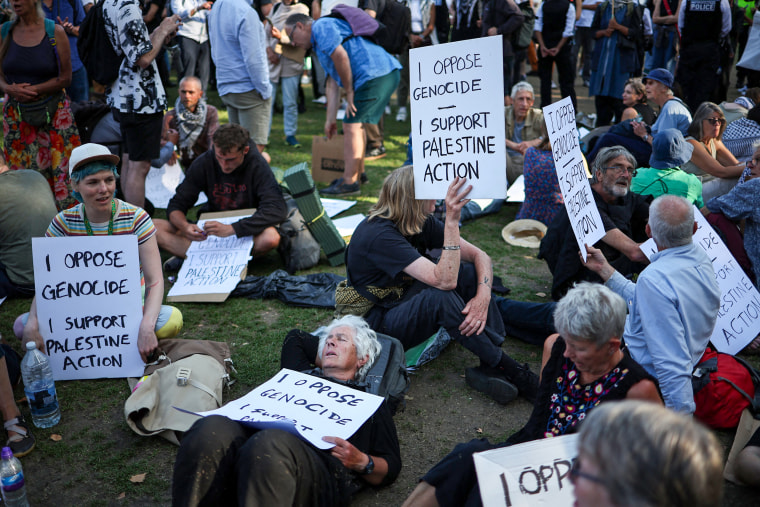
    More than 500 protesters filled the square outside the Houses of Parliament on Saturday, many daring police officers to arrest them by displaying signs reading “I oppose genocide. I support Palestine Action.” That was enough for police to step in.

    But as the demonstration began to wind down, police officers and protest organizers sparred over the number of arrests as the organizers sought to show that the law was unworkable.

    “The police have only been able to arrest a fraction of those supposedly committing ‘terrorism’ offenses, and most of those have been given street bail and allowed to go home,” Defend Our Juries, which organized the protest, said in a statement. “This is a major embarrassment to (the government), further undermining the credibility of this widely ridiculed law, brought in to punish those exposing the government’s own crimes.”

    People protest.
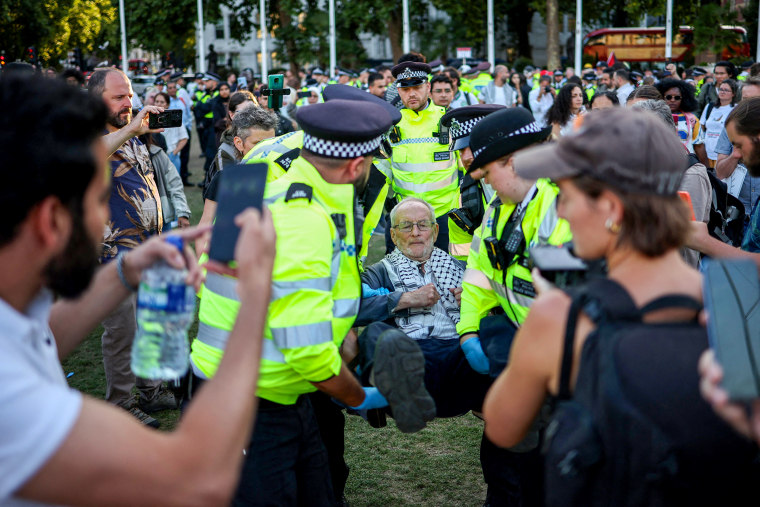
    Protesters sitting with placards supporting Palestine Action in London on Saturday.Henry Nicholls / AFP – Getty Images

    London’s Metropolitan Police Service quickly hit back, saying this wasn’t true and that many of those who gathered in the square were onlookers, media or people who didn’t hold placards supporting the group.

    “We are confident that anyone who came to Parliament Square today to hold a placard expressing support for Palestine Action was either arrested or is in the process of being arrested,” the police force said in a statement.

    On Friday, police said the demonstration was unusual in that the protesters wanted to be arrested in large numbers so as to place a strain on police and the broader criminal justice system.

    As of 9 p.m. Saturday local time (4 p.m. ET), 466 people had been arrested for showing support for Palestine Action, London’s Metropolitan Police said in a post on X. Eight others were arrested in connection with other offenses including five alleged assaults on officers, police said.

    Why the group is being banned

    The government moved to ban Palestine Action after the activists broke into a British air force base in southern England on June 20 to protest British military support for the Israel-Hamas war. The activists sprayed red paint into the engines of two tanker planes at the RAF Brize Norton base in Oxfordshire and caused further damage with crowbars.

    Palestine Action had previously targeted Israeli defense contractors and other sites in the United Kingdom that they believe have links with the Israeli military.

    Supporters of the group are challenging the ban in court, saying the government has gone too far in declaring Palestine Action a terrorist organization.

    People getting arrested.
    Backers of Palestine Action are challenging the government ban on the group, arguing that it illegally restricts freedom of expression.Henry NichollaI / AFP – Getty Images

    “Once the meaning of ‘terrorism’ is separated from campaigns of violence against a civilian population, and extended to include those causing economic damage or embarrassment to the rich, the powerful and the criminal, then the right to freedom of expression has no meaning and democracy is dead,” Defend Our Juries said on its website.

    Busy weekend of protests

    The arrests outside Parliament came amid what is expected to be a busy weekend of demonstrations in London as the war in Gaza and concerns about immigration spur protests and counterprotests across the United Kingdom.

    While Prime Minister Keir Starmer has angered Israel with plans to recognize a Palestinian state later this year, many Palestinian supporters in Britain criticize the government for not doing enough to end the war in Gaza.

    Pro-Palestinian protesters gathered Saturday afternoon in central London for a march that ended outside the gates of No. 10 Downing Street, the prime minister’s official residence and offices.

    On Sunday, a number of groups are scheduled to march through central London to demand the safe release of the Israeli hostages in Gaza. Palestinian militants have held the captives since Hamas-led attackers surged into Israel on Oct. 7, 2023, killing around 1,200 people and taking 251 hostage. There are 50 remaining hostages, with 20 of them thought to be alive.

    Police are also preparing for protests outside hotels across the country that are being used to house asylum-seekers. Protesters and counterprotesters have squared off outside the hotels in recent weeks, with some saying the migrants pose a risk to their communities and others decrying anti-immigrant racism.

    Deputy Assistant Commissioner Ade Adelekan said the scale of the events would “put pressure” on the police department.

    “This is going to be a particularly busy few days in London with many simultaneous protests and events that will require a significant policing presence,” Adelekan said before the protests began.


    Source link

    http://wp.bypass.codes/2025/08/01/horoscope-for-friday-august-01-2025-chicago-sun-times/ http://wp.bypass.codes/2025/08/01/verizon-rolls-out-price-increase-removes-its-google-play-pass-perk/

  • Ancient Gobekli Tepe site meets conspiracy theories — and Joe Rogan : NPR

    Ancient Gobekli Tepe site meets conspiracy theories — and Joe Rogan : NPR


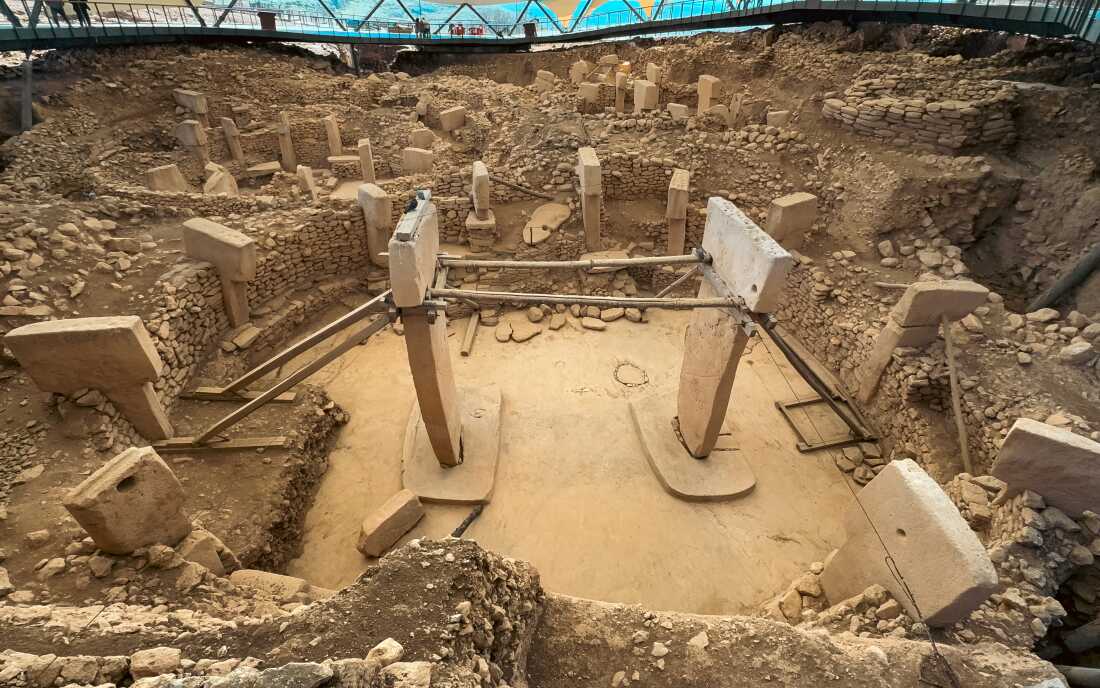
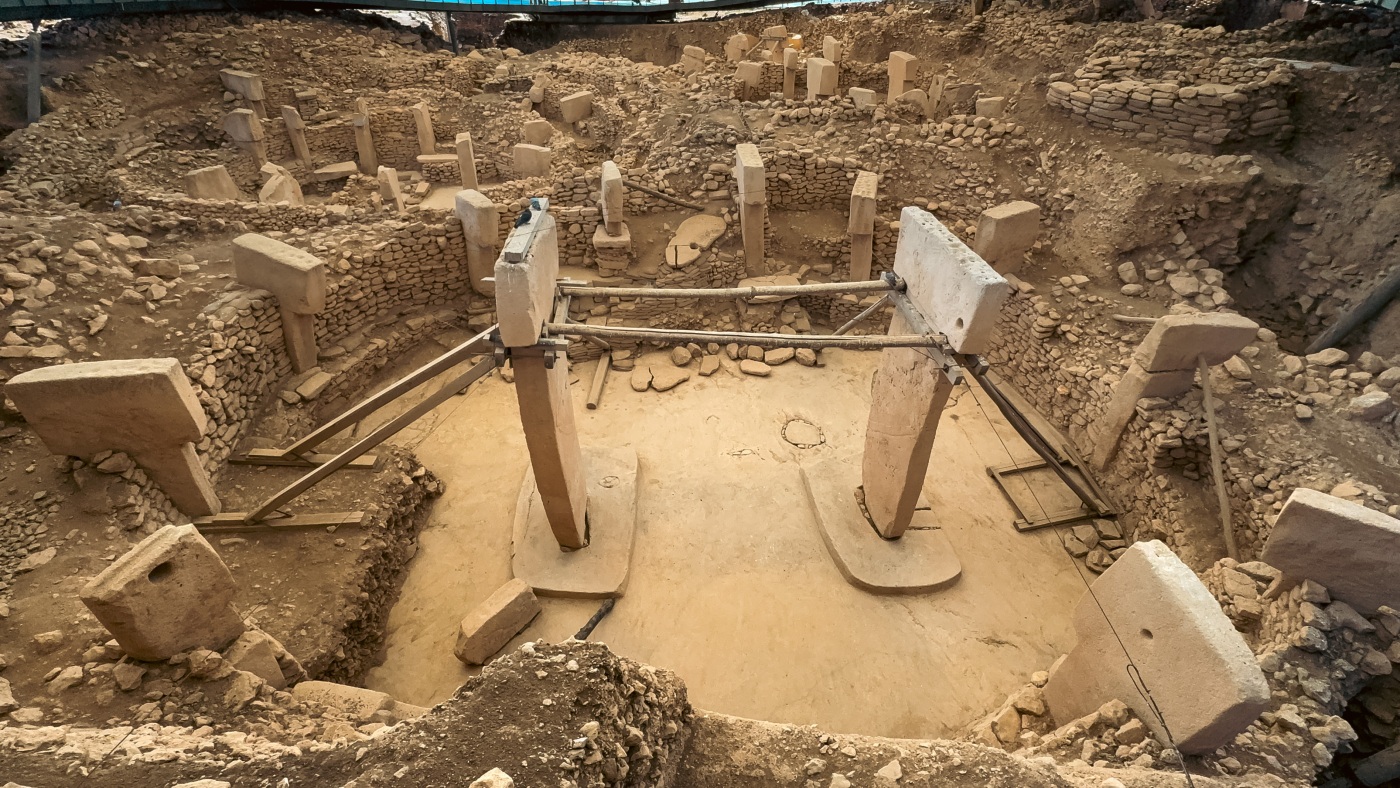
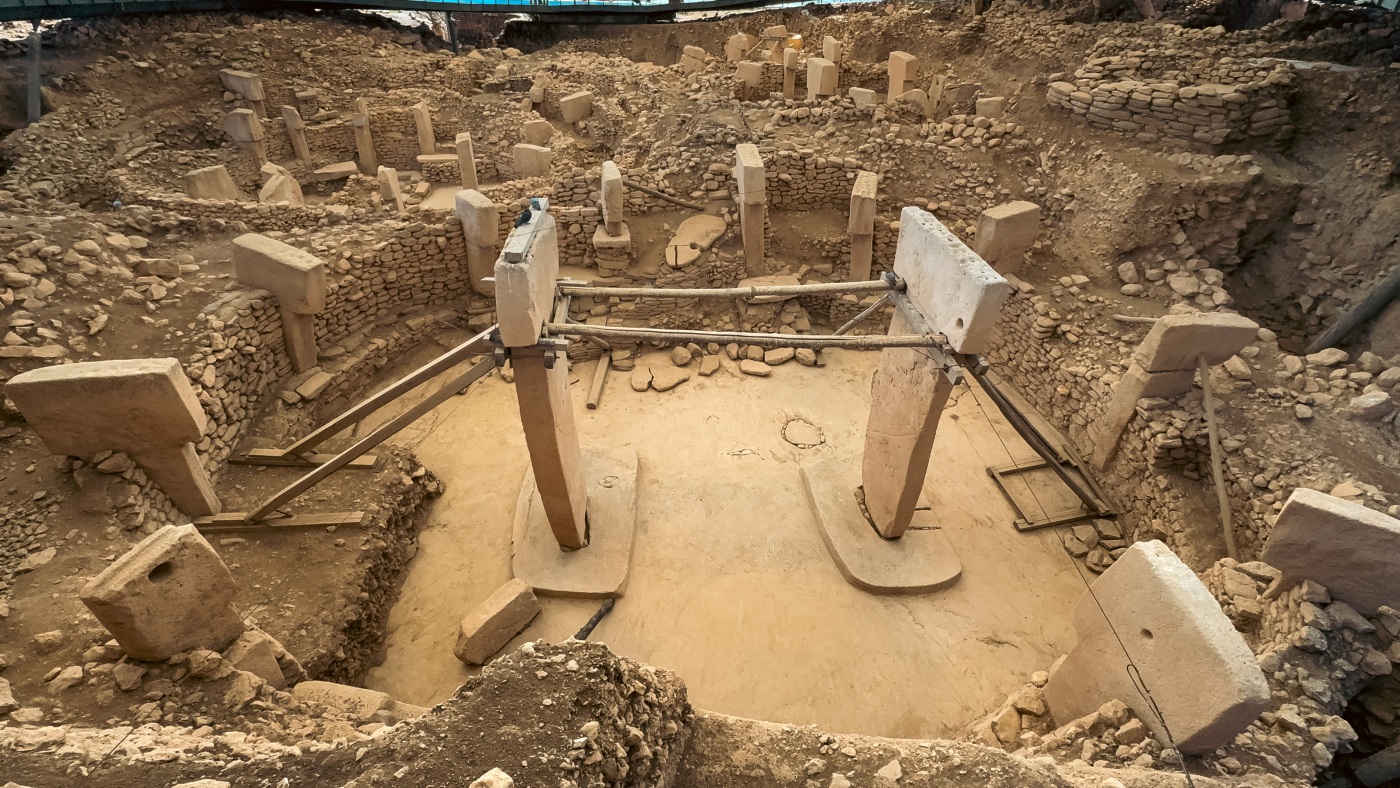
    A view of the ancient site of Gobekli Tepe, known as the world's oldest temple, in Sanliurfa, Turkey, on Feb. 17.

    A view of the ancient site of Gobekli Tepe, known as the world’s oldest temple, in Sanliurfa, Turkey, on Feb. 17.

    Mustafa Hatipoglu/Anadolu via Getty Images


    hide caption

    toggle caption

    Mustafa Hatipoglu/Anadolu via Getty Images

    GOBEKLI TEPE, Turkey — Tour guide Sabahattin Alkan herds curious tourists through the scorching afternoon heat, luring them with the promise of something far stranger than your typical vacation snap.

    “Over here on the right, you see a spaceship landed recently,” he says with a grin.

    He’s joking. Mostly. But more on that in a minute.

    We’re in the Urfa plain, a dry, dusty stretch about 25 miles from the Turkish-Syrian border.

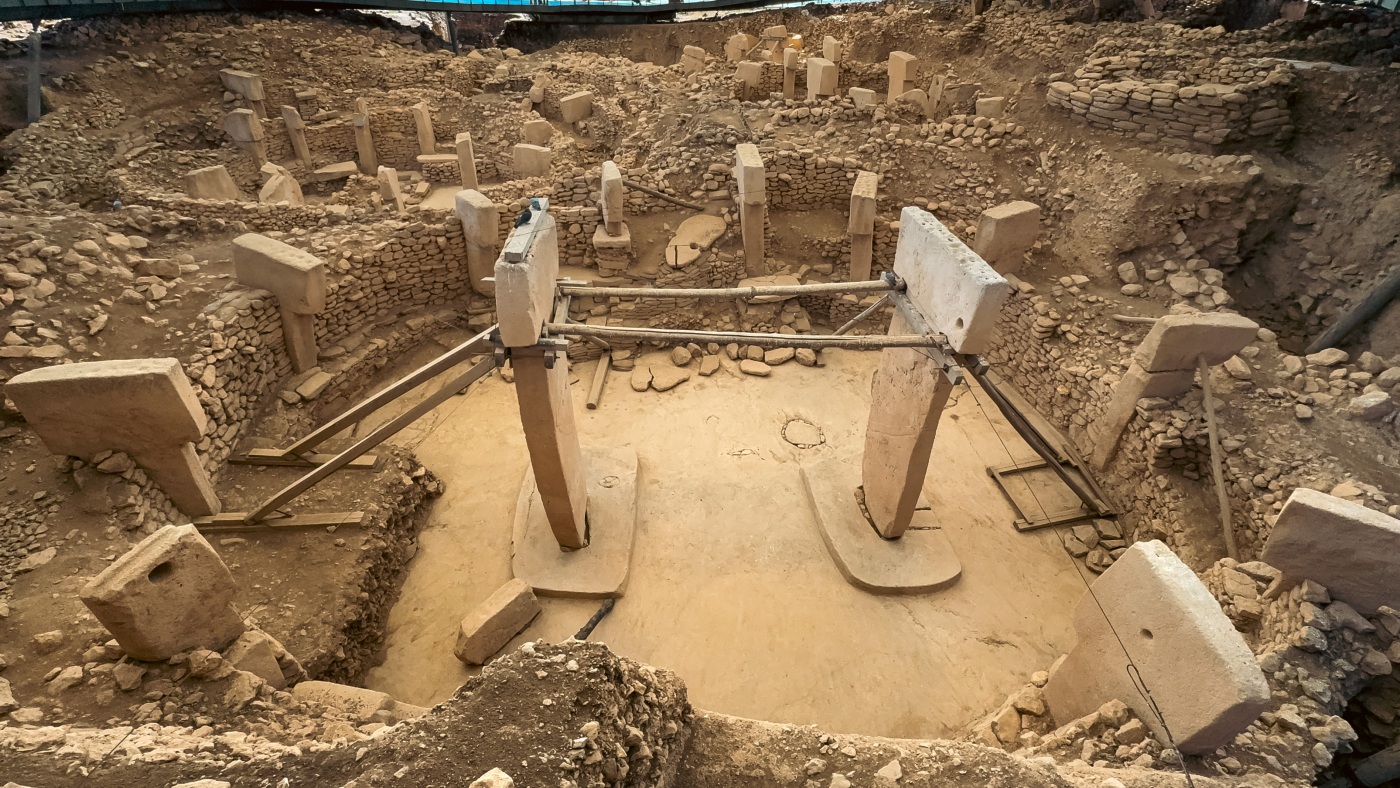
    That “spaceship” is actually just a curved roof. But what lies beneath the dome has sparked decades of mystery, curiosity — and conspiracy.

    One of the T-shaped pillars at Gobekli Tepe, depicting a bull, a fox and a crane. Scientists have spent decades trying to decode the story behind the symbols.

    One of the T-shaped pillars at Gobekli Tepe, depicting a bull, a fox and a crane. Scientists have spent decades trying to decode the story behind the symbols.

    Rebecca Rosman for NPR


    hide caption

    toggle caption

    Rebecca Rosman for NPR

    “It’s quite an interesting place, actually,” Alkan assures his audience.

    He’s talking about Gobekli Tepe, one of the oldest known archaeological sites on Earth, dating back nearly 12,000 years.

    Alkan points to T-shaped limestone pillars carved with human arms, hands resting on stomachs, and wild animals: lions, foxes, boars, scorpions and birds among them.

    Klaus Schmidt, the German archaeologist who led the site’s first major excavations in the 1990s, called Gobekli Tepe “the world’s oldest temple,” theorizing that it brought together nomadic hunter-gatherers from across the Middle East.

    German archaeologist Klaus Schmidt, who pioneered excavations at the ancient site of Gobekli Tepe, carries out research in Sanliurfa, Turkey, on May 18, 2008.

    German archaeologist Klaus Schmidt, who pioneered excavations at the ancient site of Gobekli Tepe, carries out research in Sanliurfa, Turkey, on May 18, 2008.

    Mehmet Guldas/Anadolu Agency via Getty Images


    hide caption

    toggle caption

    Mehmet Guldas/Anadolu Agency via Getty Images

    Today, that view has shifted. Some now interpret it as a ceremonial gathering site, while others suggest it functioned as a social hub where rituals helped bind together early communities.

    Emilie Salvesen, a tour operator visiting the site, says the question of whether there was a spiritual component to the site still fascinates her.

    “Did they experience the divine in the way that we might think of it today?” she asks, gesturing toward one of the inscribed pillars. “I imagine it was much more existential.”

    The truth? Still mostly a mystery.

    Scientists are regularly adjusting their hypotheses about the site’s intended purpose. And it’s not an easy investigation.

    “Whatever we tell now, I don’t know if it will be accurate information or not, because maybe our idea will change in another 50 years,” Alkan says. “We’re trying to predict 12,000 years ago.”

    But that uncertainty has thrown the door wide open for one specific group looking for answers: conspiracy theorists.

    Conspiracy theories take root — with help from Joe Rogan

    Graham Hancock, a British journalist and star of the controversial Netflix series Ancient Apocalypse, has theorized — without empirical evidence — that Gobekli Tepe was built by a “lost civilization” wiped out by an Ice Age cataclysm.

    Once confined to the fringes, theories like Hancock’s have gained mainstream traction — thanks in large part to Joe Rogan, whose massively popular podcast has become a platform for alternative takes on science and history.

    In November 2024, another Gobekli Tepe conspiracy theorist, Jimmy Corsetti, a YouTuber and self-described “ancient history investigator,” appeared on Rogan’s podcast, bringing with him a slew of speculations and wild theories about the site.

    Among them, Corsetti accused archaeologists of intentionally dragging their feet and hiding key discoveries about the site.

    “We’re talking about pillars buried in dirt. It’s 2024. Don’t tell me we don’t have the technology!” Corsetti told Rogan.

    An aerial view shows archaeologists and workers at Gobekli Tepe on May 18, 2022.

    An aerial view shows archaeologists and workers at Gobekli Tepe on May 18, 2022.

    Ozan Kose/AFP via Getty Images


    hide caption

    toggle caption

    Ozan Kose/AFP via Getty Images

    Corsetti accused archaeologists of moving slowly on purpose, perhaps to preserve the mystery and keep the curious tourists coming.

    Only a small percentage of the site has been dug up since excavations began in the mid-1990s. And with Rogan’s platform behind them, theorists like Corsetti have helped turn that slow progress into a source of global suspicion.

    A scientist responds

    Lee Clare, an archaeologist who has led the excavation site for over a decade, has heard it all — including the outlandish theories.

    Speaking from his office in Istanbul, with the Bosporus glinting behind him, Clare shrugs off the conspiracists.

    Archaeologist Lee Clare, photographed at his office in Istanbul, has overseen the Gobekli Tepe archaeological site for over a decade.

    Archaeologist Lee Clare, photographed at his office in Istanbul, has overseen the Gobekli Tepe archaeological site for over a decade.

    Rebecca Rosman for NPR


    hide caption

    toggle caption

    Rebecca Rosman for NPR

    “Some of these guys go to the site for half an hour and think they can explain the whole site,” he says of the budding conspiracy theorists.

    When it comes to Gobekli Tepe, Clare says archaeologists aren’t hiding anything. They’re trying to protect it.

    “You can’t just bulldoze a site to get everything out. That’s the wrong approach,” he says.

    In other words, archaeology moves slowly for a reason. Every layer tells part of the story. And once you dig through each layer, it’s gone for good, as are its secrets.

    “Why would I be so selfish as to dig the entire site … and take these possibilities away from future generations of archaeologists?”

    Clare says he grew up playing with toy dinosaurs and always wanted to be an archaeologist. He never expected to end up the target of conspiracy theories. But here we are.

    “It goes onto the personal level as well,” he says, which is why he deleted his social media accounts.

    “I want to stay sane in this situation.”

    12,000 years of storytelling

    The real danger here isn’t just misinformation, according to Clare. It’s that these competing narratives risk drowning out the real story, the one scientists have spent decades trying to properly decode.

    “There are a lot of narratives out there about Gobekli Tepe. The question is, whose narrative is correct? And I think we’ll never know.”

    One of the few things scientists do know for sure?

    Gobekli Tepe is proof that humans have been storytellers dating back at least 12,000 years.

    Visitors look at pillars at the archaeological site of Gobekli Tepe in Sanliurfa, Turkey, on May 18, 2022.

    Visitors look at pillars at the archaeological site of Gobekli Tepe in Sanliurfa, Turkey, on May 18, 2022.

    Ozan Kose/AFP via Getty Images


    hide caption

    toggle caption

    Ozan Kose/AFP via Getty Images

    The carvings on the T-shaped pillars — the lions, foxes and hands — they’re all stories.

    We just don’t know what they say. Gobekli Tepe may be the first place humans come together to share meaning.

    And like all good stories, this one’s still open to interpretation.


    Source link

    http://wp.bypass.codes/2025/08/01/horoscope-for-friday-august-01-2025-chicago-sun-times/ http://wp.bypass.codes/2025/08/01/verizon-rolls-out-price-increase-removes-its-google-play-pass-perk/
  • Ancient Gobekli Tepe site meets conspiracy theories — and Joe Rogan : NPR

    Ancient Gobekli Tepe site meets conspiracy theories — and Joe Rogan : NPR


    A view of the ancient site of Gobekli Tepe, known as the world's oldest temple, in Sanliurfa, Turkey, on Feb. 17.

    A view of the ancient site of Gobekli Tepe, known as the world’s oldest temple, in Sanliurfa, Turkey, on Feb. 17.

    Mustafa Hatipoglu/Anadolu via Getty Images


    hide caption

    toggle caption

    Mustafa Hatipoglu/Anadolu via Getty Images

    GOBEKLI TEPE, Turkey — Tour guide Sabahattin Alkan herds curious tourists through the scorching afternoon heat, luring them with the promise of something far stranger than your typical vacation snap.

    “Over here on the right, you see a spaceship landed recently,” he says with a grin.

    He’s joking. Mostly. But more on that in a minute.

    We’re in the Urfa plain, a dry, dusty stretch about 25 miles from the Turkish-Syrian border.

    That “spaceship” is actually just a curved roof. But what lies beneath the dome has sparked decades of mystery, curiosity — and conspiracy.

    One of the T-shaped pillars at Gobekli Tepe, depicting a bull, a fox and a crane. Scientists have spent decades trying to decode the story behind the symbols.

    One of the T-shaped pillars at Gobekli Tepe, depicting a bull, a fox and a crane. Scientists have spent decades trying to decode the story behind the symbols.

    Rebecca Rosman for NPR


    hide caption

    toggle caption

    Rebecca Rosman for NPR

    “It’s quite an interesting place, actually,” Alkan assures his audience.

    He’s talking about Gobekli Tepe, one of the oldest known archaeological sites on Earth, dating back nearly 12,000 years.

    Alkan points to T-shaped limestone pillars carved with human arms, hands resting on stomachs, and wild animals: lions, foxes, boars, scorpions and birds among them.

    Klaus Schmidt, the German archaeologist who led the site’s first major excavations in the 1990s, called Gobekli Tepe “the world’s oldest temple,” theorizing that it brought together nomadic hunter-gatherers from across the Middle East.

    German archaeologist Klaus Schmidt, who pioneered excavations at the ancient site of Gobekli Tepe, carries out research in Sanliurfa, Turkey, on May 18, 2008.

    German archaeologist Klaus Schmidt, who pioneered excavations at the ancient site of Gobekli Tepe, carries out research in Sanliurfa, Turkey, on May 18, 2008.

    Mehmet Guldas/Anadolu Agency via Getty Images


    hide caption

    toggle caption

    Mehmet Guldas/Anadolu Agency via Getty Images

    Today, that view has shifted. Some now interpret it as a ceremonial gathering site, while others suggest it functioned as a social hub where rituals helped bind together early communities.

    Emilie Salvesen, a tour operator visiting the site, says the question of whether there was a spiritual component to the site still fascinates her.

    “Did they experience the divine in the way that we might think of it today?” she asks, gesturing toward one of the inscribed pillars. “I imagine it was much more existential.”

    The truth? Still mostly a mystery.

    Scientists are regularly adjusting their hypotheses about the site’s intended purpose. And it’s not an easy investigation.

    “Whatever we tell now, I don’t know if it will be accurate information or not, because maybe our idea will change in another 50 years,” Alkan says. “We’re trying to predict 12,000 years ago.”

    But that uncertainty has thrown the door wide open for one specific group looking for answers: conspiracy theorists.

    Conspiracy theories take root — with help from Joe Rogan

    Graham Hancock, a British journalist and star of the controversial Netflix series Ancient Apocalypse, has theorized — without empirical evidence — that Gobekli Tepe was built by a “lost civilization” wiped out by an Ice Age cataclysm.

    Once confined to the fringes, theories like Hancock’s have gained mainstream traction — thanks in large part to Joe Rogan, whose massively popular podcast has become a platform for alternative takes on science and history.

    In November 2024, another Gobekli Tepe conspiracy theorist, Jimmy Corsetti, a YouTuber and self-described “ancient history investigator,” appeared on Rogan’s podcast, bringing with him a slew of speculations and wild theories about the site.

    Among them, Corsetti accused archaeologists of intentionally dragging their feet and hiding key discoveries about the site.

    “We’re talking about pillars buried in dirt. It’s 2024. Don’t tell me we don’t have the technology!” Corsetti told Rogan.

    An aerial view shows archaeologists and workers at Gobekli Tepe on May 18, 2022.

    An aerial view shows archaeologists and workers at Gobekli Tepe on May 18, 2022.

    Ozan Kose/AFP via Getty Images


    hide caption

    toggle caption

    Ozan Kose/AFP via Getty Images

    Corsetti accused archaeologists of moving slowly on purpose, perhaps to preserve the mystery and keep the curious tourists coming.

    Only a small percentage of the site has been dug up since excavations began in the mid-1990s. And with Rogan’s platform behind them, theorists like Corsetti have helped turn that slow progress into a source of global suspicion.

    A scientist responds

    Lee Clare, an archaeologist who has led the excavation site for over a decade, has heard it all — including the outlandish theories.

    Speaking from his office in Istanbul, with the Bosporus glinting behind him, Clare shrugs off the conspiracists.

    Archaeologist Lee Clare, photographed at his office in Istanbul, has overseen the Gobekli Tepe archaeological site for over a decade.

    Archaeologist Lee Clare, photographed at his office in Istanbul, has overseen the Gobekli Tepe archaeological site for over a decade.

    Rebecca Rosman for NPR


    hide caption

    toggle caption

    Rebecca Rosman for NPR

    “Some of these guys go to the site for half an hour and think they can explain the whole site,” he says of the budding conspiracy theorists.

    When it comes to Gobekli Tepe, Clare says archaeologists aren’t hiding anything. They’re trying to protect it.

    “You can’t just bulldoze a site to get everything out. That’s the wrong approach,” he says.

    In other words, archaeology moves slowly for a reason. Every layer tells part of the story. And once you dig through each layer, it’s gone for good, as are its secrets.

    “Why would I be so selfish as to dig the entire site … and take these possibilities away from future generations of archaeologists?”

    Clare says he grew up playing with toy dinosaurs and always wanted to be an archaeologist. He never expected to end up the target of conspiracy theories. But here we are.

    “It goes onto the personal level as well,” he says, which is why he deleted his social media accounts.

    “I want to stay sane in this situation.”

    12,000 years of storytelling

    The real danger here isn’t just misinformation, according to Clare. It’s that these competing narratives risk drowning out the real story, the one scientists have spent decades trying to properly decode.

    “There are a lot of narratives out there about Gobekli Tepe. The question is, whose narrative is correct? And I think we’ll never know.”

    One of the few things scientists do know for sure?

    Gobekli Tepe is proof that humans have been storytellers dating back at least 12,000 years.

    Visitors look at pillars at the archaeological site of Gobekli Tepe in Sanliurfa, Turkey, on May 18, 2022.

    Visitors look at pillars at the archaeological site of Gobekli Tepe in Sanliurfa, Turkey, on May 18, 2022.

    Ozan Kose/AFP via Getty Images


    hide caption

    toggle caption

    Ozan Kose/AFP via Getty Images

    The carvings on the T-shaped pillars — the lions, foxes and hands — they’re all stories.

    We just don’t know what they say. Gobekli Tepe may be the first place humans come together to share meaning.

    And like all good stories, this one’s still open to interpretation.


    Source link

    http://wp.bypass.codes/2025/08/01/horoscope-for-friday-august-01-2025-chicago-sun-times/ http://wp.bypass.codes/2025/08/01/verizon-rolls-out-price-increase-removes-its-google-play-pass-perk/
  • Ancient Gobekli Tepe site meets conspiracy theories — and Joe Rogan : NPR

    Ancient Gobekli Tepe site meets conspiracy theories — and Joe Rogan : NPR


    A view of the ancient site of Gobekli Tepe, known as the world's oldest temple, in Sanliurfa, Turkey, on Feb. 17.

    A view of the ancient site of Gobekli Tepe, known as the world’s oldest temple, in Sanliurfa, Turkey, on Feb. 17.

    Mustafa Hatipoglu/Anadolu via Getty Images


    hide caption

    toggle caption

    Mustafa Hatipoglu/Anadolu via Getty Images

    GOBEKLI TEPE, Turkey — Tour guide Sabahattin Alkan herds curious tourists through the scorching afternoon heat, luring them with the promise of something far stranger than your typical vacation snap.

    “Over here on the right, you see a spaceship landed recently,” he says with a grin.

    He’s joking. Mostly. But more on that in a minute.

    We’re in the Urfa plain, a dry, dusty stretch about 25 miles from the Turkish-Syrian border.

    That “spaceship” is actually just a curved roof. But what lies beneath the dome has sparked decades of mystery, curiosity — and conspiracy.

    One of the T-shaped pillars at Gobekli Tepe, depicting a bull, a fox and a crane. Scientists have spent decades trying to decode the story behind the symbols.

    One of the T-shaped pillars at Gobekli Tepe, depicting a bull, a fox and a crane. Scientists have spent decades trying to decode the story behind the symbols.

    Rebecca Rosman for NPR


    hide caption

    toggle caption

    Rebecca Rosman for NPR

    “It’s quite an interesting place, actually,” Alkan assures his audience.

    He’s talking about Gobekli Tepe, one of the oldest known archaeological sites on Earth, dating back nearly 12,000 years.

    Alkan points to T-shaped limestone pillars carved with human arms, hands resting on stomachs, and wild animals: lions, foxes, boars, scorpions and birds among them.

    Klaus Schmidt, the German archaeologist who led the site’s first major excavations in the 1990s, called Gobekli Tepe “the world’s oldest temple,” theorizing that it brought together nomadic hunter-gatherers from across the Middle East.

    German archaeologist Klaus Schmidt, who pioneered excavations at the ancient site of Gobekli Tepe, carries out research in Sanliurfa, Turkey, on May 18, 2008.

    German archaeologist Klaus Schmidt, who pioneered excavations at the ancient site of Gobekli Tepe, carries out research in Sanliurfa, Turkey, on May 18, 2008.

    Mehmet Guldas/Anadolu Agency via Getty Images


    hide caption

    toggle caption

    Mehmet Guldas/Anadolu Agency via Getty Images

    Today, that view has shifted. Some now interpret it as a ceremonial gathering site, while others suggest it functioned as a social hub where rituals helped bind together early communities.

    Emilie Salvesen, a tour operator visiting the site, says the question of whether there was a spiritual component to the site still fascinates her.

    “Did they experience the divine in the way that we might think of it today?” she asks, gesturing toward one of the inscribed pillars. “I imagine it was much more existential.”

    The truth? Still mostly a mystery.

    Scientists are regularly adjusting their hypotheses about the site’s intended purpose. And it’s not an easy investigation.

    “Whatever we tell now, I don’t know if it will be accurate information or not, because maybe our idea will change in another 50 years,” Alkan says. “We’re trying to predict 12,000 years ago.”

    But that uncertainty has thrown the door wide open for one specific group looking for answers: conspiracy theorists.

    Conspiracy theories take root — with help from Joe Rogan

    Graham Hancock, a British journalist and star of the controversial Netflix series Ancient Apocalypse, has theorized — without empirical evidence — that Gobekli Tepe was built by a “lost civilization” wiped out by an Ice Age cataclysm.

    Once confined to the fringes, theories like Hancock’s have gained mainstream traction — thanks in large part to Joe Rogan, whose massively popular podcast has become a platform for alternative takes on science and history.

    In November 2024, another Gobekli Tepe conspiracy theorist, Jimmy Corsetti, a YouTuber and self-described “ancient history investigator,” appeared on Rogan’s podcast, bringing with him a slew of speculations and wild theories about the site.

    Among them, Corsetti accused archaeologists of intentionally dragging their feet and hiding key discoveries about the site.

    “We’re talking about pillars buried in dirt. It’s 2024. Don’t tell me we don’t have the technology!” Corsetti told Rogan.

    An aerial view shows archaeologists and workers at Gobekli Tepe on May 18, 2022.

    An aerial view shows archaeologists and workers at Gobekli Tepe on May 18, 2022.

    Ozan Kose/AFP via Getty Images


    hide caption

    toggle caption

    Ozan Kose/AFP via Getty Images

    Corsetti accused archaeologists of moving slowly on purpose, perhaps to preserve the mystery and keep the curious tourists coming.

    Only a small percentage of the site has been dug up since excavations began in the mid-1990s. And with Rogan’s platform behind them, theorists like Corsetti have helped turn that slow progress into a source of global suspicion.

    A scientist responds

    Lee Clare, an archaeologist who has led the excavation site for over a decade, has heard it all — including the outlandish theories.

    Speaking from his office in Istanbul, with the Bosporus glinting behind him, Clare shrugs off the conspiracists.

    Archaeologist Lee Clare, photographed at his office in Istanbul, has overseen the Gobekli Tepe archaeological site for over a decade.

    Archaeologist Lee Clare, photographed at his office in Istanbul, has overseen the Gobekli Tepe archaeological site for over a decade.

    Rebecca Rosman for NPR


    hide caption

    toggle caption

    Rebecca Rosman for NPR

    “Some of these guys go to the site for half an hour and think they can explain the whole site,” he says of the budding conspiracy theorists.

    When it comes to Gobekli Tepe, Clare says archaeologists aren’t hiding anything. They’re trying to protect it.

    “You can’t just bulldoze a site to get everything out. That’s the wrong approach,” he says.

    In other words, archaeology moves slowly for a reason. Every layer tells part of the story. And once you dig through each layer, it’s gone for good, as are its secrets.

    “Why would I be so selfish as to dig the entire site … and take these possibilities away from future generations of archaeologists?”

    Clare says he grew up playing with toy dinosaurs and always wanted to be an archaeologist. He never expected to end up the target of conspiracy theories. But here we are.

    “It goes onto the personal level as well,” he says, which is why he deleted his social media accounts.

    “I want to stay sane in this situation.”

    12,000 years of storytelling

    The real danger here isn’t just misinformation, according to Clare. It’s that these competing narratives risk drowning out the real story, the one scientists have spent decades trying to properly decode.

    “There are a lot of narratives out there about Gobekli Tepe. The question is, whose narrative is correct? And I think we’ll never know.”

    One of the few things scientists do know for sure?

    Gobekli Tepe is proof that humans have been storytellers dating back at least 12,000 years.

    Visitors look at pillars at the archaeological site of Gobekli Tepe in Sanliurfa, Turkey, on May 18, 2022.

    Visitors look at pillars at the archaeological site of Gobekli Tepe in Sanliurfa, Turkey, on May 18, 2022.

    Ozan Kose/AFP via Getty Images


    hide caption

    toggle caption

    Ozan Kose/AFP via Getty Images

    The carvings on the T-shaped pillars — the lions, foxes and hands — they’re all stories.

    We just don’t know what they say. Gobekli Tepe may be the first place humans come together to share meaning.

    And like all good stories, this one’s still open to interpretation.


    Source link

    http://wp.bypass.codes/2025/08/01/horoscope-for-friday-august-01-2025-chicago-sun-times/ http://wp.bypass.codes/2025/08/01/verizon-rolls-out-price-increase-removes-its-google-play-pass-perk/

  • Ancient Gobekli Tepe site meets conspiracy theories — and Joe Rogan : NPR

    Ancient Gobekli Tepe site meets conspiracy theories — and Joe Rogan : NPR


    A view of the ancient site of Gobekli Tepe, known as the world's oldest temple, in Sanliurfa, Turkey, on Feb. 17.

    A view of the ancient site of Gobekli Tepe, known as the world’s oldest temple, in Sanliurfa, Turkey, on Feb. 17.

    Mustafa Hatipoglu/Anadolu via Getty Images


    hide caption

    toggle caption

    Mustafa Hatipoglu/Anadolu via Getty Images

    GOBEKLI TEPE, Turkey — Tour guide Sabahattin Alkan herds curious tourists through the scorching afternoon heat, luring them with the promise of something far stranger than your typical vacation snap.

    “Over here on the right, you see a spaceship landed recently,” he says with a grin.

    He’s joking. Mostly. But more on that in a minute.

    We’re in the Urfa plain, a dry, dusty stretch about 25 miles from the Turkish-Syrian border.

    That “spaceship” is actually just a curved roof. But what lies beneath the dome has sparked decades of mystery, curiosity — and conspiracy.

    One of the T-shaped pillars at Gobekli Tepe, depicting a bull, a fox and a crane. Scientists have spent decades trying to decode the story behind the symbols.

    One of the T-shaped pillars at Gobekli Tepe, depicting a bull, a fox and a crane. Scientists have spent decades trying to decode the story behind the symbols.

    Rebecca Rosman for NPR


    hide caption

    toggle caption

    Rebecca Rosman for NPR

    “It’s quite an interesting place, actually,” Alkan assures his audience.

    He’s talking about Gobekli Tepe, one of the oldest known archaeological sites on Earth, dating back nearly 12,000 years.

    Alkan points to T-shaped limestone pillars carved with human arms, hands resting on stomachs, and wild animals: lions, foxes, boars, scorpions and birds among them.

    Klaus Schmidt, the German archaeologist who led the site’s first major excavations in the 1990s, called Gobekli Tepe “the world’s oldest temple,” theorizing that it brought together nomadic hunter-gatherers from across the Middle East.

    German archaeologist Klaus Schmidt, who pioneered excavations at the ancient site of Gobekli Tepe, carries out research in Sanliurfa, Turkey, on May 18, 2008.

    German archaeologist Klaus Schmidt, who pioneered excavations at the ancient site of Gobekli Tepe, carries out research in Sanliurfa, Turkey, on May 18, 2008.

    Mehmet Guldas/Anadolu Agency via Getty Images


    hide caption

    toggle caption

    Mehmet Guldas/Anadolu Agency via Getty Images

    Today, that view has shifted. Some now interpret it as a ceremonial gathering site, while others suggest it functioned as a social hub where rituals helped bind together early communities.

    Emilie Salvesen, a tour operator visiting the site, says the question of whether there was a spiritual component to the site still fascinates her.

    “Did they experience the divine in the way that we might think of it today?” she asks, gesturing toward one of the inscribed pillars. “I imagine it was much more existential.”

    The truth? Still mostly a mystery.

    Scientists are regularly adjusting their hypotheses about the site’s intended purpose. And it’s not an easy investigation.

    “Whatever we tell now, I don’t know if it will be accurate information or not, because maybe our idea will change in another 50 years,” Alkan says. “We’re trying to predict 12,000 years ago.”

    But that uncertainty has thrown the door wide open for one specific group looking for answers: conspiracy theorists.

    Conspiracy theories take root — with help from Joe Rogan

    Graham Hancock, a British journalist and star of the controversial Netflix series Ancient Apocalypse, has theorized — without empirical evidence — that Gobekli Tepe was built by a “lost civilization” wiped out by an Ice Age cataclysm.

    Once confined to the fringes, theories like Hancock’s have gained mainstream traction — thanks in large part to Joe Rogan, whose massively popular podcast has become a platform for alternative takes on science and history.

    In November 2024, another Gobekli Tepe conspiracy theorist, Jimmy Corsetti, a YouTuber and self-described “ancient history investigator,” appeared on Rogan’s podcast, bringing with him a slew of speculations and wild theories about the site.

    Among them, Corsetti accused archaeologists of intentionally dragging their feet and hiding key discoveries about the site.

    “We’re talking about pillars buried in dirt. It’s 2024. Don’t tell me we don’t have the technology!” Corsetti told Rogan.

    An aerial view shows archaeologists and workers at Gobekli Tepe on May 18, 2022.

    An aerial view shows archaeologists and workers at Gobekli Tepe on May 18, 2022.

    Ozan Kose/AFP via Getty Images


    hide caption

    toggle caption

    Ozan Kose/AFP via Getty Images

    Corsetti accused archaeologists of moving slowly on purpose, perhaps to preserve the mystery and keep the curious tourists coming.

    Only a small percentage of the site has been dug up since excavations began in the mid-1990s. And with Rogan’s platform behind them, theorists like Corsetti have helped turn that slow progress into a source of global suspicion.

    A scientist responds

    Lee Clare, an archaeologist who has led the excavation site for over a decade, has heard it all — including the outlandish theories.

    Speaking from his office in Istanbul, with the Bosporus glinting behind him, Clare shrugs off the conspiracists.

    Archaeologist Lee Clare, photographed at his office in Istanbul, has overseen the Gobekli Tepe archaeological site for over a decade.

    Archaeologist Lee Clare, photographed at his office in Istanbul, has overseen the Gobekli Tepe archaeological site for over a decade.

    Rebecca Rosman for NPR


    hide caption

    toggle caption

    Rebecca Rosman for NPR

    “Some of these guys go to the site for half an hour and think they can explain the whole site,” he says of the budding conspiracy theorists.

    When it comes to Gobekli Tepe, Clare says archaeologists aren’t hiding anything. They’re trying to protect it.

    “You can’t just bulldoze a site to get everything out. That’s the wrong approach,” he says.

    In other words, archaeology moves slowly for a reason. Every layer tells part of the story. And once you dig through each layer, it’s gone for good, as are its secrets.

    “Why would I be so selfish as to dig the entire site … and take these possibilities away from future generations of archaeologists?”

    Clare says he grew up playing with toy dinosaurs and always wanted to be an archaeologist. He never expected to end up the target of conspiracy theories. But here we are.

    “It goes onto the personal level as well,” he says, which is why he deleted his social media accounts.

    “I want to stay sane in this situation.”

    12,000 years of storytelling

    The real danger here isn’t just misinformation, according to Clare. It’s that these competing narratives risk drowning out the real story, the one scientists have spent decades trying to properly decode.

    “There are a lot of narratives out there about Gobekli Tepe. The question is, whose narrative is correct? And I think we’ll never know.”

    One of the few things scientists do know for sure?

    Gobekli Tepe is proof that humans have been storytellers dating back at least 12,000 years.

    Visitors look at pillars at the archaeological site of Gobekli Tepe in Sanliurfa, Turkey, on May 18, 2022.

    Visitors look at pillars at the archaeological site of Gobekli Tepe in Sanliurfa, Turkey, on May 18, 2022.

    Ozan Kose/AFP via Getty Images


    hide caption

    toggle caption

    Ozan Kose/AFP via Getty Images

    The carvings on the T-shaped pillars — the lions, foxes and hands — they’re all stories.

    We just don’t know what they say. Gobekli Tepe may be the first place humans come together to share meaning.

    And like all good stories, this one’s still open to interpretation.


    Source link

    http://wp.bypass.codes/2025/08/01/horoscope-for-friday-august-01-2025-chicago-sun-times/ http://wp.bypass.codes/2025/08/01/verizon-rolls-out-price-increase-removes-its-google-play-pass-perk/
  • Ancient Gobekli Tepe site meets conspiracy theories — and Joe Rogan : NPR

    Ancient Gobekli Tepe site meets conspiracy theories — and Joe Rogan : NPR


    A view of the ancient site of Gobekli Tepe, known as the world's oldest temple, in Sanliurfa, Turkey, on Feb. 17.

    A view of the ancient site of Gobekli Tepe, known as the world’s oldest temple, in Sanliurfa, Turkey, on Feb. 17.

    Mustafa Hatipoglu/Anadolu via Getty Images


    hide caption

    toggle caption

    Mustafa Hatipoglu/Anadolu via Getty Images

    GOBEKLI TEPE, Turkey — Tour guide Sabahattin Alkan herds curious tourists through the scorching afternoon heat, luring them with the promise of something far stranger than your typical vacation snap.

    “Over here on the right, you see a spaceship landed recently,” he says with a grin.

    He’s joking. Mostly. But more on that in a minute.

    We’re in the Urfa plain, a dry, dusty stretch about 25 miles from the Turkish-Syrian border.

    That “spaceship” is actually just a curved roof. But what lies beneath the dome has sparked decades of mystery, curiosity — and conspiracy.

    One of the T-shaped pillars at Gobekli Tepe, depicting a bull, a fox and a crane. Scientists have spent decades trying to decode the story behind the symbols.

    One of the T-shaped pillars at Gobekli Tepe, depicting a bull, a fox and a crane. Scientists have spent decades trying to decode the story behind the symbols.

    Rebecca Rosman for NPR


    hide caption

    toggle caption

    Rebecca Rosman for NPR

    “It’s quite an interesting place, actually,” Alkan assures his audience.

    He’s talking about Gobekli Tepe, one of the oldest known archaeological sites on Earth, dating back nearly 12,000 years.

    Alkan points to T-shaped limestone pillars carved with human arms, hands resting on stomachs, and wild animals: lions, foxes, boars, scorpions and birds among them.

    Klaus Schmidt, the German archaeologist who led the site’s first major excavations in the 1990s, called Gobekli Tepe “the world’s oldest temple,” theorizing that it brought together nomadic hunter-gatherers from across the Middle East.

    German archaeologist Klaus Schmidt, who pioneered excavations at the ancient site of Gobekli Tepe, carries out research in Sanliurfa, Turkey, on May 18, 2008.

    German archaeologist Klaus Schmidt, who pioneered excavations at the ancient site of Gobekli Tepe, carries out research in Sanliurfa, Turkey, on May 18, 2008.

    Mehmet Guldas/Anadolu Agency via Getty Images


    hide caption

    toggle caption

    Mehmet Guldas/Anadolu Agency via Getty Images

    Today, that view has shifted. Some now interpret it as a ceremonial gathering site, while others suggest it functioned as a social hub where rituals helped bind together early communities.

    Emilie Salvesen, a tour operator visiting the site, says the question of whether there was a spiritual component to the site still fascinates her.

    “Did they experience the divine in the way that we might think of it today?” she asks, gesturing toward one of the inscribed pillars. “I imagine it was much more existential.”

    The truth? Still mostly a mystery.

    Scientists are regularly adjusting their hypotheses about the site’s intended purpose. And it’s not an easy investigation.

    “Whatever we tell now, I don’t know if it will be accurate information or not, because maybe our idea will change in another 50 years,” Alkan says. “We’re trying to predict 12,000 years ago.”

    But that uncertainty has thrown the door wide open for one specific group looking for answers: conspiracy theorists.

    Conspiracy theories take root — with help from Joe Rogan

    Graham Hancock, a British journalist and star of the controversial Netflix series Ancient Apocalypse, has theorized — without empirical evidence — that Gobekli Tepe was built by a “lost civilization” wiped out by an Ice Age cataclysm.

    Once confined to the fringes, theories like Hancock’s have gained mainstream traction — thanks in large part to Joe Rogan, whose massively popular podcast has become a platform for alternative takes on science and history.

    In November 2024, another Gobekli Tepe conspiracy theorist, Jimmy Corsetti, a YouTuber and self-described “ancient history investigator,” appeared on Rogan’s podcast, bringing with him a slew of speculations and wild theories about the site.

    Among them, Corsetti accused archaeologists of intentionally dragging their feet and hiding key discoveries about the site.

    “We’re talking about pillars buried in dirt. It’s 2024. Don’t tell me we don’t have the technology!” Corsetti told Rogan.

    An aerial view shows archaeologists and workers at Gobekli Tepe on May 18, 2022.

    An aerial view shows archaeologists and workers at Gobekli Tepe on May 18, 2022.

    Ozan Kose/AFP via Getty Images


    hide caption

    toggle caption

    Ozan Kose/AFP via Getty Images

    Corsetti accused archaeologists of moving slowly on purpose, perhaps to preserve the mystery and keep the curious tourists coming.

    Only a small percentage of the site has been dug up since excavations began in the mid-1990s. And with Rogan’s platform behind them, theorists like Corsetti have helped turn that slow progress into a source of global suspicion.

    A scientist responds

    Lee Clare, an archaeologist who has led the excavation site for over a decade, has heard it all — including the outlandish theories.

    Speaking from his office in Istanbul, with the Bosporus glinting behind him, Clare shrugs off the conspiracists.

    Archaeologist Lee Clare, photographed at his office in Istanbul, has overseen the Gobekli Tepe archaeological site for over a decade.

    Archaeologist Lee Clare, photographed at his office in Istanbul, has overseen the Gobekli Tepe archaeological site for over a decade.

    Rebecca Rosman for NPR


    hide caption

    toggle caption

    Rebecca Rosman for NPR

    “Some of these guys go to the site for half an hour and think they can explain the whole site,” he says of the budding conspiracy theorists.

    When it comes to Gobekli Tepe, Clare says archaeologists aren’t hiding anything. They’re trying to protect it.

    “You can’t just bulldoze a site to get everything out. That’s the wrong approach,” he says.

    In other words, archaeology moves slowly for a reason. Every layer tells part of the story. And once you dig through each layer, it’s gone for good, as are its secrets.

    “Why would I be so selfish as to dig the entire site … and take these possibilities away from future generations of archaeologists?”

    Clare says he grew up playing with toy dinosaurs and always wanted to be an archaeologist. He never expected to end up the target of conspiracy theories. But here we are.

    “It goes onto the personal level as well,” he says, which is why he deleted his social media accounts.

    “I want to stay sane in this situation.”

    12,000 years of storytelling

    The real danger here isn’t just misinformation, according to Clare. It’s that these competing narratives risk drowning out the real story, the one scientists have spent decades trying to properly decode.

    “There are a lot of narratives out there about Gobekli Tepe. The question is, whose narrative is correct? And I think we’ll never know.”

    One of the few things scientists do know for sure?

    Gobekli Tepe is proof that humans have been storytellers dating back at least 12,000 years.

    Visitors look at pillars at the archaeological site of Gobekli Tepe in Sanliurfa, Turkey, on May 18, 2022.

    Visitors look at pillars at the archaeological site of Gobekli Tepe in Sanliurfa, Turkey, on May 18, 2022.

    Ozan Kose/AFP via Getty Images


    hide caption

    toggle caption

    Ozan Kose/AFP via Getty Images

    The carvings on the T-shaped pillars — the lions, foxes and hands — they’re all stories.

    We just don’t know what they say. Gobekli Tepe may be the first place humans come together to share meaning.

    And like all good stories, this one’s still open to interpretation.


    Source link

    http://wp.bypass.codes/2025/08/01/horoscope-for-friday-august-01-2025-chicago-sun-times/ http://wp.bypass.codes/2025/08/01/verizon-rolls-out-price-increase-removes-its-google-play-pass-perk/