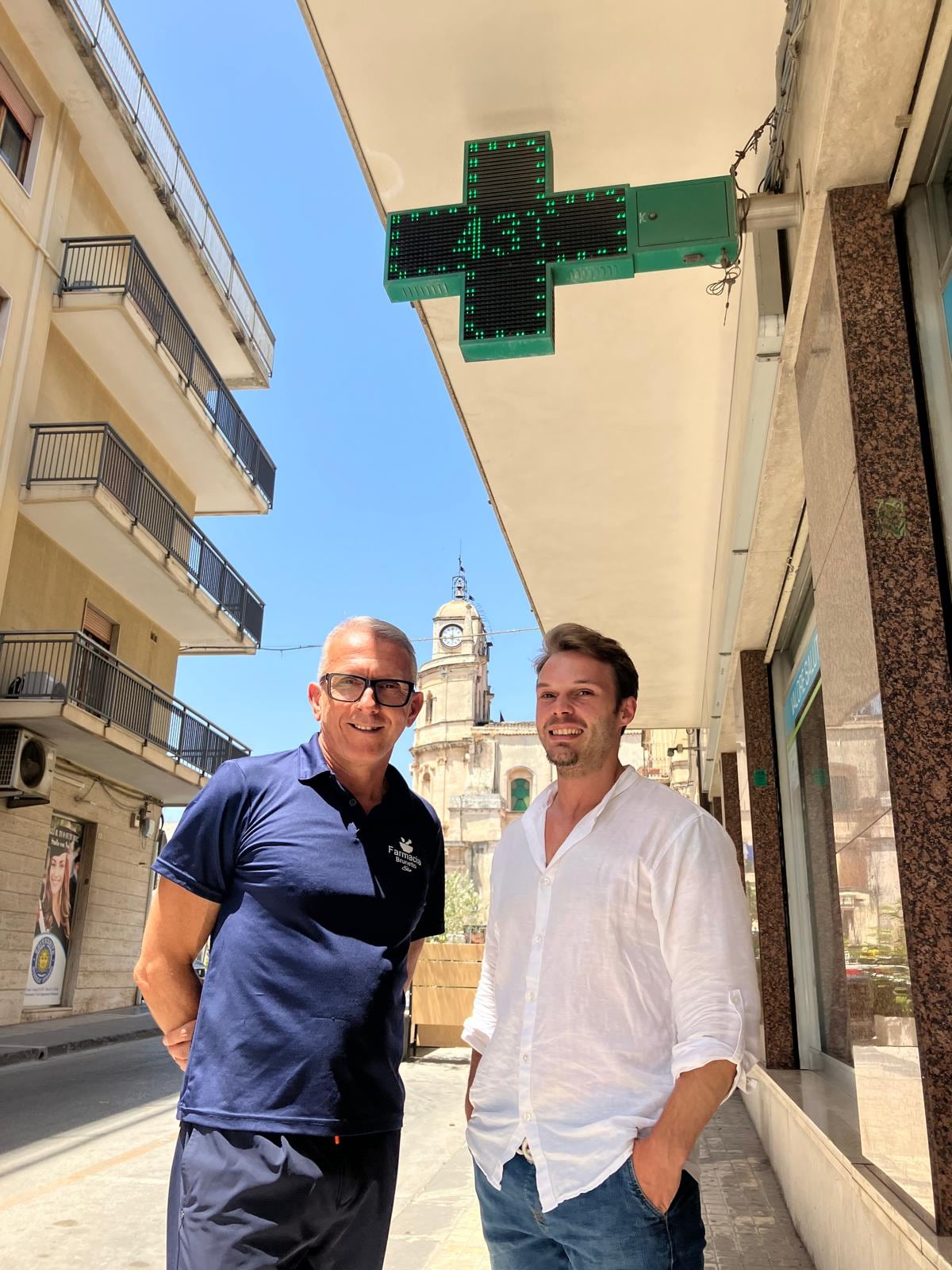
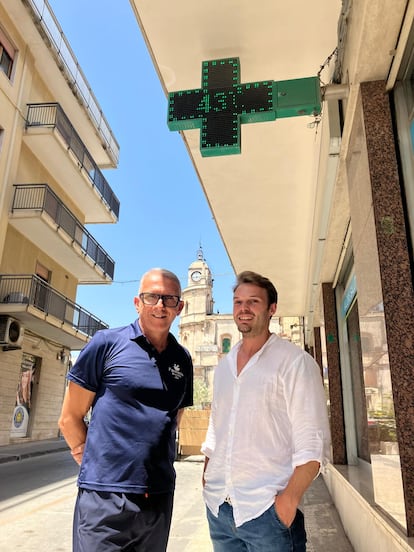
Elio Morale and Biagio Cantone in Floridia, Sicily, where the European heat record was set in 2021.Iñigo Domínguez
Catania is shrouded in a white mist, obscuring the horizon at sea, as if the earth were evaporating, as EL PAÍS arrives at the airport at 10 a.m. Tuesday morning. The thermometer is already reading 35 degrees Celsius (95ºF), but that’s nothing compared to what is expected, or rather feared, throughout the day: that Sicily will surpass its own heat record, the European record of 48.8ºC (119.8ºF) recorded on August 11, 2021, in Floridia, a small town 65 kilometers from Catania, in the province of Syracuse. Back then, newspaper headlines were already stating “Hell is in Sicily,” and similar things, but the Italian meteorological services have warned that perhaps new hyperbole will be necessary this week, as a heat wave threatens to break the record. For now, the metaphor being used is an “African flare,” due to the torrid winds blowing from the continent, which are responsible for rising temperatures. In more technical terms, it’s a subtropical anticyclone, and it is expected to last until Saturday.
On Monday, temperatures reached 41.8 degrees Celsius (108.8ºF), and Tuesday, a peak of up to 47ºC (111.7ºF) was expected in the same area as in 2021, the triangle between Catania, Syracuse, and Caltanisetta, the heart of eastern Sicily and one of the most beautiful places in Italy.
On Tuesday, the talk in the local villages was of nothing but the heat, and waiting to see what the maximum temperature would be. Heading toward Floridia, the site of the European record, the car’s thermometer jumps upwards as one moves away from the coast and enters the scorched yellow fields of inland Sicily, broken into deep ravines by centuries of earthquakes. They alternate with orange and lemon groves.
The cross-shaped electronic display at the Brunetto pharmacy, near the main square, reads 43ºC at noon. Upon entering, Elio Morale, who is working at the counter, smiles and calls to his colleague: “What was I telling you? The first foreign journalist is here.” It turns out that the illuminated green cross on his pharmacy is famous, because it’s the only one in town that accurately displays the temperature — as it’s in the shade — and that’s where the record was set in 2021 (although it wasn’t certified until 2024 by the World Meteorological Organization). In recent days, Morale has taken photos of the sign and posts them on Facebook. He doesn’t think the maximum temperature will be exceeded Tuesday, “but we’ll probably reach 46 degrees.” “I notice when the temperature isn’t returning to normal when my pupils burn and I can’t even ride my bike,” he explains. “Today I’ve already said I’m not going home for lunch.”
Talking to the townspeople at Bar Piperito and Bar Centrale, everyone says the same thing: “We’re used to it.” It’s assumed with a certain fatalism or lack of drama, depending on how you look at it. They say that in Sicily it’s always been very hot in the summer, that on hot nights people slept on the floor, which was cooler, or on the balcony, but what’s changed everything is air conditioning. Now you can’t live without it, even though it comes at a price: the electricity bill shoots up to around €300 or €400 euros a month ($352-$469). And in commercial premises, even more, up to €600 or €700 ($704-$821). Returning to the car at 12:40 p.m., the thermometer read 51ºC, which isn’t reliable because it was in the sun, but it makes a certain impression.
In the hardest-hit provinces of Catania, Syracuse, and Enna, authorities have opened climate shelters during the hottest hours, between 11:00 a.m. and 6:00 p.m. At that time, there are no birds; the countryside is silent. There are hardly any parks or trees in any town.
Since June, in Sicily, as in other southern regions of the country, outdoor work has been prohibited between 12:30 p.m. and 4:00 p.m. during periods of extreme heat. Driving from town to town, the fields are empty, the greenhouses deserted, and construction sites halted. From 1:00 p.m. onward, the towns empty out, everyone locks themselves in their homes, and there’s not a soul around until after 5:00 p.m. Everything is closed; they’re ghost towns.
This newspaper visits each town, looking for the verdict from the green crosses on the pharmacies. The one in Villasmundos, at 1:15 p.m., reads 44ºC. It’s on the road to Francofonte, which on Monday had one of the highest temperatures in Sicily (41.2ºC) and at 6:00 a.m. Tuesday, it was no less than 36.2ºC. “Yes, it was unusually hot. I open the bar at 3:30 a.m. because the people who are going to pick the grapes come for breakfast, and it was already hot,” says the owner of Bar Royal, one of the few that are open. He goes to the fields at night and returns around 10:30 a.m. because it’s impossible to work in the sun beyond then. At the bar is one of the villagers who has gone to harvest. He shows his cell phone with the image of the greenhouse thermometer at 9:40 a.m.: 43ºC. “And outside it was 40. Now you can’t go near it, it’s an oven,” he says.
Last stop in Catenanuova, another of the hottest villages in Europe, which registered 48.5ºC in August 1999. On Monday, as the sun set, the temperature was still 38ºC. At 4:00 p.m., the owner of the “Baggiano Bros (eat and live)” bar was alone, bored. He also runs the tobacco shop across the street and is waiting for a repairman to fix a problem. In this town, there’s an additional problem: water. It’s a chronic issue in some areas of Sicily, due to the drought, but above all to a disastrous distribution network, where more than half of the water (56%) is lost along the way, and to equally disastrous political management over the course of decades, with reservoirs unfinished. Of 47 dams, 26 are out of service or operating with limitations; in many, water is released, wasted, into the sea to avoid safety issues.
The mayor of Catenanuova, as he explained to the media, considers it almost an achievement to have water every two days, because elsewhere it’s worse, and the aqueduct from the foot of Mount Etna reaches here. The supply is rationed: there’s water only at night, for a few hours, until dawn. Residents take one shower in the morning and another at night. The rest of the day, they drink bottled water. The town’s two fountains are dry.
In Italy, the weather is increasingly being talked about, as in Spain and throughout Europe, and this week the contrast between the climatic madness is evident: while Sicily is a furnace, the north of the country is plagued by storms and floods. It’s true that the distance from Turin to Reggio Calabria is more than 1,300 kilometers (807 miles) and Sicily is right on the edge of Africa, but when the weather is on television, it records one extreme to the other in the same forecast, in the same country. Late Tuesday afternoon, the Sicilian Agrometeorological Information Service (SIAS) confirmed that this time there was no new record: in the end, Tuesday’s maximum temperature was reached in Paternò, half an hour from Catania: 45.7ºC. Francofonte came in second, with 44.5ºC. In Floridia, a phone call to the pharmacy late in the afternoon confirmed that they had reached 45ºC. However, there’s still a lot of summer remaining and August hasn’t even arrived yet.
Sign up for our weekly newsletter to get more English-language news coverage from EL PAÍS USA Edition
Ukrainian President Volodymyr Zelenskyy has promised to introduce new legislation amid continuing protests and international criticism over a law passed earlier this week that critics say undermines Ukraine’s fight against corruption.
The controversial law, passed on Tuesday, places the National Anti-Corruption Bureau of Ukraine (NABU) and the Specialised Anti-Corruption Prosecutor’s Office (SAPO) under the direct authority of the country’s prosecutor general – an official appointed by the president. Critics say the law strips the agencies of their independence and could allow political interference.
While Zelenskyy has defended the law as a necessary response to suspected “Russian influence” within the agencies, European Union officials and rights groups say that it contains no specific provisions to target Kremlin-linked operatives and warn it could derail any Ukrainian accession bid to the European Union.
“I have analysed all concerns,” Zelenskyy wrote on X following a meeting with top government and law enforcement officials.
Writing about the proposal of the new bill, he said: “We will prepare and submit a bill to the Verkhovna Rada [parliament] that ensures the strength of the rule-of-law system. There will be no Russian influence or interference … and all the norms for the independence of anti-corruption institutions will be in place.”
Public anger and European backlash
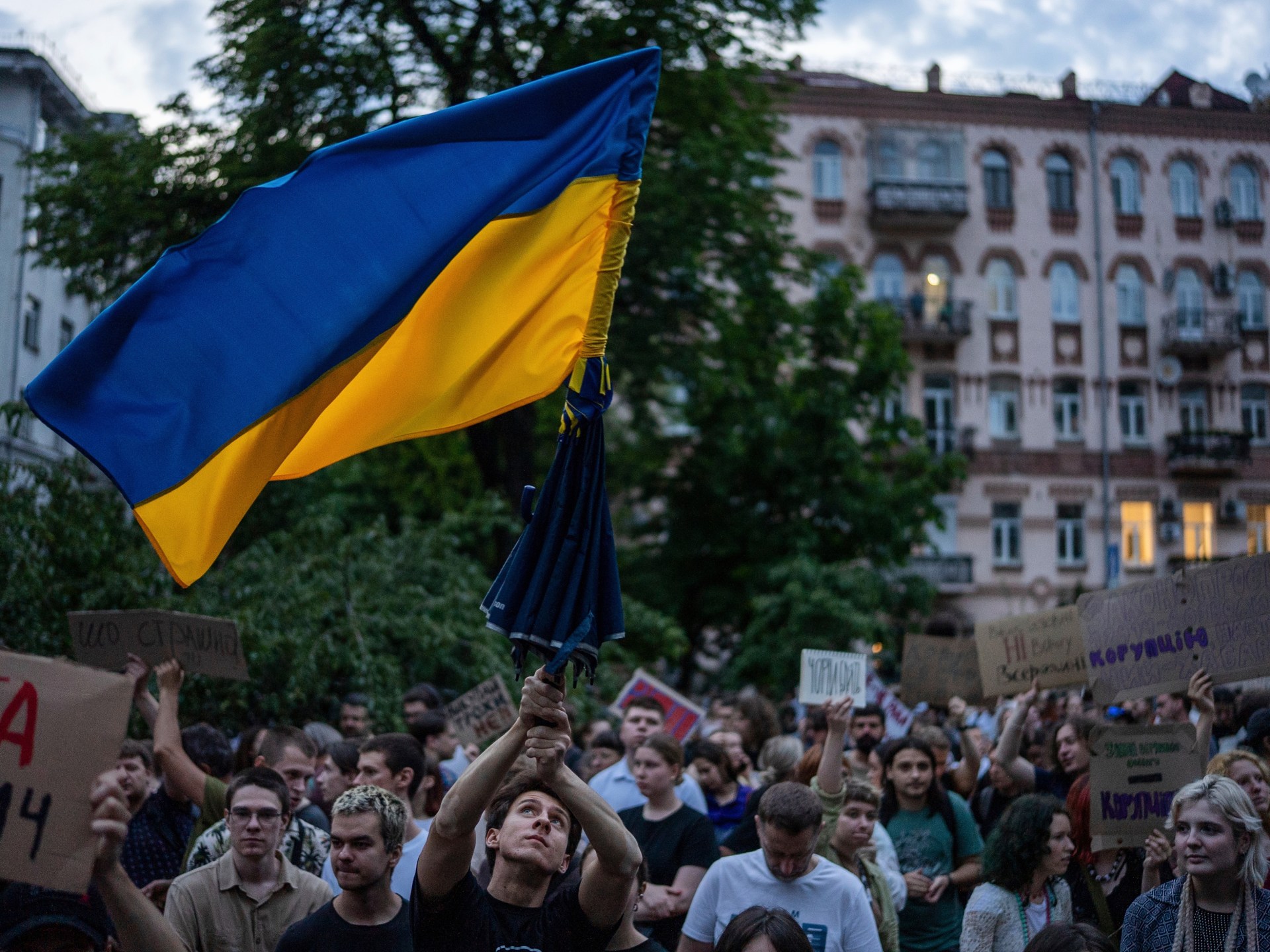
On Tuesday night, thousands of Ukrainians rallied in Kyiv and other major cities in rare wartime protests. More than 1,000 demonstrators defied martial law, which bans large public gatherings, to express their anger at the government, while on Wednesday, more protests took place in the capital.
“This is complete nonsense from the president’s office,” 20-year-old student Solomiia Telishevska told the news agency Reuters, referring to the law signed by Zelenskyy on Tuesday. “This contradicts what we are fighting for and what we are striving for, namely to [join] the European Union.”
Cleaning up systemic corruption has long been a core requirement for Ukraine’s EU membership and for unlocking billions in foreign aid. The law’s passage risks alienating Kyiv’s Western allies as the war grinds on.
European Commission President Ursula von der Leyen has demanded “explanations” from Zelenskyy, with a spokesperson confirming on Wednesday that she conveyed “strong concerns about the consequences of the amendments”. Germany’s Johann Wadephul, deputy leader of the Christian Democratic Union, warned on X that the restrictions were “hampering Ukraine’s path to the EU”.
Anticorruption bodies targeted
The storm erupted days after law enforcement raided NABU offices and arrested an employee on suspicion of spying for Russia. Another employee was accused of illegal business ties to Moscow. The Security Service of Ukraine (SBU) agency also carried out searches and arrests related to other alleged infractions, including a traffic incident.
Zelenskyy suggested these incidents justified the law passed on Tuesday, but Ukrainian analysts have warned the changes could erode public trust in Zelenskyy’s leadership during a critical phase of the war.
NABU was created in 2015 after Ukraine’s 2014 pro-European revolution to tackle deep-rooted government corruption. The agency has investigated multiple high-profile cases, including figures close to Zelenskyy’s administration.
Transparency International Ukraine denounced the raids as “an attempt by the authorities to undermine the independence of Ukraine’s post-Revolution of Dignity anti-corruption institutions”.
Some Ukrainians believe the government is protecting loyal insiders at the expense of transparency. “Those who swore to protect the laws and the constitution have instead chosen to shield their inner circle, even at the expense of Ukrainian democracy,” said veteran Oleh Symoroz, who lost both legs in 2022 fighting Russian forces.
The political firestorm risks creating deeper rifts within Ukraine at a time when unity is vital in Kyiv’s war against Russia. Oleksandra Matviichuk, head of the Nobel Peace Prize-winning Center for Civil Liberties, warned the law could play directly into the Kremlin’s hands. “This is a gift to Putin,” she said.
Russian officials have already seized on the controversy. Kremlin spokesman Dmitry Peskov remarked there was “a lot of corruption” when asked about the protests in Kyiv.
Prosecutors in South Korea have apologised to a woman who was convicted for defending herself during a sexually violent attack more than 60 years ago.
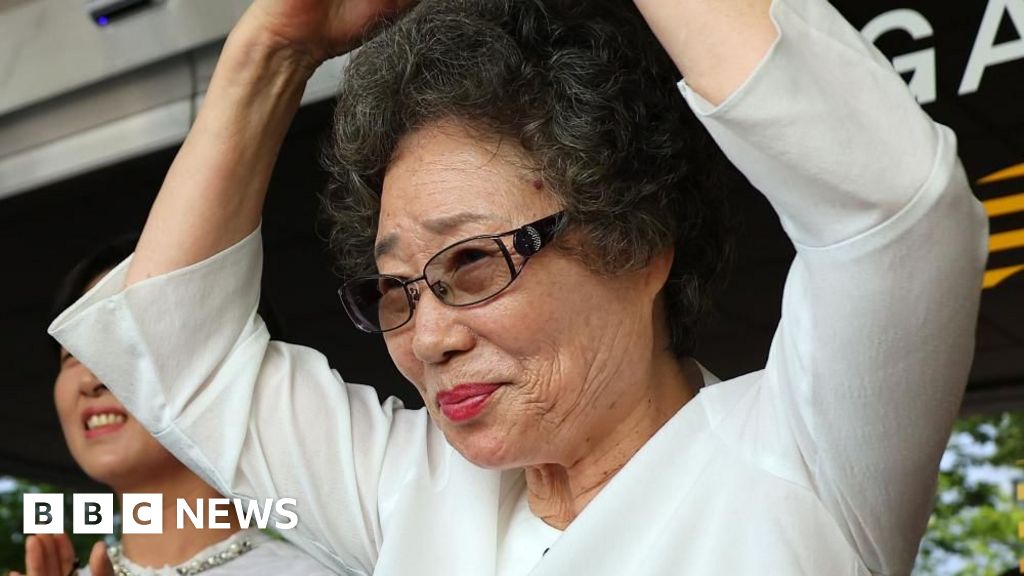
Choi Mal-ja was sentenced to 10 months in prison, suspended for two years, for biting off part of her attacker’s tongue as he allegedly tried to rape her in 1964, when she was 18 years old.
Inspired by the country’s #MeToo movement, MsChoi, now 78, has campaigned for years to have her conviction overturned.
Her retrial began in the city of Busan on Wednesday, where prosecutors issued an apology and asked for the court to quash her guilty verdict.
“For 61 years, the state made me live as a criminal,” Ms Choi told reporters outside the court ahead of the hearing.
She said she hoped future generations could live a happy life free from sexual violence.
At the start of the trial, Busan’s Chief Prosecutor Jeong Myeong-won said “we sincerely apologise”.
“We have caused Choi Mal-ja, a victim of a sex crime who should have been protected as one, indescribable pain and agony.”
A final ruling is scheduled for 10 September, with legal observers expecting the court to overturn Ms Choi’s conviction.
Outside the courtroom after the hearing, Ms Choi raised her fist and said: “We won!”
She celebrated by embracing campaigners from civic organisations who were there to support her.
In 1964, an 18-year-old Choi Mal-ja was attacked by a 21-year-old man, who forced his tongue into her mouth as he pinned her to the ground in the southern town of Gimhae, according to court records.
Ms Choi escaped the attack by biting off 1.5cm (0.59in) of the aggressor’s tongue.
The man was sentenced to six months in prison, suspended for two years, for trespassing and intimidation. He was never convicted of attempted rape.
Ms Choi was given a harsher sentence than her attacker for causing him grievous bodily harm.
The court at the time said her actions had exceeded the “reasonable bounds” of self-defence.
Ms Choi’s case has since been cited in legal textbooks in South Korea as a classic example of a court failing to recognise self-defence during sexual violence.
‘Justice is alive in this country’
After taking inspiration from South Korea’s #MeToo movement in the late 2010s, Ms Choi contacted advocacy groups to begin work on petitioning for a retrial.
She filed a petition in 2020, 56 years after the attack, but it was initially rejected by the lower courts. Three years later, the Supreme Court ruled that Ms Choi’s retrial could go ahead.
Her fight for justice became well known in South Korea, with Ms Choi and fellow activists holding protests outside the Supreme Court building in Seoul.
“I still can’t believe it,” Ms Choi said after Wednesday’s hearing, the Korea JoongAng Daily newspaper reported.
“But if the prosecution is admitting its mistake even now, then I believe justice is alive in this country.”
Some travelers may need to pay more to enter parts of Europe come 2026.
The price for travel authorization under the European Travel Information and Authorisation System is set to nearly triple, according to an announcement from the European Commission Friday.
The system, known as ETIAS, hasn’t been implemented yet. The authorization, which was adopted in 2018, has been postponed several times, and is now set to take effect in the fourth quarter of 2026.
A proposal was made to increase the fee from 7 euros ($8) to 20 euros ($23), according to the announcement.
Inflation and additional operational costs were reasons for the price hike, according to the announcement.
The new fee comports with the price of other travel authorizations, such as the U.K.’s Electronic Travel Authorisation (ETA) and the U.S.’ Electronic System for Travel Authorization, known as ESTA, the European Commission said.
Currently, an ETA costs £16 ($21.70), and the ESTA costs $21.
Travelers from 59 places will need to obtain an ETIAS authorization, including those from Australia, Canada, Japan, Singapore, South Korea, the United States and the United Kingdom.
The proposed adjustment is subject to a two-month review period by the European Council and Parliament, according to the announcement.
Some travelers may need to pay more to enter parts of Europe come 2026.
The price for travel authorization under the European Travel Information and Authorisation System is set to nearly triple, according to an announcement from the European Commission Friday.
The system, known as ETIAS, hasn’t been implemented yet. The authorization, which was adopted in 2018, has been postponed several times, and is now set to take effect in the fourth quarter of 2026.
A proposal was made to increase the fee from 7 euros ($8) to 20 euros ($23), according to the announcement.
Inflation and additional operational costs were reasons for the price hike, according to the announcement.
The new fee comports with the price of other travel authorizations, such as the U.K.’s Electronic Travel Authorisation (ETA) and the U.S.’ Electronic System for Travel Authorization, known as ESTA, the European Commission said.
Currently, an ETA costs £16 ($21.70), and the ESTA costs $21.
Travelers from 59 places will need to obtain an ETIAS authorization, including those from Australia, Canada, Japan, Singapore, South Korea, the United States and the United Kingdom.
The proposed adjustment is subject to a two-month review period by the European Council and Parliament, according to the announcement.