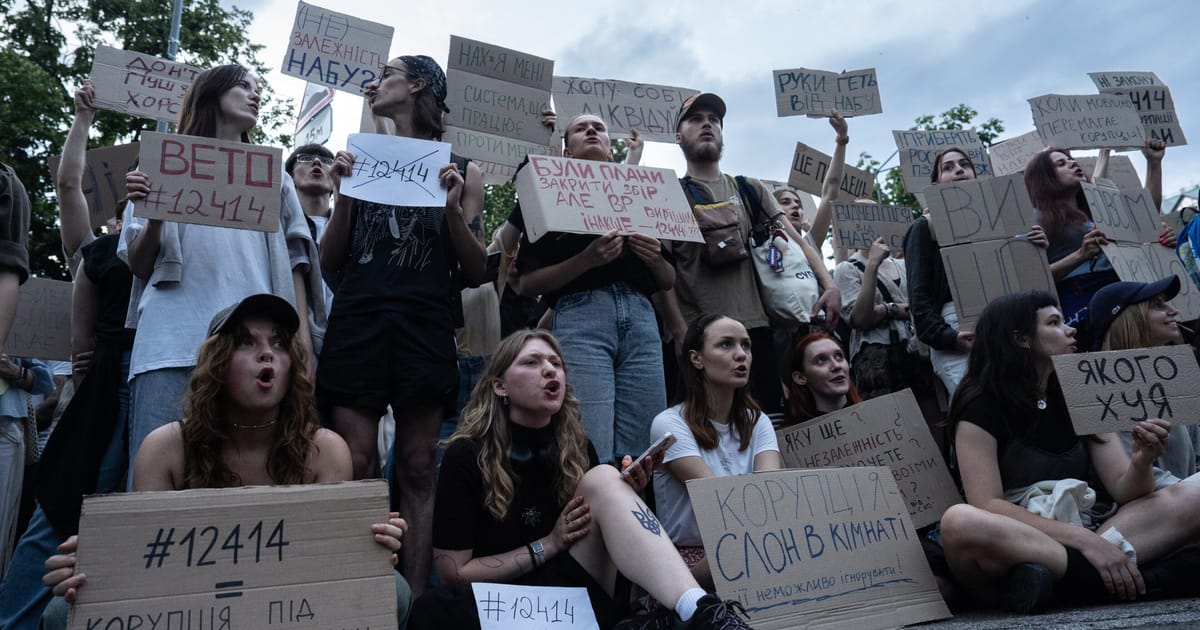
Zelenskyy argued that the radical move was needed to block Russian interference — and on Wednesday said he had “heard the public opinion” and promised to fix the situation with a new bill that he pledged would preserve the agencies’ independence.
But there is growing worry that Zelenskyy and his entourage might be using the authority granted him under martial law to concentrate power in a bid to keep the country fighting — in a way that raises fears over the country’s democratic credentials.
Svitlana Matviienko, executive director of the Agency for Legislative Initiatives, a Ukrainian NGO, warned that there is a “common pattern in the government’s abuse of power through violation of rules and procedure.”
In addition to this week’s legislation on anti-corruption agencies, the NGO pointed to last week’s Cabinet reshuffle as violating procedural rules, laws signed in violation of legislative deadlines, and cases like the prosecution of Vitaliy Shabunin, a Ukrainian army soldier and co-founder of Anti-Corruption Action Center, a top watchdog pushing for anti-corruption reform in Ukraine.
Shabunin is being charged with desertion and fraud. He insists his commander sent him to Kyiv to the national anti-corruption prevention commission to reform army procurement transparency, but the government says he’s being treated the same as any other soldier absent without leave.
“While persecuting me, the president’s office sends a message to all watchdogs, investigative journalists and Ukrainian servicemen that they can persecute anyone anywhere and at any moment,” Shabunin said.
“We heard what people are saying these days, what people are saying on social networks, to each other, on the streets. All this is not in vain. We have analyzed all the concerns, all the aspects of what should be changed,” Zelenskyy said in a video address on Wednesday evening, as protesters chanted on the streets outside his office.
Zelenskyy said that after a day of talks with affected parties, he will soon propose a bill to the Ukrainian parliament that will be “a response to the situation, and will provide strength to the law enforcement system.”
“All the norms for the independence of anti-corruption institutions will be there,” Zelenskyy said.
“This will be a presidential bill, and we will implement it within the framework of our strategy for transforming the state,” Zelenskyy added, providing few specifics and no deadline for the new bill.
The NABU and SAP supported Zelenskyy’s pivot, saying they are ready to join the discussion and preparation of a legislative solution that will eliminate legal risks, meet rule-of-law standards and provide greater potential for guaranteeing justice in Ukraine.
But Zelenskyy’s sudden concession did not calm the streets, as protesters demanded to see the law first.
“We heard what people are saying these days, what people are saying on social networks, to each other, on the streets. All this is not in vain. We have analyzed all the concerns, all the aspects of what should be changed,” Zelenskyy said in a video address on Wednesday evening, as protesters chanted on the streets outside his office.
Zelenskyy said that after a day of talks with affected parties, he will soon propose a bill to the Ukrainian parliament that will be “a response to the situation, and will provide strength to the law enforcement system.”
“All the norms for the independence of anti-corruption institutions will be there,” Zelenskyy said.
“This will be a presidential bill, and we will implement it within the framework of our strategy for transforming the state,” Zelenskyy added, providing few specifics and no deadline for the new bill.
The NABU and SAP supported Zelenskyy’s pivot, saying they are ready to join the discussion and preparation of a legislative solution that will eliminate legal risks, meet rule-of-law standards and provide greater potential for guaranteeing justice in Ukraine.
But Zelenskyy’s sudden concession did not calm the streets, as protesters demanded to see the law first.
“We heard what people are saying these days, what people are saying on social networks, to each other, on the streets. All this is not in vain. We have analyzed all the concerns, all the aspects of what should be changed,” Zelenskyy said in a video address on Wednesday evening, as protesters chanted on the streets outside his office.
Zelenskyy said that after a day of talks with affected parties, he will soon propose a bill to the Ukrainian parliament that will be “a response to the situation, and will provide strength to the law enforcement system.”
“All the norms for the independence of anti-corruption institutions will be there,” Zelenskyy said.
“This will be a presidential bill, and we will implement it within the framework of our strategy for transforming the state,” Zelenskyy added, providing few specifics and no deadline for the new bill.
The NABU and SAP supported Zelenskyy’s pivot, saying they are ready to join the discussion and preparation of a legislative solution that will eliminate legal risks, meet rule-of-law standards and provide greater potential for guaranteeing justice in Ukraine.
But Zelenskyy’s sudden concession did not calm the streets, as protesters demanded to see the law first.
“We heard what people are saying these days, what people are saying on social networks, to each other, on the streets. All this is not in vain. We have analyzed all the concerns, all the aspects of what should be changed,” Zelenskyy said in a video address on Wednesday evening, as protesters chanted on the streets outside his office.
Zelenskyy said that after a day of talks with affected parties, he will soon propose a bill to the Ukrainian parliament that will be “a response to the situation, and will provide strength to the law enforcement system.”
“All the norms for the independence of anti-corruption institutions will be there,” Zelenskyy said.
“This will be a presidential bill, and we will implement it within the framework of our strategy for transforming the state,” Zelenskyy added, providing few specifics and no deadline for the new bill.
The NABU and SAP supported Zelenskyy’s pivot, saying they are ready to join the discussion and preparation of a legislative solution that will eliminate legal risks, meet rule-of-law standards and provide greater potential for guaranteeing justice in Ukraine.
But Zelenskyy’s sudden concession did not calm the streets, as protesters demanded to see the law first.
For nearly two decades, no one had spotted the world’s smallest-known snake.
Some scientists worried that maybe the Barbados threadsnake had become extinct, but one sunny morning, Connor Blades lifted a rock in a tiny forest in the eastern Caribbean island and held his breath.
This photo provided by Re:wild shows the Barbados threadsnake next to a ruler, in the Scotland District of St. Andrew, Barbados, Thursday, March 20, 2025.
Connor Blades/Re:wild via AP
“After a year of searching, you begin to get a little pessimistic,” said Blades, project officer with the Ministry of Environment in Barbados.
The snake can fit comfortably on a coin, so it was able to elude scientists for almost 20 years.
Scientifically named Tetracheilostoma carlae, the petite creature is listed as Critically Endangered in the International Union for Conservation of Nature’s Red List of Threatened Species when it was last assessed in 2015.
Too tiny to identify with the naked eye, Blades placed it in a small glass jar and added soil, substrate and leaf litter.
The Barbados threadsnake, a species lost to science for nearly 20 years, was rediscovered during an ecological survey on Barbados by the Barbados Ministry of the Environment and National Beautification and Re:wild in March 2025.
Photo by Connor Blades/Re:wild
Several hours later, in front of a microscope at the University of the West Indies, Blades looked at the specimen. It wriggled in the petri dish, making it nearly impossible to identify.
“It was a struggle,” Blades recalled, adding that he shot a video of the snake and finally identified it thanks to a still image.
It had pale yellow dorsal lines running through its body, and its eyes were located on the side of its head.
“I tried to keep a level head,” Blades recalled, knowing that the Barbados threadsnake looks very much like a Brahminy blind snake, best known as the flower pot snake, which is a bit longer and has no dorsal lines.
On Wednesday, the Re:wild conservation group, which is collaborating with the local environment ministry, announced the rediscovery of the Barbados threadsnake.
“Rediscovering one of our endemics on many levels is significant,” said Justin Springer, Caribbean program officer for Re:wild who helped rediscover the snake along with Blades. “It reminds us that we still have something important left that plays an important role in our ecosystem.”
The Barbados threadsnake has only been seen a handful of times since 1889. It was on a list of 4,800 plant, animal and fungi species that Re:wild described as “lost to science.”
There’s no information on its population and the most recent record of the snake was a 2005 photograph from near Hillaby town in St. Thomas Parish, according to the IUCN. One of the oldest known records of the species dates back to 1918, and it has only been rarely spotted since then, with a few documentations from 1966, 1997 and 2008, the Switzerland-based conservation organization said.
“Given the dense human population on Barbados, if the species was simply underrecorded it seems likely that local people would be aware of additional records,” the IUCN said on its website. “The lack of records suggests that this species is genuinely rare and restricted.”
The snake is blind, burrows in the ground, eats termites and ants and lays one single, slender egg. Fully grown, it measures up to four inches.
“They’re very cryptic,” Blades said. “You can do a survey for a number of hours, and even if they are there, you may actually not see them.”
But on March 20 at around 10:30 a.m., Blades and Springer surrounded a jack-in-the-box tree in central Barbados and started looking under rocks while the rest of the team began measuring the tree, whose distribution is very limited in Barbados.
“That’s why the story is so exciting,” Springer said. “It all happened around the same time.”
S. Blair Hedges, a professor at Temple University and director of its center for biology, was the first to identify the Barbados threadsnake. Previously, it was mistakenly lumped in with another species.
In 2008, Hedges’ discovery was published in a scientific journal, with the snake baptized Tetracheilostoma carlae, in honor of his wife.
“I spent days searching for them,” Hedges recalled. “Based on my observations and the hundreds of rocks, objects that I turned over looking for this thing without success, I do think it is a rare species.”
That was June 2006, and there were only three other such specimens known at the time: two at a London museum and a third at a museum collection in California that was wrongly identified as being from Antigua instead of Barbados, Hedges said.
Hedges said that he didn’t realize he had collected a new species until he did a genetic analysis.
“The aha moment was in the laboratory,” he said, noting that the discovery established the Barbados threadsnake as the world’s smallest-known snake.
Hedges then became inundated for years with letters, photographs and emails from people thinking they had found more Barbados threadsnakes. Some of the pictures were of earthworms, he recalled.
“It was literally years of distraction,” he said.
Scientists hope the rediscovery means that the Barbados threadsnake could become a champion for the protection of wildlife habitat.
A lot of endemic species on the tiny island have gone extinct, including the Barbados racer, the Barbados skink and a particular species of cave shrimp.
“I hope they can get some interest in protecting it,” Hedges said. “Barbados is kind of unique in the Caribbean for a bad reason: it has the least amount of original forest, outside of Haiti.”
For nearly two decades, no one had spotted the world’s smallest-known snake.
Some scientists worried that maybe the Barbados threadsnake had become extinct, but one sunny morning, Connor Blades lifted a rock in a tiny forest in the eastern Caribbean island and held his breath.
This photo provided by Re:wild shows the Barbados threadsnake next to a ruler, in the Scotland District of St. Andrew, Barbados, Thursday, March 20, 2025.
Connor Blades/Re:wild via AP
“After a year of searching, you begin to get a little pessimistic,” said Blades, project officer with the Ministry of Environment in Barbados.
The snake can fit comfortably on a coin, so it was able to elude scientists for almost 20 years.
Scientifically named Tetracheilostoma carlae, the petite creature is listed as Critically Endangered in the International Union for Conservation of Nature’s Red List of Threatened Species when it was last assessed in 2015.
Too tiny to identify with the naked eye, Blades placed it in a small glass jar and added soil, substrate and leaf litter.
The Barbados threadsnake, a species lost to science for nearly 20 years, was rediscovered during an ecological survey on Barbados by the Barbados Ministry of the Environment and National Beautification and Re:wild in March 2025.
Photo by Connor Blades/Re:wild
Several hours later, in front of a microscope at the University of the West Indies, Blades looked at the specimen. It wriggled in the petri dish, making it nearly impossible to identify.
“It was a struggle,” Blades recalled, adding that he shot a video of the snake and finally identified it thanks to a still image.
It had pale yellow dorsal lines running through its body, and its eyes were located on the side of its head.
“I tried to keep a level head,” Blades recalled, knowing that the Barbados threadsnake looks very much like a Brahminy blind snake, best known as the flower pot snake, which is a bit longer and has no dorsal lines.
On Wednesday, the Re:wild conservation group, which is collaborating with the local environment ministry, announced the rediscovery of the Barbados threadsnake.
“Rediscovering one of our endemics on many levels is significant,” said Justin Springer, Caribbean program officer for Re:wild who helped rediscover the snake along with Blades. “It reminds us that we still have something important left that plays an important role in our ecosystem.”
The Barbados threadsnake has only been seen a handful of times since 1889. It was on a list of 4,800 plant, animal and fungi species that Re:wild described as “lost to science.”
There’s no information on its population and the most recent record of the snake was a 2005 photograph from near Hillaby town in St. Thomas Parish, according to the IUCN. One of the oldest known records of the species dates back to 1918, and it has only been rarely spotted since then, with a few documentations from 1966, 1997 and 2008, the Switzerland-based conservation organization said.
“Given the dense human population on Barbados, if the species was simply underrecorded it seems likely that local people would be aware of additional records,” the IUCN said on its website. “The lack of records suggests that this species is genuinely rare and restricted.”
The snake is blind, burrows in the ground, eats termites and ants and lays one single, slender egg. Fully grown, it measures up to four inches.
“They’re very cryptic,” Blades said. “You can do a survey for a number of hours, and even if they are there, you may actually not see them.”
But on March 20 at around 10:30 a.m., Blades and Springer surrounded a jack-in-the-box tree in central Barbados and started looking under rocks while the rest of the team began measuring the tree, whose distribution is very limited in Barbados.
“That’s why the story is so exciting,” Springer said. “It all happened around the same time.”
S. Blair Hedges, a professor at Temple University and director of its center for biology, was the first to identify the Barbados threadsnake. Previously, it was mistakenly lumped in with another species.
In 2008, Hedges’ discovery was published in a scientific journal, with the snake baptized Tetracheilostoma carlae, in honor of his wife.
“I spent days searching for them,” Hedges recalled. “Based on my observations and the hundreds of rocks, objects that I turned over looking for this thing without success, I do think it is a rare species.”
That was June 2006, and there were only three other such specimens known at the time: two at a London museum and a third at a museum collection in California that was wrongly identified as being from Antigua instead of Barbados, Hedges said.
Hedges said that he didn’t realize he had collected a new species until he did a genetic analysis.
“The aha moment was in the laboratory,” he said, noting that the discovery established the Barbados threadsnake as the world’s smallest-known snake.
Hedges then became inundated for years with letters, photographs and emails from people thinking they had found more Barbados threadsnakes. Some of the pictures were of earthworms, he recalled.
“It was literally years of distraction,” he said.
Scientists hope the rediscovery means that the Barbados threadsnake could become a champion for the protection of wildlife habitat.
A lot of endemic species on the tiny island have gone extinct, including the Barbados racer, the Barbados skink and a particular species of cave shrimp.
“I hope they can get some interest in protecting it,” Hedges said. “Barbados is kind of unique in the Caribbean for a bad reason: it has the least amount of original forest, outside of Haiti.”
On a steamy night deep in one of Taipei’s most conservative suburbs, a group of elderly neighbours are yelling at each other next to a garbage truck. They have just been handed a leaflet by a university student calling on them to recall – expel – their sitting legislator.
There are hundreds of these campaigners across Taiwan, targeting members of the Kuomintang (KMT) opposition who they accuse of being too pro-China. But this neighbourhood is deeply loyal to the party, and the campaigners are not welcome.
A woman shouts angrily: “Throw that leaflet away! … We are against the recall!”
The group of activists are pushing to overturn the balance of power in Taiwan’s government, just 18 months after the national election. They are using an extraordinary mechanism that allows civilians to vacate individual seats midterm, in a way it has never been used before.
The campaign’s success has taken everyone by surprise. More than 30 of Taiwan’s 113 legislators are facing recall – the highest number in Taiwan’s history. All of them come from the opposition KMT party.
The campaign has set off a political storm across Taiwan, with arrests, assaults, and accusations of authoritarianism and collaboration, fuelling the island’s already deep political divisions.
The first 24 recall votes will take place on Saturday, and another seven in August, at a cost equivalent to about £40m. If just six are expelled the party will lose its majority in parliament to the ruling Democratic Progressive party (DPP).
Both sides say they are fighting for Taiwan’s democracy.
The campaigners calling for the KMT recall are a collection of civic groups who have won the backing of the ruling DPP.
In April tens of thousands of opposition party supporters rallied in Taiwan’s capital, Taipei. Photograph: Charlie Chu
What started as a protest against opposition obstructionism has become about the existential threat of China, where the ruling Communist party (CCP) plans to annex Taiwan. Campaigners claim the targeted legislators are too close to China and are undermining Taiwan’s national security, pointing to those who have visited Beijing and met with senior officials, and a raft of proposed China-related bills that they say will weaken Taiwan’s defences.
“Certainly a good number of these legislators have stated on the record their support for pro-Beijing policy, or at the least strong anti-DPP policy,” says Lev Nachman, a political science professor at National Taiwan University.
“There’s a difference between anti-DPP and pro-Beijing, but from the recallers’ perspective these have become synonymous.”
The KMT denies the accusations against its MPs. The party officially opposes annexation by the CCP but argues the way to preserve peace is through friendlier ties with Beijing. Fu Kun-chi, a controversial senior KMT legislator up for recall, told Nikkei Asia it was in the spirit of “fostering mutual understanding” that he went to Beijing and met with Wang Huning, Xi Jinping’s chief adviser overseeing Taiwan relations. Critics said Fu was “selling out Taiwan”.
The KMT and its supporters see the recalls as a grab for power by people who can’t accept the legitimate election results. They are misusing Taiwan’s democratic processes to “suppress opposition voices”, a senior KMT official told a recent background briefing.
A scandal-filled campaign
The recall mechanism is a drawn-out process that first requires two rounds of signature collections in an electorate: 1% of voting residents and then a separate 10%. Once approved by electoral officials a date is set for the recall vote. A majority must agree to vacate the seat, and the number in favour must exceed 25% of the number of voters in the constituency. If successful, a byelection with new candidates is held within three months, and the recalled legislator is banned from running again for seven years.
Thousands of campaigners have swarmed street corners, transit stations, and the designated garbage collection points where residents bring their trash to trucks each night – first chasing signatures and now lobbying for votes.
Supporters of the recall movement gather in Taipei. Photograph: Ann Wang/Reuters
The campaign battle between the two sides has been hostile, scandal-filled, and very public.
Retaliatory petitions against DPP seats by the KMT failed spectacularly. None were approved, and dozens of officials were arrested on accusations of faking signatures and using the names of dead residents to fill petitions.
In April the KMT party chief, Eric Chu, called Lai a “dictator” who is “more communist than the communists, more fascist than the fascists”. A KMT spokesman told the Guardian Chu’s comments were “a sharp critique of what he sees as the DPP’s growing authoritarian tendencies”.
In June Lai drew criticism of his own after he appeared to refer to opposition forces as “impurities” that needed to be “driven out”, in one of a planned 10 speeches designed to “unify the nation”. The Presidential office said the comments were taken out of context and his speech was “about using democracy to temper the power of national unity”. That same month Robert Tsao, a tech tycoon supporting the recall campaign, told Nikkei Asia that he wanted to “burn” down the entire KMT party, which he called a “Trojan horse” for Beijing.
On the ground, campaign workers have been doxed and assaulted in the streets – those working in Dazhi wore body cameras and were accompanied by a well-built volunteer as their security guard.
The cities and towns are plastered with billboards, while trucks loaded with LCD screens drive laps of the streets blaring accusations of treason and collaboration.
Tens of thousands of people have protested for and against the recall around Taiwan.
“These people were elected, and you’re wasting resources to try and turn them out,” said Patrick at a pro-opposition rally. “We need to keep the country running smoothly instead of constantly wasting money.”
In Dazhi, resident Sarah Li says pro-China legislators have to go. She says they are blinded by favourable treatment from Beijing and supporters – like most of her neighbours – are ignoring the current climate to stay loyal to their party.
A truck carrying LCD screens parked in central Taipei urges people to vote to expel opposition legislators. Photograph: Helen Davidson/The Guardian
“They don’t care about people’s lives,” she says of the legislators. “They just want power, political power.”
It’s illegal to discuss polling this close to the vote, but observers, like Taiwan-based political commentator Courtney Donovan Smith, say that people in support of the recall are far more likely to actually go and vote.
“There’s more people against these recalls, but they’re not all that motivated,” he says.
Politics as usual or something worse?
Beijing is likely watching the chaos with some glee. Fomenting social division is a key part of its strategy, and right now local politics is doing the CCP’s job. Much of the saga has made its way into CCP propagandaseeking to undermine Taiwan’s governmentwith state media reporting the campaign as “extremist” activity to “remove opposition voices”.
On Wednesday, Taiwan’s Mainland Affairs Council said it was “evident and clear” that the CCP was trying to interfere in Taiwan’s democratic process.
At a press briefing on Friday, Taiwan’s vice-president, Hsiao Bi-Khim, said the recalls were a constitutional civic right just like elections, and a sign of Taiwan’s “robust” democracy.
“I think it’s pretty obvious that China has been very proactive in trying to utilise hybrid means of disrupting our social cohesion: disinformation, infiltration, United Front tactics, et cetera. And that is why we also feel strongly that we need to step up to better defend and protect our society, and at the same time build greater unity,” she said.
Asked about international concerns over the fighting, she said it was a challenge, but: “Is there any democracy that doesn’t have deep political divisions?”
No analyst or politician the Guardian spoke to for this story dared to predict an outcome.
Nachman says he has never seen Taiwan more divided.
“That wound needs to be addressed, regardless of who wins in the end.”
Additional research by Jason Tzu Kuan Lu and Lillian Yang
On a steamy night deep in one of Taipei’s most conservative suburbs, a group of elderly neighbours are yelling at each other next to a garbage truck. They have just been handed a leaflet by a university student calling on them to recall – expel – their sitting legislator.
There are hundreds of these campaigners across Taiwan, targeting members of the Kuomintang (KMT) opposition who they accuse of being too pro-China. But this neighbourhood is deeply loyal to the party, and the campaigners are not welcome.
A woman shouts angrily: “Throw that leaflet away! … We are against the recall!”
The group of activists are pushing to overturn the balance of power in Taiwan’s government, just 18 months after the national election. They are using an extraordinary mechanism that allows civilians to vacate individual seats midterm, in a way it has never been used before.
The campaign’s success has taken everyone by surprise. More than 30 of Taiwan’s 113 legislators are facing recall – the highest number in Taiwan’s history. All of them come from the opposition KMT party.
The campaign has set off a political storm across Taiwan, with arrests, assaults, and accusations of authoritarianism and collaboration, fuelling the island’s already deep political divisions.
The first 24 recall votes will take place on Saturday, and another seven in August, at a cost equivalent to about £40m. If just six are expelled the party will lose its majority in parliament to the ruling Democratic Progressive party (DPP).
Both sides say they are fighting for Taiwan’s democracy.
The campaigners calling for the KMT recall are a collection of civic groups who have won the backing of the ruling DPP.
In April tens of thousands of opposition party supporters rallied in Taiwan’s capital, Taipei. Photograph: Charlie Chu
What started as a protest against opposition obstructionism has become about the existential threat of China, where the ruling Communist party (CCP) plans to annex Taiwan. Campaigners claim the targeted legislators are too close to China and are undermining Taiwan’s national security, pointing to those who have visited Beijing and met with senior officials, and a raft of proposed China-related bills that they say will weaken Taiwan’s defences.
“Certainly a good number of these legislators have stated on the record their support for pro-Beijing policy, or at the least strong anti-DPP policy,” says Lev Nachman, a political science professor at National Taiwan University.
“There’s a difference between anti-DPP and pro-Beijing, but from the recallers’ perspective these have become synonymous.”
The KMT denies the accusations against its MPs. The party officially opposes annexation by the CCP but argues the way to preserve peace is through friendlier ties with Beijing. Fu Kun-chi, a controversial senior KMT legislator up for recall, told Nikkei Asia it was in the spirit of “fostering mutual understanding” that he went to Beijing and met with Wang Huning, Xi Jinping’s chief adviser overseeing Taiwan relations. Critics said Fu was “selling out Taiwan”.
The KMT and its supporters see the recalls as a grab for power by people who can’t accept the legitimate election results. They are misusing Taiwan’s democratic processes to “suppress opposition voices”, a senior KMT official told a recent background briefing.
A scandal-filled campaign
The recall mechanism is a drawn-out process that first requires two rounds of signature collections in an electorate: 1% of voting residents and then a separate 10%. Once approved by electoral officials a date is set for the recall vote. A majority must agree to vacate the seat, and the number in favour must exceed 25% of the number of voters in the constituency. If successful, a byelection with new candidates is held within three months, and the recalled legislator is banned from running again for seven years.
Thousands of campaigners have swarmed street corners, transit stations, and the designated garbage collection points where residents bring their trash to trucks each night – first chasing signatures and now lobbying for votes.
Supporters of the recall movement gather in Taipei. Photograph: Ann Wang/Reuters
The campaign battle between the two sides has been hostile, scandal-filled, and very public.
Retaliatory petitions against DPP seats by the KMT failed spectacularly. None were approved, and dozens of officials were arrested on accusations of faking signatures and using the names of dead residents to fill petitions.
In April the KMT party chief, Eric Chu, called Lai a “dictator” who is “more communist than the communists, more fascist than the fascists”. A KMT spokesman told the Guardian Chu’s comments were “a sharp critique of what he sees as the DPP’s growing authoritarian tendencies”.
In June Lai drew criticism of his own after he appeared to refer to opposition forces as “impurities” that needed to be “driven out”, in one of a planned 10 speeches designed to “unify the nation”. The Presidential office said the comments were taken out of context and his speech was “about using democracy to temper the power of national unity”. That same month Robert Tsao, a tech tycoon supporting the recall campaign, told Nikkei Asia that he wanted to “burn” down the entire KMT party, which he called a “Trojan horse” for Beijing.
On the ground, campaign workers have been doxed and assaulted in the streets – those working in Dazhi wore body cameras and were accompanied by a well-built volunteer as their security guard.
The cities and towns are plastered with billboards, while trucks loaded with LCD screens drive laps of the streets blaring accusations of treason and collaboration.
Tens of thousands of people have protested for and against the recall around Taiwan.
“These people were elected, and you’re wasting resources to try and turn them out,” said Patrick at a pro-opposition rally. “We need to keep the country running smoothly instead of constantly wasting money.”
In Dazhi, resident Sarah Li says pro-China legislators have to go. She says they are blinded by favourable treatment from Beijing and supporters – like most of her neighbours – are ignoring the current climate to stay loyal to their party.
A truck carrying LCD screens parked in central Taipei urges people to vote to expel opposition legislators. Photograph: Helen Davidson/The Guardian
“They don’t care about people’s lives,” she says of the legislators. “They just want power, political power.”
It’s illegal to discuss polling this close to the vote, but observers, like Taiwan-based political commentator Courtney Donovan Smith, say that people in support of the recall are far more likely to actually go and vote.
“There’s more people against these recalls, but they’re not all that motivated,” he says.
Politics as usual or something worse?
Beijing is likely watching the chaos with some glee. Fomenting social division is a key part of its strategy, and right now local politics is doing the CCP’s job. Much of the saga has made its way into CCP propagandaseeking to undermine Taiwan’s governmentwith state media reporting the campaign as “extremist” activity to “remove opposition voices”.
On Wednesday, Taiwan’s Mainland Affairs Council said it was “evident and clear” that the CCP was trying to interfere in Taiwan’s democratic process.
At a press briefing on Friday, Taiwan’s vice-president, Hsiao Bi-Khim, said the recalls were a constitutional civic right just like elections, and a sign of Taiwan’s “robust” democracy.
“I think it’s pretty obvious that China has been very proactive in trying to utilise hybrid means of disrupting our social cohesion: disinformation, infiltration, United Front tactics, et cetera. And that is why we also feel strongly that we need to step up to better defend and protect our society, and at the same time build greater unity,” she said.
Asked about international concerns over the fighting, she said it was a challenge, but: “Is there any democracy that doesn’t have deep political divisions?”
No analyst or politician the Guardian spoke to for this story dared to predict an outcome.
Nachman says he has never seen Taiwan more divided.
“That wound needs to be addressed, regardless of who wins in the end.”
Additional research by Jason Tzu Kuan Lu and Lillian Yang