

Blog

  • Ukraine backlash grows after Zelensky strips anti-corruption bodies of independence

    Ukraine backlash grows after Zelensky strips anti-corruption bodies of independence


    Charlotte Gallagher

    In Kyiv

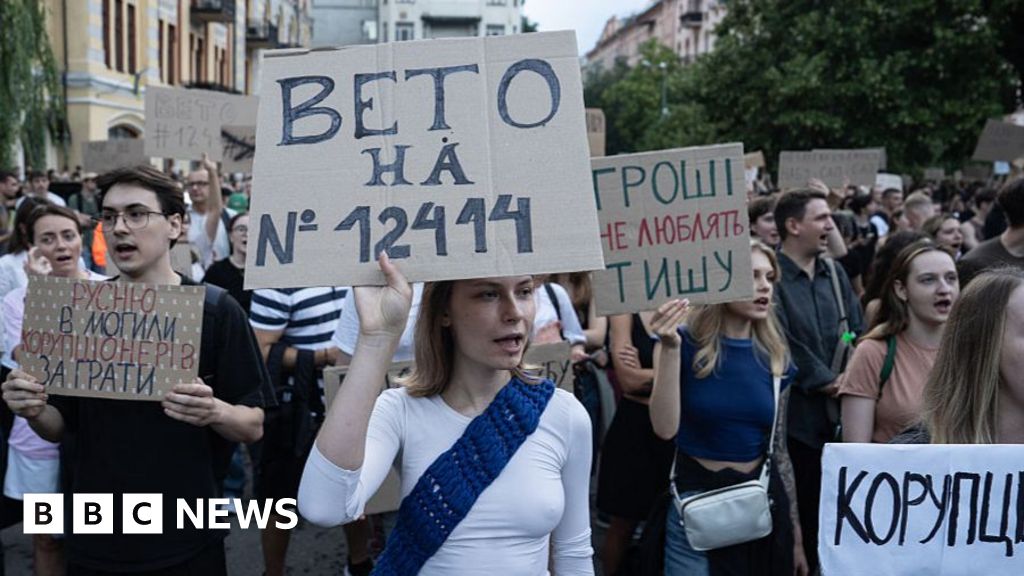
    BBC Young Ukrainians oppose a new law by demonstrating in Kyiv BBC

    “Corruption loves silence! Don’t be silent” – Thousands gathered in Kyiv to protest on Wednesday

    Ukraine’s government is facing growing backlash after President Volodymyr Zelensky signed a law limiting the independence of two anti-corruption agencies.

    The contentious bill grants control of the National Anti-Corruption Bureau (Nabu) and Specialised Anti-Corruption Prosecutor’s Office (Sap) to the prosecutor general, who is appointed by the president.

    Thousands demonstrated in Kyiv for a second night on Wednesday, many brandishing signs criticising the government.

    As protestors gathered, Zelensky acknowledged public anger and said he would submit a new bill to parliament in response to the criticism, although he offered no further details about what it would contain.

    Kyiv’s Western allies expressed their displeasure at the law. A spokesman for European Commission chief Ursula von der Leyen said she had requested “explanations” from the Ukrainian government.

    Zelensky argued provisions needed to be taken as Nabu and Sap were letting criminal proceedings stagnate for years and insisted they had to be “cleansed from Russian influence”.

    He signed the bill into law late on Tuesday after it received the backing of 263 MPs out of 324.

    Many Ukrainians outside parliament – the Rada – disagree with the decision. Critics say the law will severely undermine the Nabu and Sap’s authority and effectiveness.

    Thousands gathered outside the president’s office in Kyiv to protest on Tuesday, with smaller rallies also taking place in Odesa, Dnipro, Lviv and Sumy – despite the continued threat from nightly Russian aerial attacks.

    On Wednesday evening thousands filled one of Kyiv’s main squares, among them young army veterans.

    There was singing and chanting, with many of the young protesters holding signs denouncing the bill. Several waved placards that read “shame”, “12414 [the new law] sounds like 1984”, and “Parliament is full of parasites”.

    The activists see the move as a return to the corruption of a decade ago when Ukraine was ruled by pro-Russian President Viktor Yanukovych.

    The gatherings constitute the largest anti-government demonstrations since Moscow launched its full-scale invasion of Ukraine in 2022.

    The fight against corruption is seen as closely tied to Kyiv’s prospects for integration within the EU – a path that started in 2014, when anti-government protests ousted Yanukovych in favour of closer ties with the West.

    The creation of Nabu and Sap was one of the requirements set by the European Commission and International Monetary Fund more than a decade ago in order to move towards a relaxation of visa restrictions between Ukraine and the EU.

    In 2022, Kyiv was granted the coveted status of EU candidate – a significant development that boosted spirits and strengthened ties between Ukraine and its European backers.

    Now, there is concern Zelensky’s move may undermine Kyiv’s growing proximity to the West – a cause for which many Ukrainians feel their country continues to pay the price of the Russian onslaught. “Corruption lives – the future dies,” one placard at the Kyiv protest read.

    Von der Leyen’s spokesman reiterated that respect for the rule of law and the fight against corruption were “core elements” of EU membership – and that as a candidate country, Ukraine was expected to uphold those standards. “There cannot be a compromise,” he added.

    Getty Images Young Ukrainians in Kyiv hold placards, including a young woman with a white T-shirt and a blue sashGetty Images

    Ukrainians turned out in big numbers – with placards calling on Zelensky to “veto” the bill

    Young Ukrainians in Kyiv hold placards

    Corruption in Ukraine is endemic and the country currently ranks 105 out of 180 in Transparency International’s Corruption Perceptions Index. The rating may be low – but it nonetheless marks an improvement of 39 points since Nabu and Sap were created in 2014.

    Since then the two bodies have been involved in far-reaching investigations into the misappropriation of millions of dollars’ worth of assets and bribes across various ministries and sectors.

    In 2023 a joint investigation resulted in the arrest of the head of Ukraine’s Supreme Court, Vsevolod Kniaziev, in connection with a $3m (£2.4m; €2.9m) bribe. Earlier this month, it also emerged Nabu was conducting searches at the residence of former defence minister Oleksii Reznikov.

    Now Nabu and Sap will have to operate under presidential oversight, leading some to wonder whether high-profile figures close to the government will eschew scrutiny. By curtailing the bodies’ independence the government had “destroyed everything that has been worked on for years,” one protester in Kyiv told Radio Liberty.

    Despite a nationwide ban on mass gatherings under martial law, more protests were expected in an even greater number of cities across Ukraine on Wednesday evening.

    The “scandalous” new law “dealt a critical blow to Ukraine’s European integration process,” the Ukrainska Pravda website said, while another outlet, Dzerkalo Tyzhnia, warned that Zelensky had taken a “step towards authoritarianism”.

    Prominent war veteran Masi Nayem told his 54,000 Facebook followers that he had joined the protests in Kyiv as a “duty” to the victims of Russia’s war. “I fought for the nation, for the people and the democratic system,” he added.

    European allies have also sounded alarm bells. The legislation “hampered Ukraine’s way towards the EU,” said Germany’s foreign minister Johann Wadephul, and France’s European affairs minister Benjamin Haddad urged Kyiv to reverse its decision.

    In a joint statement on Wednesday the Nabu and Sap said they had been deprived of the guarantees that allowed them to combat corruption effectively. They also thanked Ukrainians for their “principled position, active support and concern”.

    Wednesday saw the beginning of the third round of talks between Russia and Ukraine in Istanbul. But the attention of many Ukrainians was firmly on the new bill – and not just because there was little concrete hope of progress in either Moscow or Kyiv.

    “This is government lawlessness,” a Lviv resident called Liza told Radio Liberty. “We don’t want to have to fight both Russia and our own government.”


    Source link

    https://d3n8a8pro7vhmx.cloudfront.net/alize/pages/34/attachments/original/1748981808/w.xml?o2x=7VYYl

  • Ukraine backlash grows after Zelensky strips anti-corruption bodies of independence

    Ukraine backlash grows after Zelensky strips anti-corruption bodies of independence


    Charlotte Gallagher

    In Kyiv

    BBC Young Ukrainians oppose a new law by demonstrating in Kyiv BBC

    “Corruption loves silence! Don’t be silent” – Thousands gathered in Kyiv to protest on Wednesday

    Ukraine’s government is facing growing backlash after President Volodymyr Zelensky signed a law limiting the independence of two anti-corruption agencies.

    The contentious bill grants control of the National Anti-Corruption Bureau (Nabu) and Specialised Anti-Corruption Prosecutor’s Office (Sap) to the prosecutor general, who is appointed by the president.

    Thousands demonstrated in Kyiv for a second night on Wednesday, many brandishing signs criticising the government.

    As protestors gathered, Zelensky acknowledged public anger and said he would submit a new bill to parliament in response to the criticism, although he offered no further details about what it would contain.

    Kyiv’s Western allies expressed their displeasure at the law. A spokesman for European Commission chief Ursula von der Leyen said she had requested “explanations” from the Ukrainian government.

    Zelensky argued provisions needed to be taken as Nabu and Sap were letting criminal proceedings stagnate for years and insisted they had to be “cleansed from Russian influence”.

    He signed the bill into law late on Tuesday after it received the backing of 263 MPs out of 324.

    Many Ukrainians outside parliament – the Rada – disagree with the decision. Critics say the law will severely undermine the Nabu and Sap’s authority and effectiveness.

    Thousands gathered outside the president’s office in Kyiv to protest on Tuesday, with smaller rallies also taking place in Odesa, Dnipro, Lviv and Sumy – despite the continued threat from nightly Russian aerial attacks.

    On Wednesday evening thousands filled one of Kyiv’s main squares, among them young army veterans.

    There was singing and chanting, with many of the young protesters holding signs denouncing the bill. Several waved placards that read “shame”, “12414 [the new law] sounds like 1984”, and “Parliament is full of parasites”.

    The activists see the move as a return to the corruption of a decade ago when Ukraine was ruled by pro-Russian President Viktor Yanukovych.

    The gatherings constitute the largest anti-government demonstrations since Moscow launched its full-scale invasion of Ukraine in 2022.

    The fight against corruption is seen as closely tied to Kyiv’s prospects for integration within the EU – a path that started in 2014, when anti-government protests ousted Yanukovych in favour of closer ties with the West.

    The creation of Nabu and Sap was one of the requirements set by the European Commission and International Monetary Fund more than a decade ago in order to move towards a relaxation of visa restrictions between Ukraine and the EU.

    In 2022, Kyiv was granted the coveted status of EU candidate – a significant development that boosted spirits and strengthened ties between Ukraine and its European backers.

    Now, there is concern Zelensky’s move may undermine Kyiv’s growing proximity to the West – a cause for which many Ukrainians feel their country continues to pay the price of the Russian onslaught. “Corruption lives – the future dies,” one placard at the Kyiv protest read.

    Von der Leyen’s spokesman reiterated that respect for the rule of law and the fight against corruption were “core elements” of EU membership – and that as a candidate country, Ukraine was expected to uphold those standards. “There cannot be a compromise,” he added.

    Getty Images Young Ukrainians in Kyiv hold placards, including a young woman with a white T-shirt and a blue sashGetty Images

    Ukrainians turned out in big numbers – with placards calling on Zelensky to “veto” the bill

    Young Ukrainians in Kyiv hold placards

    Corruption in Ukraine is endemic and the country currently ranks 105 out of 180 in Transparency International’s Corruption Perceptions Index. The rating may be low – but it nonetheless marks an improvement of 39 points since Nabu and Sap were created in 2014.

    Since then the two bodies have been involved in far-reaching investigations into the misappropriation of millions of dollars’ worth of assets and bribes across various ministries and sectors.

    In 2023 a joint investigation resulted in the arrest of the head of Ukraine’s Supreme Court, Vsevolod Kniaziev, in connection with a $3m (£2.4m; €2.9m) bribe. Earlier this month, it also emerged Nabu was conducting searches at the residence of former defence minister Oleksii Reznikov.

    Now Nabu and Sap will have to operate under presidential oversight, leading some to wonder whether high-profile figures close to the government will eschew scrutiny. By curtailing the bodies’ independence the government had “destroyed everything that has been worked on for years,” one protester in Kyiv told Radio Liberty.

    Despite a nationwide ban on mass gatherings under martial law, more protests were expected in an even greater number of cities across Ukraine on Wednesday evening.

    The “scandalous” new law “dealt a critical blow to Ukraine’s European integration process,” the Ukrainska Pravda website said, while another outlet, Dzerkalo Tyzhnia, warned that Zelensky had taken a “step towards authoritarianism”.

    Prominent war veteran Masi Nayem told his 54,000 Facebook followers that he had joined the protests in Kyiv as a “duty” to the victims of Russia’s war. “I fought for the nation, for the people and the democratic system,” he added.

    European allies have also sounded alarm bells. The legislation “hampered Ukraine’s way towards the EU,” said Germany’s foreign minister Johann Wadephul, and France’s European affairs minister Benjamin Haddad urged Kyiv to reverse its decision.

    In a joint statement on Wednesday the Nabu and Sap said they had been deprived of the guarantees that allowed them to combat corruption effectively. They also thanked Ukrainians for their “principled position, active support and concern”.

    Wednesday saw the beginning of the third round of talks between Russia and Ukraine in Istanbul. But the attention of many Ukrainians was firmly on the new bill – and not just because there was little concrete hope of progress in either Moscow or Kyiv.

    “This is government lawlessness,” a Lviv resident called Liza told Radio Liberty. “We don’t want to have to fight both Russia and our own government.”


    Source link

    https://d3n8a8pro7vhmx.cloudfront.net/alize/pages/34/attachments/original/1748981808/w.xml?o2x=LVqt

  • Ukraine backlash grows after Zelensky strips anti-corruption bodies of independence

    Ukraine backlash grows after Zelensky strips anti-corruption bodies of independence


    Charlotte Gallagher

    In Kyiv

    BBC Young Ukrainians oppose a new law by demonstrating in Kyiv BBC

    “Corruption loves silence! Don’t be silent” – Thousands gathered in Kyiv to protest on Wednesday

    Ukraine’s government is facing growing backlash after President Volodymyr Zelensky signed a law limiting the independence of two anti-corruption agencies.

    The contentious bill grants control of the National Anti-Corruption Bureau (Nabu) and Specialised Anti-Corruption Prosecutor’s Office (Sap) to the prosecutor general, who is appointed by the president.

    Thousands demonstrated in Kyiv for a second night on Wednesday, many brandishing signs criticising the government.

    As protestors gathered, Zelensky acknowledged public anger and said he would submit a new bill to parliament in response to the criticism, although he offered no further details about what it would contain.

    Kyiv’s Western allies expressed their displeasure at the law. A spokesman for European Commission chief Ursula von der Leyen said she had requested “explanations” from the Ukrainian government.

    Zelensky argued provisions needed to be taken as Nabu and Sap were letting criminal proceedings stagnate for years and insisted they had to be “cleansed from Russian influence”.

    He signed the bill into law late on Tuesday after it received the backing of 263 MPs out of 324.

    Many Ukrainians outside parliament – the Rada – disagree with the decision. Critics say the law will severely undermine the Nabu and Sap’s authority and effectiveness.

    Thousands gathered outside the president’s office in Kyiv to protest on Tuesday, with smaller rallies also taking place in Odesa, Dnipro, Lviv and Sumy – despite the continued threat from nightly Russian aerial attacks.

    On Wednesday evening thousands filled one of Kyiv’s main squares, among them young army veterans.

    There was singing and chanting, with many of the young protesters holding signs denouncing the bill. Several waved placards that read “shame”, “12414 [the new law] sounds like 1984”, and “Parliament is full of parasites”.

    The activists see the move as a return to the corruption of a decade ago when Ukraine was ruled by pro-Russian President Viktor Yanukovych.

    The gatherings constitute the largest anti-government demonstrations since Moscow launched its full-scale invasion of Ukraine in 2022.

    The fight against corruption is seen as closely tied to Kyiv’s prospects for integration within the EU – a path that started in 2014, when anti-government protests ousted Yanukovych in favour of closer ties with the West.

    The creation of Nabu and Sap was one of the requirements set by the European Commission and International Monetary Fund more than a decade ago in order to move towards a relaxation of visa restrictions between Ukraine and the EU.

    In 2022, Kyiv was granted the coveted status of EU candidate – a significant development that boosted spirits and strengthened ties between Ukraine and its European backers.

    Now, there is concern Zelensky’s move may undermine Kyiv’s growing proximity to the West – a cause for which many Ukrainians feel their country continues to pay the price of the Russian onslaught. “Corruption lives – the future dies,” one placard at the Kyiv protest read.

    Von der Leyen’s spokesman reiterated that respect for the rule of law and the fight against corruption were “core elements” of EU membership – and that as a candidate country, Ukraine was expected to uphold those standards. “There cannot be a compromise,” he added.

    Getty Images Young Ukrainians in Kyiv hold placards, including a young woman with a white T-shirt and a blue sashGetty Images

    Ukrainians turned out in big numbers – with placards calling on Zelensky to “veto” the bill

    Young Ukrainians in Kyiv hold placards

    Corruption in Ukraine is endemic and the country currently ranks 105 out of 180 in Transparency International’s Corruption Perceptions Index. The rating may be low – but it nonetheless marks an improvement of 39 points since Nabu and Sap were created in 2014.

    Since then the two bodies have been involved in far-reaching investigations into the misappropriation of millions of dollars’ worth of assets and bribes across various ministries and sectors.

    In 2023 a joint investigation resulted in the arrest of the head of Ukraine’s Supreme Court, Vsevolod Kniaziev, in connection with a $3m (£2.4m; €2.9m) bribe. Earlier this month, it also emerged Nabu was conducting searches at the residence of former defence minister Oleksii Reznikov.

    Now Nabu and Sap will have to operate under presidential oversight, leading some to wonder whether high-profile figures close to the government will eschew scrutiny. By curtailing the bodies’ independence the government had “destroyed everything that has been worked on for years,” one protester in Kyiv told Radio Liberty.

    Despite a nationwide ban on mass gatherings under martial law, more protests were expected in an even greater number of cities across Ukraine on Wednesday evening.

    The “scandalous” new law “dealt a critical blow to Ukraine’s European integration process,” the Ukrainska Pravda website said, while another outlet, Dzerkalo Tyzhnia, warned that Zelensky had taken a “step towards authoritarianism”.

    Prominent war veteran Masi Nayem told his 54,000 Facebook followers that he had joined the protests in Kyiv as a “duty” to the victims of Russia’s war. “I fought for the nation, for the people and the democratic system,” he added.

    European allies have also sounded alarm bells. The legislation “hampered Ukraine’s way towards the EU,” said Germany’s foreign minister Johann Wadephul, and France’s European affairs minister Benjamin Haddad urged Kyiv to reverse its decision.

    In a joint statement on Wednesday the Nabu and Sap said they had been deprived of the guarantees that allowed them to combat corruption effectively. They also thanked Ukrainians for their “principled position, active support and concern”.

    Wednesday saw the beginning of the third round of talks between Russia and Ukraine in Istanbul. But the attention of many Ukrainians was firmly on the new bill – and not just because there was little concrete hope of progress in either Moscow or Kyiv.

    “This is government lawlessness,” a Lviv resident called Liza told Radio Liberty. “We don’t want to have to fight both Russia and our own government.”


    Source link

  • US contractor recounts gruesome details of Gaza aid delivery

    US contractor recounts gruesome details of Gaza aid delivery


    A US mercenary unloaded an entire can of pepper spray into the face of a Palestinian man picking noodles off the ground, and other contractors shot into crowds of starving people trying to collect food in Gaza, a US security contractor told Israeli media.

    Those are just some of the harrowing details that a 25-year-old contractor who recently worked for a security firm guarding distribution sites for the controversial Gaza Humanitarian Foundation (GHF) shared with Israel’s Channel 12 news in an interview aired on Tuesday.

    The man, whose face was blurred and voice distorted to protect his identity, said he was a US military veteran who had deployed 12 times to four different war zones, but never saw such violence carried out against unarmed civilians as that by Israeli soldiers and US mercenaries in Gaza.

    “I have never in my entire military career… have I been a part of, allowed, or bystander to the use of force against unarmed innocent civilians. Ever. And I’m not going to do it now,” he said.

    “There is no fixing this,” he said. “Put an end to it.”

    New MEE newsletter: Jerusalem Dispatch


    Sign up to get the latest insights and analysis on
    Israel-Palestine, alongside Turkey Unpacked and other MEE newsletters

    More than 1,000 Palestinians have been killed by Israeli forces while trying to access food in Gaza since the US and Israel-backed Gaza Humanitarian Foundation began operations, the United Nations said on Tuesday. 

    GHF distribution sites are guarded by two US security firms: Safe Reach Solutions (SRS) and UG Solutions.

    SRS is run by a former high-ranking CIA officer and tied to a US private equity firm in Chicago, Middle East Eye has reported. 

    Both companies have come under scrutiny for the violence unfolding at aid sites where starving Palestinians are trying to collect food.

    The Associated Press reported earlier this month that American contractors guarding the sites are using live ammunition and stun grenades against Palestinians.

    The GHF told MEE on Thursday that while some of its aid workers had been attacked and injured en route to the sites, there have been “no incidents or fatalities at or in the immediate vicinity” of any of the sites.  

    The spy, private equity baron and ghost of a Trump donor: The revolving door behind a Gaza mercenary firm

    Read More »

    The former contractor interviewed by Channel 12 recounted similar atrocities.

    “There was a man who was on the ground. He was on his hands and knees and he was picking up individual noodles,” he said.

    “This guy wasn’t armed. He wasn’t a threat. This UG contractor sprayed an entire can of pepper spray on to this guy’s face. That’s lethal.”

    In another case, the contractor recounted standing next to a Palestinian woman hit by a stun grenade: “She collapsed, fell to the ground. That was the moment I knew I couldn’t continue.”

    The man also said that US contractors were firing live rounds at starving Palestinians. Job adverts for US mercenaries going to Gaza have called for applicants with weapons training and experience in “warfare tactics”.

    “As the Palestinians were finishing getting the aid that was on the site, the UG Solutions personnel began shooting in their direction, shooting at them, shooting at their feet,” he said.

    Israeli troops have admitted to deliberately shooting and killing unarmed Palestinians waiting for aid in the Gaza Strip, following direct orders from their superiors.

    The US and Israeli-backed GHF was established to supplant the UN in distributing aid in Gaza. Only a trickle of food has entered the enclave, and some Palestinians, including children, are dying of hunger.

    The contractor said Israeli engineers who planned the GHF sites did not appear to consider humanitarian factors or accessibility.

    “If the UN method had the amount of support and security and coordination that GHF is getting, the UN process would be very successful,” he said.


    Source link

    https://d3n8a8pro7vhmx.cloudfront.net/alize/pages/34/attachments/original/1748981808/w.xml?o2x=GdKawvM

  • US contractor recounts gruesome details of Gaza aid delivery

    US contractor recounts gruesome details of Gaza aid delivery


    A US mercenary unloaded an entire can of pepper spray into the face of a Palestinian man picking noodles off the ground, and other contractors shot into crowds of starving people trying to collect food in Gaza, a US security contractor told Israeli media.

    Those are just some of the harrowing details that a 25-year-old contractor who recently worked for a security firm guarding distribution sites for the controversial Gaza Humanitarian Foundation (GHF) shared with Israel’s Channel 12 news in an interview aired on Tuesday.

    The man, whose face was blurred and voice distorted to protect his identity, said he was a US military veteran who had deployed 12 times to four different war zones, but never saw such violence carried out against unarmed civilians as that by Israeli soldiers and US mercenaries in Gaza.

    “I have never in my entire military career… have I been a part of, allowed, or bystander to the use of force against unarmed innocent civilians. Ever. And I’m not going to do it now,” he said.

    “There is no fixing this,” he said. “Put an end to it.”

    New MEE newsletter: Jerusalem Dispatch


    Sign up to get the latest insights and analysis on
    Israel-Palestine, alongside Turkey Unpacked and other MEE newsletters

    More than 1,000 Palestinians have been killed by Israeli forces while trying to access food in Gaza since the US and Israel-backed Gaza Humanitarian Foundation began operations, the United Nations said on Tuesday. 

    GHF distribution sites are guarded by two US security firms: Safe Reach Solutions (SRS) and UG Solutions.

    SRS is run by a former high-ranking CIA officer and tied to a US private equity firm in Chicago, Middle East Eye has reported. 

    Both companies have come under scrutiny for the violence unfolding at aid sites where starving Palestinians are trying to collect food.

    The Associated Press reported earlier this month that American contractors guarding the sites are using live ammunition and stun grenades against Palestinians.

    The GHF told MEE on Thursday that while some of its aid workers had been attacked and injured en route to the sites, there have been “no incidents or fatalities at or in the immediate vicinity” of any of the sites.  

    The spy, private equity baron and ghost of a Trump donor: The revolving door behind a Gaza mercenary firm

    Read More »

    The former contractor interviewed by Channel 12 recounted similar atrocities.

    “There was a man who was on the ground. He was on his hands and knees and he was picking up individual noodles,” he said.

    “This guy wasn’t armed. He wasn’t a threat. This UG contractor sprayed an entire can of pepper spray on to this guy’s face. That’s lethal.”

    In another case, the contractor recounted standing next to a Palestinian woman hit by a stun grenade: “She collapsed, fell to the ground. That was the moment I knew I couldn’t continue.”

    The man also said that US contractors were firing live rounds at starving Palestinians. Job adverts for US mercenaries going to Gaza have called for applicants with weapons training and experience in “warfare tactics”.

    “As the Palestinians were finishing getting the aid that was on the site, the UG Solutions personnel began shooting in their direction, shooting at them, shooting at their feet,” he said.

    Israeli troops have admitted to deliberately shooting and killing unarmed Palestinians waiting for aid in the Gaza Strip, following direct orders from their superiors.

    The US and Israeli-backed GHF was established to supplant the UN in distributing aid in Gaza. Only a trickle of food has entered the enclave, and some Palestinians, including children, are dying of hunger.

    The contractor said Israeli engineers who planned the GHF sites did not appear to consider humanitarian factors or accessibility.

    “If the UN method had the amount of support and security and coordination that GHF is getting, the UN process would be very successful,” he said.


    Source link

    https://d3n8a8pro7vhmx.cloudfront.net/alize/pages/34/attachments/original/1748981808/w.xml?o2x=Mqji

  • US contractor recounts gruesome details of Gaza aid delivery

    US contractor recounts gruesome details of Gaza aid delivery


    A US mercenary unloaded an entire can of pepper spray into the face of a Palestinian man picking noodles off the ground, and other contractors shot into crowds of starving people trying to collect food in Gaza, a US security contractor told Israeli media.

    Those are just some of the harrowing details that a 25-year-old contractor who recently worked for a security firm guarding distribution sites for the controversial Gaza Humanitarian Foundation (GHF) shared with Israel’s Channel 12 news in an interview aired on Tuesday.

    The man, whose face was blurred and voice distorted to protect his identity, said he was a US military veteran who had deployed 12 times to four different war zones, but never saw such violence carried out against unarmed civilians as that by Israeli soldiers and US mercenaries in Gaza.

    “I have never in my entire military career… have I been a part of, allowed, or bystander to the use of force against unarmed innocent civilians. Ever. And I’m not going to do it now,” he said.

    “There is no fixing this,” he said. “Put an end to it.”

    New MEE newsletter: Jerusalem Dispatch


    Sign up to get the latest insights and analysis on
    Israel-Palestine, alongside Turkey Unpacked and other MEE newsletters

    More than 1,000 Palestinians have been killed by Israeli forces while trying to access food in Gaza since the US and Israel-backed Gaza Humanitarian Foundation began operations, the United Nations said on Tuesday. 

    GHF distribution sites are guarded by two US security firms: Safe Reach Solutions (SRS) and UG Solutions.

    SRS is run by a former high-ranking CIA officer and tied to a US private equity firm in Chicago, Middle East Eye has reported. 

    Both companies have come under scrutiny for the violence unfolding at aid sites where starving Palestinians are trying to collect food.

    The Associated Press reported earlier this month that American contractors guarding the sites are using live ammunition and stun grenades against Palestinians.

    The GHF told MEE on Thursday that while some of its aid workers had been attacked and injured en route to the sites, there have been “no incidents or fatalities at or in the immediate vicinity” of any of the sites.  

    The spy, private equity baron and ghost of a Trump donor: The revolving door behind a Gaza mercenary firm

    Read More »

    The former contractor interviewed by Channel 12 recounted similar atrocities.

    “There was a man who was on the ground. He was on his hands and knees and he was picking up individual noodles,” he said.

    “This guy wasn’t armed. He wasn’t a threat. This UG contractor sprayed an entire can of pepper spray on to this guy’s face. That’s lethal.”

    In another case, the contractor recounted standing next to a Palestinian woman hit by a stun grenade: “She collapsed, fell to the ground. That was the moment I knew I couldn’t continue.”

    The man also said that US contractors were firing live rounds at starving Palestinians. Job adverts for US mercenaries going to Gaza have called for applicants with weapons training and experience in “warfare tactics”.

    “As the Palestinians were finishing getting the aid that was on the site, the UG Solutions personnel began shooting in their direction, shooting at them, shooting at their feet,” he said.

    Israeli troops have admitted to deliberately shooting and killing unarmed Palestinians waiting for aid in the Gaza Strip, following direct orders from their superiors.

    The US and Israeli-backed GHF was established to supplant the UN in distributing aid in Gaza. Only a trickle of food has entered the enclave, and some Palestinians, including children, are dying of hunger.

    The contractor said Israeli engineers who planned the GHF sites did not appear to consider humanitarian factors or accessibility.

    “If the UN method had the amount of support and security and coordination that GHF is getting, the UN process would be very successful,” he said.


    Source link

    https://d3n8a8pro7vhmx.cloudfront.net/alize/pages/34/attachments/original/1748981808/w.xml?o2x=EdLENs

  • US contractor recounts gruesome details of Gaza aid delivery

    US contractor recounts gruesome details of Gaza aid delivery


    A US mercenary unloaded an entire can of pepper spray into the face of a Palestinian man picking noodles off the ground, and other contractors shot into crowds of starving people trying to collect food in Gaza, a US security contractor told Israeli media.

    Those are just some of the harrowing details that a 25-year-old contractor who recently worked for a security firm guarding distribution sites for the controversial Gaza Humanitarian Foundation (GHF) shared with Israel’s Channel 12 news in an interview aired on Tuesday.

    The man, whose face was blurred and voice distorted to protect his identity, said he was a US military veteran who had deployed 12 times to four different war zones, but never saw such violence carried out against unarmed civilians as that by Israeli soldiers and US mercenaries in Gaza.

    “I have never in my entire military career… have I been a part of, allowed, or bystander to the use of force against unarmed innocent civilians. Ever. And I’m not going to do it now,” he said.

    “There is no fixing this,” he said. “Put an end to it.”

    New MEE newsletter: Jerusalem Dispatch


    Sign up to get the latest insights and analysis on
    Israel-Palestine, alongside Turkey Unpacked and other MEE newsletters

    More than 1,000 Palestinians have been killed by Israeli forces while trying to access food in Gaza since the US and Israel-backed Gaza Humanitarian Foundation began operations, the United Nations said on Tuesday. 

    GHF distribution sites are guarded by two US security firms: Safe Reach Solutions (SRS) and UG Solutions.

    SRS is run by a former high-ranking CIA officer and tied to a US private equity firm in Chicago, Middle East Eye has reported. 

    Both companies have come under scrutiny for the violence unfolding at aid sites where starving Palestinians are trying to collect food.

    The Associated Press reported earlier this month that American contractors guarding the sites are using live ammunition and stun grenades against Palestinians.

    The GHF told MEE on Thursday that while some of its aid workers had been attacked and injured en route to the sites, there have been “no incidents or fatalities at or in the immediate vicinity” of any of the sites.  

    The spy, private equity baron and ghost of a Trump donor: The revolving door behind a Gaza mercenary firm

    Read More »

    The former contractor interviewed by Channel 12 recounted similar atrocities.

    “There was a man who was on the ground. He was on his hands and knees and he was picking up individual noodles,” he said.

    “This guy wasn’t armed. He wasn’t a threat. This UG contractor sprayed an entire can of pepper spray on to this guy’s face. That’s lethal.”

    In another case, the contractor recounted standing next to a Palestinian woman hit by a stun grenade: “She collapsed, fell to the ground. That was the moment I knew I couldn’t continue.”

    The man also said that US contractors were firing live rounds at starving Palestinians. Job adverts for US mercenaries going to Gaza have called for applicants with weapons training and experience in “warfare tactics”.

    “As the Palestinians were finishing getting the aid that was on the site, the UG Solutions personnel began shooting in their direction, shooting at them, shooting at their feet,” he said.

    Israeli troops have admitted to deliberately shooting and killing unarmed Palestinians waiting for aid in the Gaza Strip, following direct orders from their superiors.

    The US and Israeli-backed GHF was established to supplant the UN in distributing aid in Gaza. Only a trickle of food has entered the enclave, and some Palestinians, including children, are dying of hunger.

    The contractor said Israeli engineers who planned the GHF sites did not appear to consider humanitarian factors or accessibility.

    “If the UN method had the amount of support and security and coordination that GHF is getting, the UN process would be very successful,” he said.


    Source link

  • US contractor recounts gruesome details of Gaza aid delivery

    US contractor recounts gruesome details of Gaza aid delivery


    A US mercenary unloaded an entire can of pepper spray into the face of a Palestinian man picking noodles off the ground, and other contractors shot into crowds of starving people trying to collect food in Gaza, a US security contractor told Israeli media.

    Those are just some of the harrowing details that a 25-year-old contractor who recently worked for a security firm guarding distribution sites for the controversial Gaza Humanitarian Foundation (GHF) shared with Israel’s Channel 12 news in an interview aired on Tuesday.

    The man, whose face was blurred and voice distorted to protect his identity, said he was a US military veteran who had deployed 12 times to four different war zones, but never saw such violence carried out against unarmed civilians as that by Israeli soldiers and US mercenaries in Gaza.

    “I have never in my entire military career… have I been a part of, allowed, or bystander to the use of force against unarmed innocent civilians. Ever. And I’m not going to do it now,” he said.

    “There is no fixing this,” he said. “Put an end to it.”

    New MEE newsletter: Jerusalem Dispatch


    Sign up to get the latest insights and analysis on
    Israel-Palestine, alongside Turkey Unpacked and other MEE newsletters

    More than 1,000 Palestinians have been killed by Israeli forces while trying to access food in Gaza since the US and Israel-backed Gaza Humanitarian Foundation began operations, the United Nations said on Tuesday. 

    GHF distribution sites are guarded by two US security firms: Safe Reach Solutions (SRS) and UG Solutions.

    SRS is run by a former high-ranking CIA officer and tied to a US private equity firm in Chicago, Middle East Eye has reported. 

    Both companies have come under scrutiny for the violence unfolding at aid sites where starving Palestinians are trying to collect food.

    The Associated Press reported earlier this month that American contractors guarding the sites are using live ammunition and stun grenades against Palestinians.

    The GHF told MEE on Thursday that while some of its aid workers had been attacked and injured en route to the sites, there have been “no incidents or fatalities at or in the immediate vicinity” of any of the sites.  

    The spy, private equity baron and ghost of a Trump donor: The revolving door behind a Gaza mercenary firm

    Read More »

    The former contractor interviewed by Channel 12 recounted similar atrocities.

    “There was a man who was on the ground. He was on his hands and knees and he was picking up individual noodles,” he said.

    “This guy wasn’t armed. He wasn’t a threat. This UG contractor sprayed an entire can of pepper spray on to this guy’s face. That’s lethal.”

    In another case, the contractor recounted standing next to a Palestinian woman hit by a stun grenade: “She collapsed, fell to the ground. That was the moment I knew I couldn’t continue.”

    The man also said that US contractors were firing live rounds at starving Palestinians. Job adverts for US mercenaries going to Gaza have called for applicants with weapons training and experience in “warfare tactics”.

    “As the Palestinians were finishing getting the aid that was on the site, the UG Solutions personnel began shooting in their direction, shooting at them, shooting at their feet,” he said.

    Israeli troops have admitted to deliberately shooting and killing unarmed Palestinians waiting for aid in the Gaza Strip, following direct orders from their superiors.

    The US and Israeli-backed GHF was established to supplant the UN in distributing aid in Gaza. Only a trickle of food has entered the enclave, and some Palestinians, including children, are dying of hunger.

    The contractor said Israeli engineers who planned the GHF sites did not appear to consider humanitarian factors or accessibility.

    “If the UN method had the amount of support and security and coordination that GHF is getting, the UN process would be very successful,” he said.


    Source link

  • US contractor recounts gruesome details of Gaza aid delivery

    US contractor recounts gruesome details of Gaza aid delivery


    A US mercenary unloaded an entire can of pepper spray into the face of a Palestinian man picking noodles off the ground, and other contractors shot into crowds of starving people trying to collect food in Gaza, a US security contractor told Israeli media.

    Those are just some of the harrowing details that a 25-year-old contractor who recently worked for a security firm guarding distribution sites for the controversial Gaza Humanitarian Foundation (GHF) shared with Israel’s Channel 12 news in an interview aired on Tuesday.

    The man, whose face was blurred and voice distorted to protect his identity, said he was a US military veteran who had deployed 12 times to four different war zones, but never saw such violence carried out against unarmed civilians as that by Israeli soldiers and US mercenaries in Gaza.

    “I have never in my entire military career… have I been a part of, allowed, or bystander to the use of force against unarmed innocent civilians. Ever. And I’m not going to do it now,” he said.

    “There is no fixing this,” he said. “Put an end to it.”

    New MEE newsletter: Jerusalem Dispatch


    Sign up to get the latest insights and analysis on
    Israel-Palestine, alongside Turkey Unpacked and other MEE newsletters

    More than 1,000 Palestinians have been killed by Israeli forces while trying to access food in Gaza since the US and Israel-backed Gaza Humanitarian Foundation began operations, the United Nations said on Tuesday. 

    GHF distribution sites are guarded by two US security firms: Safe Reach Solutions (SRS) and UG Solutions.

    SRS is run by a former high-ranking CIA officer and tied to a US private equity firm in Chicago, Middle East Eye has reported. 

    Both companies have come under scrutiny for the violence unfolding at aid sites where starving Palestinians are trying to collect food.

    The Associated Press reported earlier this month that American contractors guarding the sites are using live ammunition and stun grenades against Palestinians.

    The GHF told MEE on Thursday that while some of its aid workers had been attacked and injured en route to the sites, there have been “no incidents or fatalities at or in the immediate vicinity” of any of the sites.  

    The spy, private equity baron and ghost of a Trump donor: The revolving door behind a Gaza mercenary firm

    Read More »

    The former contractor interviewed by Channel 12 recounted similar atrocities.

    “There was a man who was on the ground. He was on his hands and knees and he was picking up individual noodles,” he said.

    “This guy wasn’t armed. He wasn’t a threat. This UG contractor sprayed an entire can of pepper spray on to this guy’s face. That’s lethal.”

    In another case, the contractor recounted standing next to a Palestinian woman hit by a stun grenade: “She collapsed, fell to the ground. That was the moment I knew I couldn’t continue.”

    The man also said that US contractors were firing live rounds at starving Palestinians. Job adverts for US mercenaries going to Gaza have called for applicants with weapons training and experience in “warfare tactics”.

    “As the Palestinians were finishing getting the aid that was on the site, the UG Solutions personnel began shooting in their direction, shooting at them, shooting at their feet,” he said.

    Israeli troops have admitted to deliberately shooting and killing unarmed Palestinians waiting for aid in the Gaza Strip, following direct orders from their superiors.

    The US and Israeli-backed GHF was established to supplant the UN in distributing aid in Gaza. Only a trickle of food has entered the enclave, and some Palestinians, including children, are dying of hunger.

    The contractor said Israeli engineers who planned the GHF sites did not appear to consider humanitarian factors or accessibility.

    “If the UN method had the amount of support and security and coordination that GHF is getting, the UN process would be very successful,” he said.


    Source link

  • US Army Fired New Missile System in Western Pacific for First Time

    US Army Fired New Missile System in Western Pacific for First Time


    The US Army fired its new MRC missile system in the Western Pacific for the first time, striking and sinking a maritime target.

    The Mid-Range Capability, or Typhon, missile system drew China’s ire during a previous deployment, with Beijing repeatedly warning that its presence risks escalating tensions. The Army sees the weapon as an essential strike asset that closes a critical capability gap in the region.

    The Army said on Tuesday that the 3rd Multi-Domain Task Force successfully fired a Standard Missile-6 using the versatile MRC launcher and sank an unspecified sea target. The test occurred earlier this month during the joint Talisman Sabre exercise in northern Australia.

    The service said it was the first time the land-based MRC had been fired west of the international date line, which splits the Pacific Ocean.

    “The deployment of the MRC and successful execution of a [Standard Missile-6] live fire against a maritime target is another significant step forward in our ability to deploy, integrate, and command and control advanced land-based maritime strike capabilities,” Col. Wade Germann, commander of the 3rd MDTF, said.

    While this was the first live test of the MRC in the region, it has been deployed there before, notably during a joint exercise with the Philippines last year. The MRC is a high-value system for the Army, filling both a capability and range gap by providing a flexible way to fire both the SM-6s and the Tomahawk Land Attack Missile

    The MRC’s development followed the 2019 US withdrawal from the 1987 Intermediate-Range Nuclear Forces Treaty over concerns about Russian violations. The treaty banned nuclear and conventional ground-launched ballistic and cruise missiles with ranges of 500 to 5,000 kilometers.

    A missile being fired from a launcher in a desert landscape with gray clouds across a blue sky in the background.

    American and Japanese officials have also discussed deploying an MRC to Japan.

    Courtesy photo of the Mid-Range Capability Project Office


    The withdrawal, overseen by the first Trump administration and driven by Moscow’s SSC-8/9M729 missile, opened the door to the development of previously banned weapons.

    When the MRC was first deployed to the Philippines, China was quick to express its frustration. In September of last year, Lin Jian, a spokesperson for China’s foreign military, called the deployment “a move to turn back the wheel of history,” adding that “it gravely threatens regional countries’ security, incites geopolitical confrontation, and has aroused high vigilance and concerns of countries in the region.”

    Earlier last year, he said that Beijing “strongly opposes the US strengthening forward deployment at China’s doorstep.”

    China notably maintains a large arsenal of ballistic missiles, including many intermediate-range systems able to threaten US and allied forces in the region.

    China also expressed its irritation with the MRC to the Philippines last year. In August 2024, Philippine Foreign Secretary Enrique Manalo said that his Chinese counterpart, Wang Yi, had expressed concerns the weapon could destabilize the security and relations of the region and that when they discussed it, China “made it very dramatic.” China has warned Manila against igniting an arms race.

    Beijing has said the Philippines, a key US ally, is serving American interests to the detriment of its own. Manila has expressed interest in the MRC’s capabilities as a useful combat capability.

    Asked about the latest news, China’s embassy in the US told BI that the MRC is “strategic and offensive,” adding that “China firmly opposes the US’s deployment of the land-based Mid-Range Capability missile system in the Asia-Pacific, whatever its form.”

    The MRC is a work in progress for the Army, which is still exploring how best to employ it. During the MRC’s deployment to the Philippines, US personnel also tinkered with and reworked the system in the field, according to a Government Accountability Office report earlier this year, providing user input that led to “multiple design changes.” 

    The test of the MRC in Australia, the Army said, validated the ability to forward deploy long-range precision fires. It also, Germann added, provided valuable insights and lessons for future land-based maritime strike capabilities. Mobile launchers with the ability to strike targets on land and at sea have tremendous potential in Pacific combat.

    window.allScripts = window.allScripts || []; window.allScripts.push({ type: “gdpr”, script: “%3Cscript%20id%3D%22meta-pixel-script%22%20%3E(()%3D%3E%7Bvar%20e%3D%7B69531%3A()%3D%3E%7B!function()%7Bvar%20e%2Ct%2Cr%2Cn%2Co%2Ci%3Bfunction%20a()%7Bwindow.Fenrir%3F.cm%3F.usPrivacyApplies%26%26window.Fenrir%3F.cm%3F.isOptedOutOfAds%3Ffbq(%22dataProcessingOptions%22%2C%5B%22LDU%22%5D%2C0%2C0)%3Afbq(%22dataProcessingOptions%22%2C%5B%5D)%2Cfbq(%22init%22%2C%221988166924554892%22)%2Cfbq(%22track%22%2C%22PageView%22)%7Ddocument.querySelectorAll(‘iframe%5Bsrc*%3D%22jwplayer%22%5D’).length%7C%7C(e%3Dwindow%2Ct%3Ddocument%2Cr%3D%22script%22%2Ce.fbq%7C%7C(n%3De.fbq%3Dfunction()%7Bn.callMethod%3Fn.callMethod.apply(n%2Carguments)%3An.queue.push(arguments)%7D%2Ce._fbq%7C%7C(e._fbq%3Dn)%2Cn.push%3Dn%2Cn.loaded%3D!0%2Cn.version%3D%222.0%22%2Cn.queue%3D%5B%5D%2C(o%3Dt.createElement(r)).async%3D!0%2Co.src%3D%22https%3A%2F%2Fconnect.facebook.net%2Fen_US%2Ffbevents.js%22%2C(i%3Dt.getElementsByTagName(r)%5B0%5D).parentNode.insertBefore(o%2Ci))%2Cwindow.Fenrir%3F.cm%3F.cmStarted%3Fa()%3AsetTimeout(a%2C1e3))%7D()%7D%7D%2Ct%3D%7B%7D%3Bfunction%20r(n)%7Bvar%20o%3Dt%5Bn%5D%3Bif(void%200!%3D%3Do)return%20o.exports%3Bvar%20i%3Dt%5Bn%5D%3D%7Bexports%3A%7B%7D%7D%3Breturn%20e%5Bn%5D(i%2Ci.exports%2Cr)%2Ci.exports%7Dr.m%3De%2Cr.c%3Dt%2Cr.o%3D(e%2Ct)%3D%3EObject.prototype.hasOwnProperty.call(e%2Ct)%2C(()%3D%3E%7Br.S%3D%7B%7D%3Bvar%20e%3D%7B%7D%2Ct%3D%7B%7D%3Br.I%3D(n%2Co)%3D%3E%7Bo%7C%7C(o%3D%5B%5D)%3Bvar%20i%3Dt%5Bn%5D%3Bif(i%7C%7C(i%3Dt%5Bn%5D%3D%7B%7D)%2C!(o.indexOf(i)%3E%3D0))%7Bif(o.push(i)%2Ce%5Bn%5D)return%20e%5Bn%5D%3Br.o(r.S%2Cn)%7C%7C(r.S%5Bn%5D%3D%7B%7D)%3Br.S%5Bn%5D%3Bvar%20a%3D%5B%5D%3Breturn%20a.length%3Fe%5Bn%5D%3DPromise.all(a).then((()%3D%3Ee%5Bn%5D%3D1))%3Ae%5Bn%5D%3D1%7D%7D%7D)()%3Br(69531)%7D)()%3B%3C%2Fscript%3E” });


    Source link