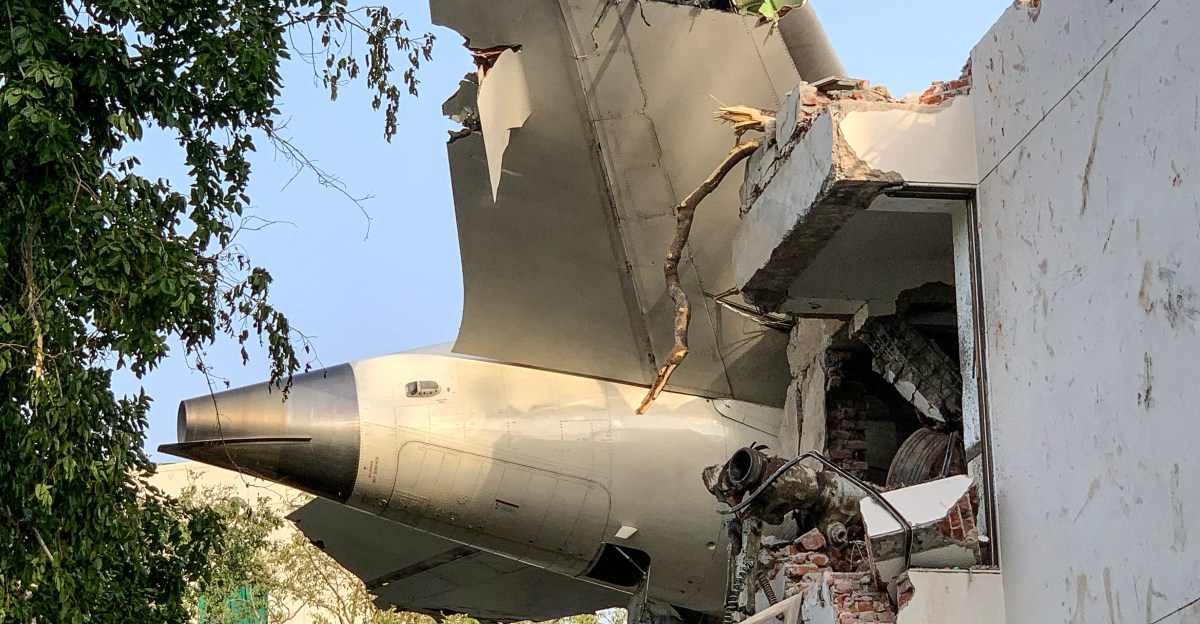
With 260 casualties and only one surviving passenger, the Air India 171 crash is one of the deadliest aviation incidents in recent history — and so far it’s proving to be one of the most frustratingly opaque.
Video of the June 12 incident had previously captured the Boeing 787 taking off successfully from Ahmedabad bound for London, only to rapidly descend, crash into a medical college complex, and explode into flames. The crash killed all but one of the plane’s 242 occupants. It also damaged five buildings, killed 19 people on the ground, and injured over 60 more.
The weeks that followed saw rampant speculation, AI-generated hoaxes, and conspiracy theories. Finally, on July 11 India’s air safety organization, the Aircraft Accident Investigation Bureau (AAIB), issued a preliminary report into the cause of the disaster. The 15-page report pinpointed a dark and disturbing factor as the reason for the crash: Shortly after takeoff, someone or something cut the flow of fuel to both engines, almost simultaneously. This caused a brief but fatal dual engine shutdown that proved impossible for the plane to recover from.
The implications of that double shutdown are quite bleak — but there’s still a lot we don’t know.
In the weeks following the tragedy, public speculation about the potential cause ranged from a bird strike to an electrical problem; some suggested fuel contamination, others a malfunction with the wing flaps. Many focused on what seemed to have been an extreme occurrence suggested by the visibility of the Ram Air Turbine (RAT), which deploys when there are engine problems: a total engine failure.
Over on YouTube, many analyzed the crash, including some pilots. Among them was Trevor Smith, call sign “Hoover,” a former military pilot who now flies for a commercial airline. On the side, he runs the YouTube crash analysis channel Pilot Debrief. Following the Air India crash, he emphasized what seemed to be the dual loss of thrust to both engines, and speculated that perhaps one engine had lost thrust for an unknown reason and that then one of the pilots had accidentally turned off the fuel control switch to the other engine, causing both to lose thrust.
Smith was hypothesizing a scenario in which at least one engine had been lost due to a mechanical failure, and an overwhelmed pilot mistakenly deactivated the other engine. The preliminary report, however, was more grim. It rejected all of those possibilities and instead pointed firmly toward a simple but unthinkable event: Both engines were shut down, first one and then the other, by way of the fuel control cutoff switch.
In most Boeing airplanes, the flow of fuel to the engines gets activated via two fuel control switches. In the Boeing 787, the jet fuel control switches sit in the main console of the aircraft just below the throttles (which are used to control thrust power). The fuel switches are not easy to engage by accident; they have a built-in spring-loaded locking mechanism that requires anyone using them to first pull up on the knobs, turn them slightly, and then maneuver them up or down into the position you want — a bit like a safety-proof lid on a pill bottle. Additionally, two raised metal guards on either side of the two switches protect against accidental bumping or jostling.
The console of a Boeing 787.Paige Vickers; Vox/Getty Images
There were no historical issues with the switches on this particular 787, and that section of the console had been refurbished as recently as 2023. Additionally, following the crash, other Air India Boeings were inspected, and no fuel switch issues were found with any of them. In a second inspection, Air India reportedly found no issues with the locking mechanisms on the switches either.
This crucial context underscores both the reliability of the switches — they were functioning normally with no problems — and the guardrails that were in place to protect against any associated mishaps. With the metal guards and the locking mechanisms, it would be all but impossible for an accident to knock both switches into the cutoff position, especially at the same time.
And yet what we know from the preliminary report is that the fuel cutoff switches were somehow switched from “run” to “cutoff” — from “on” to “off,” effectively. They were moved immediately after the airplane lifted off the ground and reached its maximum takeoff speed of 180 knots, or about 207 miles per hour. In a follow-up analysis video, Smith mapped out the timeline provided in the report, emphasizing that the two switches were turned off in quick succession, just a second apart — a short gap that makes sense, he noted, if someone were to move their hand from one switch to another.
Without a fuel supply, the engines immediately lost power. The RAT began supplying hydraulic power to the plane a few seconds after the fuel was cut off. A few seconds after this, one or both pilots realized what had happened. They placed the switches back into the correct position about nine seconds after they were moved. The engines began to restart, but by the time they had recovered, it was already too late.
Initial media reports claimed that whichever pilot made the mayday call to air traffic control had stated, “Thrust not achieved,” as the explanation for the call shortly before losing contact. However, the investigative report didn’t include this statement, and recordings from the cockpit have not been made public.
What we do know is that according to the preliminary report, “one of the pilots is heard asking the other why did he cut off [the fuel]. The other pilot responded that he did not do so.”
So was the cutoff done intentionally?
The preliminary report has drawn criticism for its vagueness, and for the lack of a direct transcript of the aforementioned moment from the cockpit recorder. The AAIB has also drawn fire for its decision not to issue any safety guidelines as a result of the early stages of its investigation. However, the report was clear that the investigation is ongoing, and multiple pilots associations have cautioned against speculating before all the facts are known.
Still, through its inclusion of the cockpit exchange, the preliminary report indicates that one pilot realized the switches had been manually moved and questioned the other pilot about it before moving the switches back into the “run” position. Given the virtual impossibility of an accidental dual cutoff, and the extreme unlikelihood of a dual engine shutdown being caused by any other issue, the pilot’s implied assumption in the moment that his colleague had manually moved the switches himself seems reasonable.
Following the report’s release, the Wall Street Journal reported that the investigation was intensifying its focus on the captain, 56-year-old Sumeet Sabharwal. As the pilot monitoring, Sabharwal would likely have had his hands free during the takeoff, while the first officer, Clive Kunder, 32, would have been busy actually flying the plane.
According to the Journal, the exchange referenced in the preliminary report involved Kunder querying Sabharwal about why the captain had moved the switches. In the following moments, Kunder “expressed surprise and then panicked” while Sabharwal “seemed to remain calm.”
Of course, without video of the moment, and without knowing more about the closely held details of the investigation thus far, it’s difficult to know what the situation in the cockpit truly was. It’s possible that Kunder’s panic and Sabharwal’s calm reflected nothing more than their respective level of career experience.
As Nathan Fielder’s The Rehearsal recently explored, the power imbalance in a cockpit between a senior and a younger or less experienced pilot can have a huge impact on the outcome of a plane mishap. Yet in this case, it seems likely that even in a balanced co-piloting dynamic, nothing could have helped an unwary pilot predict, prevent, or recover from the engine failure.
What do we know about the pilots and the airline?
Sabharwal was a true veteran pilot, with over 15,000 career flight hours, nearly half of them piloting the 787. As a younger pilot, Kunder had just 3,400 hours of flight time, but over 1,100 of them were on the 787.
It’s been widely reported that Sabharwal was planning to retire soon to care for his ailing father, who himself was a career aviation ministry official. In reporting after the crash, he has been universally described by friends and colleagues as extremely kind, gentle, reserved, and soft-spoken. Kunder came from a family of pilots, went to flight school in Florida, and reportedly chose piloting over a career in esports because he loved to fly.
Following the crash, the Telegraph quoted a source claiming that Sabharwal had struggled with depression and had taken mental health leave from the company. However, Air India’s parent company, the Tata Group, contradicted this, with a spokesperson clarifying to the Telegraph that Sabharwal’s last medical leave was a bereavement leave in 2022, and emphasizing that “the preliminary report did not find anything noteworthy” in his recent medical history.
If pilots don’t get therapy, they could endanger themselves and others while in the air. But if they do get therapy, the airline could ground them.
However, it could be very easy for mental health issues in pilots to go undetected and unreported. That’s because the strict scrutiny and restrictions placed upon commercial pilots in the wake of the 2015 Germanwings tragedy — in which a pilot locked his co-pilot out of the cockpit and deliberately crashed the plane, killing everyone on board — creates a dangerous catch-22 for pilots: If they don’t get thorough and regular mental health treatment, they could be endangering themselves and others when they’re in the air. But if they do get mental health treatment, the airline could ground them, perhaps permanently. For pilots who love flying, it’s a major risk assessment: Around 1,100 people have been killed because of plane crashes intentionally caused by pilots since 1982.
The tragedy comes at a pivotal moment for both Air India and Boeing, which have each been attempting to rebound from criticism.
Air India is one of the oldest and formerly one of the most influential airlines in the world, known for the opulence and exceptional artistic style it cultivated throughout the 20th century. After the company was nationalized in the 1950s, however, its once-sterling reputation significantly backslid, until it was finally re-privatized in 2022 and handed off to the Tata Group. The company’s attempts to revitalize the airline have included investing billions in readying the company for an expanded fleet and a reentry into the global market — an expansion that could be jeopardized because of the high-profile nature of the June crash. India’s civil aviation minister recently announced that the company has additionally received nine safety notices in the last six months.
Meanwhile Boeing continues to face criticism in the face of ongoing safety and maintenance concerns, and recently agreed to pay over $1 billion to avoid criminal prosecution over two plane crashes linked to faulty flight control systems that resulted in the deaths of 346 people. While there’s no indication yet that anything about the Air India crash was due to a defect in the plane, the optics won’t help the beleaguered airline.
Perhaps because the stakes are so high, multiple pilot organizations in India as well as a bevy of media commentators have resisted the preliminary report’s implication that one of the pilots caused the crash. The Airline Pilots Association of India as well as the Indian Commercial Pilots Association both released statements criticizing the preliminary report and objecting to any presumption of guilt. Others have suggested an undetected issue with the plane might be at fault, or that the AAIB, which issued the preliminary report, might have something to hide.
The full investigation into the crash is likely to take at least a year to complete, but given the vagaries of the information obtained from the cockpit, it’s uncertain whether we will ever know more than we currently do. Official aviation organizations have cautioned against a rush to judgment until the investigation is completed.
With 260 casualties and only one surviving passenger, the Air India 171 crash is one of the deadliest aviation incidents in recent history — and so far it’s proving to be one of the most frustratingly opaque.
Video of the June 12 incident had previously captured the Boeing 787 taking off successfully from Ahmedabad bound for London, only to rapidly descend, crash into a medical college complex, and explode into flames. The crash killed all but one of the plane’s 242 occupants. It also damaged five buildings, killed 19 people on the ground, and injured over 60 more.
The weeks that followed saw rampant speculation, AI-generated hoaxes, and conspiracy theories. Finally, on July 11 India’s air safety organization, the Aircraft Accident Investigation Bureau (AAIB), issued a preliminary report into the cause of the disaster. The 15-page report pinpointed a dark and disturbing factor as the reason for the crash: Shortly after takeoff, someone or something cut the flow of fuel to both engines, almost simultaneously. This caused a brief but fatal dual engine shutdown that proved impossible for the plane to recover from.
The implications of that double shutdown are quite bleak — but there’s still a lot we don’t know.
In the weeks following the tragedy, public speculation about the potential cause ranged from a bird strike to an electrical problem; some suggested fuel contamination, others a malfunction with the wing flaps. Many focused on what seemed to have been an extreme occurrence suggested by the visibility of the Ram Air Turbine (RAT), which deploys when there are engine problems: a total engine failure.
Over on YouTube, many analyzed the crash, including some pilots. Among them was Trevor Smith, call sign “Hoover,” a former military pilot who now flies for a commercial airline. On the side, he runs the YouTube crash analysis channel Pilot Debrief. Following the Air India crash, he emphasized what seemed to be the dual loss of thrust to both engines, and speculated that perhaps one engine had lost thrust for an unknown reason and that then one of the pilots had accidentally turned off the fuel control switch to the other engine, causing both to lose thrust.
Smith was hypothesizing a scenario in which at least one engine had been lost due to a mechanical failure, and an overwhelmed pilot mistakenly deactivated the other engine. The preliminary report, however, was more grim. It rejected all of those possibilities and instead pointed firmly toward a simple but unthinkable event: Both engines were shut down, first one and then the other, by way of the fuel control cutoff switch.
In most Boeing airplanes, the flow of fuel to the engines gets activated via two fuel control switches. In the Boeing 787, the jet fuel control switches sit in the main console of the aircraft just below the throttles (which are used to control thrust power). The fuel switches are not easy to engage by accident; they have a built-in spring-loaded locking mechanism that requires anyone using them to first pull up on the knobs, turn them slightly, and then maneuver them up or down into the position you want — a bit like a safety-proof lid on a pill bottle. Additionally, two raised metal guards on either side of the two switches protect against accidental bumping or jostling.
The console of a Boeing 787.Paige Vickers; Vox/Getty Images
There were no historical issues with the switches on this particular 787, and that section of the console had been refurbished as recently as 2023. Additionally, following the crash, other Air India Boeings were inspected, and no fuel switch issues were found with any of them. In a second inspection, Air India reportedly found no issues with the locking mechanisms on the switches either.
This crucial context underscores both the reliability of the switches — they were functioning normally with no problems — and the guardrails that were in place to protect against any associated mishaps. With the metal guards and the locking mechanisms, it would be all but impossible for an accident to knock both switches into the cutoff position, especially at the same time.
And yet what we know from the preliminary report is that the fuel cutoff switches were somehow switched from “run” to “cutoff” — from “on” to “off,” effectively. They were moved immediately after the airplane lifted off the ground and reached its maximum takeoff speed of 180 knots, or about 207 miles per hour. In a follow-up analysis video, Smith mapped out the timeline provided in the report, emphasizing that the two switches were turned off in quick succession, just a second apart — a short gap that makes sense, he noted, if someone were to move their hand from one switch to another.
Without a fuel supply, the engines immediately lost power. The RAT began supplying hydraulic power to the plane a few seconds after the fuel was cut off. A few seconds after this, one or both pilots realized what had happened. They placed the switches back into the correct position about nine seconds after they were moved. The engines began to restart, but by the time they had recovered, it was already too late.
Initial media reports claimed that whichever pilot made the mayday call to air traffic control had stated, “Thrust not achieved,” as the explanation for the call shortly before losing contact. However, the investigative report didn’t include this statement, and recordings from the cockpit have not been made public.
What we do know is that according to the preliminary report, “one of the pilots is heard asking the other why did he cut off [the fuel]. The other pilot responded that he did not do so.”
So was the cutoff done intentionally?
The preliminary report has drawn criticism for its vagueness, and for the lack of a direct transcript of the aforementioned moment from the cockpit recorder. The AAIB has also drawn fire for its decision not to issue any safety guidelines as a result of the early stages of its investigation. However, the report was clear that the investigation is ongoing, and multiple pilots associations have cautioned against speculating before all the facts are known.
Still, through its inclusion of the cockpit exchange, the preliminary report indicates that one pilot realized the switches had been manually moved and questioned the other pilot about it before moving the switches back into the “run” position. Given the virtual impossibility of an accidental dual cutoff, and the extreme unlikelihood of a dual engine shutdown being caused by any other issue, the pilot’s implied assumption in the moment that his colleague had manually moved the switches himself seems reasonable.
Following the report’s release, the Wall Street Journal reported that the investigation was intensifying its focus on the captain, 56-year-old Sumeet Sabharwal. As the pilot monitoring, Sabharwal would likely have had his hands free during the takeoff, while the first officer, Clive Kunder, 32, would have been busy actually flying the plane.
According to the Journal, the exchange referenced in the preliminary report involved Kunder querying Sabharwal about why the captain had moved the switches. In the following moments, Kunder “expressed surprise and then panicked” while Sabharwal “seemed to remain calm.”
Of course, without video of the moment, and without knowing more about the closely held details of the investigation thus far, it’s difficult to know what the situation in the cockpit truly was. It’s possible that Kunder’s panic and Sabharwal’s calm reflected nothing more than their respective level of career experience.
As Nathan Fielder’s The Rehearsal recently explored, the power imbalance in a cockpit between a senior and a younger or less experienced pilot can have a huge impact on the outcome of a plane mishap. Yet in this case, it seems likely that even in a balanced co-piloting dynamic, nothing could have helped an unwary pilot predict, prevent, or recover from the engine failure.
What do we know about the pilots and the airline?
Sabharwal was a true veteran pilot, with over 15,000 career flight hours, nearly half of them piloting the 787. As a younger pilot, Kunder had just 3,400 hours of flight time, but over 1,100 of them were on the 787.
It’s been widely reported that Sabharwal was planning to retire soon to care for his ailing father, who himself was a career aviation ministry official. In reporting after the crash, he has been universally described by friends and colleagues as extremely kind, gentle, reserved, and soft-spoken. Kunder came from a family of pilots, went to flight school in Florida, and reportedly chose piloting over a career in esports because he loved to fly.
Following the crash, the Telegraph quoted a source claiming that Sabharwal had struggled with depression and had taken mental health leave from the company. However, Air India’s parent company, the Tata Group, contradicted this, with a spokesperson clarifying to the Telegraph that Sabharwal’s last medical leave was a bereavement leave in 2022, and emphasizing that “the preliminary report did not find anything noteworthy” in his recent medical history.
If pilots don’t get therapy, they could endanger themselves and others while in the air. But if they do get therapy, the airline could ground them.
However, it could be very easy for mental health issues in pilots to go undetected and unreported. That’s because the strict scrutiny and restrictions placed upon commercial pilots in the wake of the 2015 Germanwings tragedy — in which a pilot locked his co-pilot out of the cockpit and deliberately crashed the plane, killing everyone on board — creates a dangerous catch-22 for pilots: If they don’t get thorough and regular mental health treatment, they could be endangering themselves and others when they’re in the air. But if they do get mental health treatment, the airline could ground them, perhaps permanently. For pilots who love flying, it’s a major risk assessment: Around 1,100 people have been killed because of plane crashes intentionally caused by pilots since 1982.
The tragedy comes at a pivotal moment for both Air India and Boeing, which have each been attempting to rebound from criticism.
Air India is one of the oldest and formerly one of the most influential airlines in the world, known for the opulence and exceptional artistic style it cultivated throughout the 20th century. After the company was nationalized in the 1950s, however, its once-sterling reputation significantly backslid, until it was finally re-privatized in 2022 and handed off to the Tata Group. The company’s attempts to revitalize the airline have included investing billions in readying the company for an expanded fleet and a reentry into the global market — an expansion that could be jeopardized because of the high-profile nature of the June crash. India’s civil aviation minister recently announced that the company has additionally received nine safety notices in the last six months.
Meanwhile Boeing continues to face criticism in the face of ongoing safety and maintenance concerns, and recently agreed to pay over $1 billion to avoid criminal prosecution over two plane crashes linked to faulty flight control systems that resulted in the deaths of 346 people. While there’s no indication yet that anything about the Air India crash was due to a defect in the plane, the optics won’t help the beleaguered airline.
Perhaps because the stakes are so high, multiple pilot organizations in India as well as a bevy of media commentators have resisted the preliminary report’s implication that one of the pilots caused the crash. The Airline Pilots Association of India as well as the Indian Commercial Pilots Association both released statements criticizing the preliminary report and objecting to any presumption of guilt. Others have suggested an undetected issue with the plane might be at fault, or that the AAIB, which issued the preliminary report, might have something to hide.
The full investigation into the crash is likely to take at least a year to complete, but given the vagaries of the information obtained from the cockpit, it’s uncertain whether we will ever know more than we currently do. Official aviation organizations have cautioned against a rush to judgment until the investigation is completed.
With 260 casualties and only one surviving passenger, the Air India 171 crash is one of the deadliest aviation incidents in recent history — and so far it’s proving to be one of the most frustratingly opaque.
Video of the June 12 incident had previously captured the Boeing 787 taking off successfully from Ahmedabad bound for London, only to rapidly descend, crash into a medical college complex, and explode into flames. The crash killed all but one of the plane’s 242 occupants. It also damaged five buildings, killed 19 people on the ground, and injured over 60 more.
The weeks that followed saw rampant speculation, AI-generated hoaxes, and conspiracy theories. Finally, on July 11 India’s air safety organization, the Aircraft Accident Investigation Bureau (AAIB), issued a preliminary report into the cause of the disaster. The 15-page report pinpointed a dark and disturbing factor as the reason for the crash: Shortly after takeoff, someone or something cut the flow of fuel to both engines, almost simultaneously. This caused a brief but fatal dual engine shutdown that proved impossible for the plane to recover from.
The implications of that double shutdown are quite bleak — but there’s still a lot we don’t know.
In the weeks following the tragedy, public speculation about the potential cause ranged from a bird strike to an electrical problem; some suggested fuel contamination, others a malfunction with the wing flaps. Many focused on what seemed to have been an extreme occurrence suggested by the visibility of the Ram Air Turbine (RAT), which deploys when there are engine problems: a total engine failure.
Over on YouTube, many analyzed the crash, including some pilots. Among them was Trevor Smith, call sign “Hoover,” a former military pilot who now flies for a commercial airline. On the side, he runs the YouTube crash analysis channel Pilot Debrief. Following the Air India crash, he emphasized what seemed to be the dual loss of thrust to both engines, and speculated that perhaps one engine had lost thrust for an unknown reason and that then one of the pilots had accidentally turned off the fuel control switch to the other engine, causing both to lose thrust.
Smith was hypothesizing a scenario in which at least one engine had been lost due to a mechanical failure, and an overwhelmed pilot mistakenly deactivated the other engine. The preliminary report, however, was more grim. It rejected all of those possibilities and instead pointed firmly toward a simple but unthinkable event: Both engines were shut down, first one and then the other, by way of the fuel control cutoff switch.
In most Boeing airplanes, the flow of fuel to the engines gets activated via two fuel control switches. In the Boeing 787, the jet fuel control switches sit in the main console of the aircraft just below the throttles (which are used to control thrust power). The fuel switches are not easy to engage by accident; they have a built-in spring-loaded locking mechanism that requires anyone using them to first pull up on the knobs, turn them slightly, and then maneuver them up or down into the position you want — a bit like a safety-proof lid on a pill bottle. Additionally, two raised metal guards on either side of the two switches protect against accidental bumping or jostling.
The console of a Boeing 787.Paige Vickers; Vox/Getty Images
There were no historical issues with the switches on this particular 787, and that section of the console had been refurbished as recently as 2023. Additionally, following the crash, other Air India Boeings were inspected, and no fuel switch issues were found with any of them. In a second inspection, Air India reportedly found no issues with the locking mechanisms on the switches either.
This crucial context underscores both the reliability of the switches — they were functioning normally with no problems — and the guardrails that were in place to protect against any associated mishaps. With the metal guards and the locking mechanisms, it would be all but impossible for an accident to knock both switches into the cutoff position, especially at the same time.
And yet what we know from the preliminary report is that the fuel cutoff switches were somehow switched from “run” to “cutoff” — from “on” to “off,” effectively. They were moved immediately after the airplane lifted off the ground and reached its maximum takeoff speed of 180 knots, or about 207 miles per hour. In a follow-up analysis video, Smith mapped out the timeline provided in the report, emphasizing that the two switches were turned off in quick succession, just a second apart — a short gap that makes sense, he noted, if someone were to move their hand from one switch to another.
Without a fuel supply, the engines immediately lost power. The RAT began supplying hydraulic power to the plane a few seconds after the fuel was cut off. A few seconds after this, one or both pilots realized what had happened. They placed the switches back into the correct position about nine seconds after they were moved. The engines began to restart, but by the time they had recovered, it was already too late.
Initial media reports claimed that whichever pilot made the mayday call to air traffic control had stated, “Thrust not achieved,” as the explanation for the call shortly before losing contact. However, the investigative report didn’t include this statement, and recordings from the cockpit have not been made public.
What we do know is that according to the preliminary report, “one of the pilots is heard asking the other why did he cut off [the fuel]. The other pilot responded that he did not do so.”
So was the cutoff done intentionally?
The preliminary report has drawn criticism for its vagueness, and for the lack of a direct transcript of the aforementioned moment from the cockpit recorder. The AAIB has also drawn fire for its decision not to issue any safety guidelines as a result of the early stages of its investigation. However, the report was clear that the investigation is ongoing, and multiple pilots associations have cautioned against speculating before all the facts are known.
Still, through its inclusion of the cockpit exchange, the preliminary report indicates that one pilot realized the switches had been manually moved and questioned the other pilot about it before moving the switches back into the “run” position. Given the virtual impossibility of an accidental dual cutoff, and the extreme unlikelihood of a dual engine shutdown being caused by any other issue, the pilot’s implied assumption in the moment that his colleague had manually moved the switches himself seems reasonable.
Following the report’s release, the Wall Street Journal reported that the investigation was intensifying its focus on the captain, 56-year-old Sumeet Sabharwal. As the pilot monitoring, Sabharwal would likely have had his hands free during the takeoff, while the first officer, Clive Kunder, 32, would have been busy actually flying the plane.
According to the Journal, the exchange referenced in the preliminary report involved Kunder querying Sabharwal about why the captain had moved the switches. In the following moments, Kunder “expressed surprise and then panicked” while Sabharwal “seemed to remain calm.”
Of course, without video of the moment, and without knowing more about the closely held details of the investigation thus far, it’s difficult to know what the situation in the cockpit truly was. It’s possible that Kunder’s panic and Sabharwal’s calm reflected nothing more than their respective level of career experience.
As Nathan Fielder’s The Rehearsal recently explored, the power imbalance in a cockpit between a senior and a younger or less experienced pilot can have a huge impact on the outcome of a plane mishap. Yet in this case, it seems likely that even in a balanced co-piloting dynamic, nothing could have helped an unwary pilot predict, prevent, or recover from the engine failure.
What do we know about the pilots and the airline?
Sabharwal was a true veteran pilot, with over 15,000 career flight hours, nearly half of them piloting the 787. As a younger pilot, Kunder had just 3,400 hours of flight time, but over 1,100 of them were on the 787.
It’s been widely reported that Sabharwal was planning to retire soon to care for his ailing father, who himself was a career aviation ministry official. In reporting after the crash, he has been universally described by friends and colleagues as extremely kind, gentle, reserved, and soft-spoken. Kunder came from a family of pilots, went to flight school in Florida, and reportedly chose piloting over a career in esports because he loved to fly.
Following the crash, the Telegraph quoted a source claiming that Sabharwal had struggled with depression and had taken mental health leave from the company. However, Air India’s parent company, the Tata Group, contradicted this, with a spokesperson clarifying to the Telegraph that Sabharwal’s last medical leave was a bereavement leave in 2022, and emphasizing that “the preliminary report did not find anything noteworthy” in his recent medical history.
If pilots don’t get therapy, they could endanger themselves and others while in the air. But if they do get therapy, the airline could ground them.
However, it could be very easy for mental health issues in pilots to go undetected and unreported. That’s because the strict scrutiny and restrictions placed upon commercial pilots in the wake of the 2015 Germanwings tragedy — in which a pilot locked his co-pilot out of the cockpit and deliberately crashed the plane, killing everyone on board — creates a dangerous catch-22 for pilots: If they don’t get thorough and regular mental health treatment, they could be endangering themselves and others when they’re in the air. But if they do get mental health treatment, the airline could ground them, perhaps permanently. For pilots who love flying, it’s a major risk assessment: Around 1,100 people have been killed because of plane crashes intentionally caused by pilots since 1982.
The tragedy comes at a pivotal moment for both Air India and Boeing, which have each been attempting to rebound from criticism.
Air India is one of the oldest and formerly one of the most influential airlines in the world, known for the opulence and exceptional artistic style it cultivated throughout the 20th century. After the company was nationalized in the 1950s, however, its once-sterling reputation significantly backslid, until it was finally re-privatized in 2022 and handed off to the Tata Group. The company’s attempts to revitalize the airline have included investing billions in readying the company for an expanded fleet and a reentry into the global market — an expansion that could be jeopardized because of the high-profile nature of the June crash. India’s civil aviation minister recently announced that the company has additionally received nine safety notices in the last six months.
Meanwhile Boeing continues to face criticism in the face of ongoing safety and maintenance concerns, and recently agreed to pay over $1 billion to avoid criminal prosecution over two plane crashes linked to faulty flight control systems that resulted in the deaths of 346 people. While there’s no indication yet that anything about the Air India crash was due to a defect in the plane, the optics won’t help the beleaguered airline.
Perhaps because the stakes are so high, multiple pilot organizations in India as well as a bevy of media commentators have resisted the preliminary report’s implication that one of the pilots caused the crash. The Airline Pilots Association of India as well as the Indian Commercial Pilots Association both released statements criticizing the preliminary report and objecting to any presumption of guilt. Others have suggested an undetected issue with the plane might be at fault, or that the AAIB, which issued the preliminary report, might have something to hide.
The full investigation into the crash is likely to take at least a year to complete, but given the vagaries of the information obtained from the cockpit, it’s uncertain whether we will ever know more than we currently do. Official aviation organizations have cautioned against a rush to judgment until the investigation is completed.
Israeli strikes in Gaza killed at least 21 people late Tuesday and early Wednesday, health officials said, as hunger worsened among Palestinians struggling to live under the weight of the 21-month war.
Desperation is mounting in the Palestinian territory of more than 2 million. An official familiar with the negotiations said Wednesday that special envoy Steve Witkoff planned to head to Rome for talks with an Israeli official as the U.S. tries to reach a ceasefire deal between Israel and Hamas.
More than 1,000 Palestinians have been killed by Israeli forces since May while trying to get food in the Gaza Strip, mostly near aid sites run by an American contractor, the U.N. human rights office said Tuesday.
Smokes rises after an explosion during Israeli air and ground operations in the Gaza Strip as seen from southern Israel, Tuesday, July 22, 2025. (AP Photo/Leo Correa)
Smokes rises after an explosion during Israeli air and ground operations in the Gaza Strip as seen from southern Israel, Tuesday, July 22, 2025. (AP Photo/Leo Correa)
More than 100 human rights groups and charities signed a letter published Wednesday demanding more aid for Gaza and warning of starvation.
More than 59,000 Palestinians have been killed during the Israel-Hamas war, according to Gaza’s Health Ministry, which is part of the Hamas-run government and staffed by medical professionals. Its count doesn’t distinguish between militants and civilians, but the ministry says that more than half of the dead are women and children. The U.N. and other international organizations see it as the most reliable source of data on casualties.
Here is the latest:
WHO warns Gaza nears starvation as malnutrition spikes
The head of the World Health Organization warned that over 2 million people in Gaza face starvation, citing a “deadly surge” in malnutrition and related diseases.
WHO Director-General Tedros Adhanom Ghebreyesus said acute malnutrition centers in Gaza are full of patients, but lack adequate supplies. He said that rates of acute malnutrition exceed 10% and that among pregnant and breastfeeding women, more than 20% are malnourished, often severely.
“The hunger crisis is being accelerated by the collapse of aid pipelines,” Tedros said, adding that 95% of households in Gaza face severe water shortages.
Dr. Rik Peeperkorn, the WHO representative for Occupied Palestinian Territories, said there were more than 30,000 children under 5 with acute malnutrition in Gaza so far this year, and that there had been 21 deaths. He noted that many of the U.N. health agency’s supplies were destroyed after its main warehouse was destroyed during attacks in Deir al-Balah on Sunday.
Israel rejects Gaza starvation warning from rights groups
Israel’s Foreign Ministry accused the groups of “echoing Hamas’ propaganda.” It said it has allowed around 4,500 aid trucks to enter Gaza since lifting a complete blockade in May, and that more than 700 are waiting to be picked up and distributed by the United Nations.
That’s an average of around 70 trucks a day, the lowest rate of the war and far below the 500-600 trucks a day the U.N. says are needed, and which entered during a six-week ceasefire earlier this year.
The U.N. says it has struggled to deliver aid inside Gaza because of Israeli military restrictions, ongoing fighting, and a breakdown of law and order.
In the letter issued Wednesday, 115 human rights and charity groups said they were watching their own colleagues, as well as the Palestinians they serve, “waste away.”
Top adviser to Netanyahu will meet US envoy in Rome
An official familiar with ceasefire negotiations between Israel and Hamas said a top adviser to Israeli Prime Minister Benjamin Netanyahu, Ron Dermer, was traveling to Rome to meet U.S. special envoy Steve Witkoff on Thursday to discuss the state of the talks.
The official spoke Wednesday on condition of anonymity because they were not authorized to discuss the sensitive negotiations.
U.S. officials said Witkoff planned to head to Europe this week. The U.S. State Department spokesperson said he was headed to the Middle East in a sign that momentum may be building toward a deal.
— By Tia Goldenberg in Tel Aviv, Israel
Israeli military says Gaza church was struck accidentally
The Holy Family Church in Gaza City was struck last week by an Israeli shell, an attack that killed three, wounded 10 and damaged the church’s compound.
The military said an internal inquiry found the church was hit after an “unintentional deviation of munitions.”
The strike drew condemnation from Pope Leo XIV and U.S. President Donald Trump, and prompted statements of regret from Israel.
Holy Family is the only Catholic church in Gaza. Top church leaders from the Holy Land visited the site a day after the incident and said they encountered a Gaza “almost totally destroyed.”
Human Rights Watch says Houthi attacks on Red Sea vessels amount to war crimes
The Iranian-backed Houthi rebels in Yemen attacked two ships, the Magic Seas and the Eternity C, on July 6 and 9, killing some of their crew and detaining others, Human Rights Watch said in a statement.
The rebels have been launching missile and drone attacks against commercial and military ships in the region in what the group’s leadership has described as an effort to end Israel’s offensive against Hamas in the Gaza Strip.
HRW, however, said the Houthis’ attacks on the two vessels “violates the laws of war applicable to the armed conflict between the Houthis and Israel.”
“The Houthis have sought to justify unlawful attacks by pointing to Israeli violations against Palestinians,” said Niku Jafarnia, HRW’s Yemen and Bahrain researcher.
Jafarnia called for the rebels to end all attacks on ships that don’t take part in the Israeli-Hamas war and immediately release detained crew members.
Israel extends detention of senior Gaza health official
Dr. Marwan al-Hams, acting director of Gaza’s field hospitals and the health ministry’s spokesman, was detained by Israeli troops earlier this week in the Palestinian territory.
Alaa al-Sakafi, head of Addameer, a Palestinian rights group, told The Associated Press Wednesday that lawyers have not been allowed to see al-Hams. His detention in a southern Israel prison was extended until the end of the month, al-Sakafi said.
He said al-Hams suffered from a gunshot wound in his leg, which he sustained during his detention in Gaza’s southern city of Rafah on Monday.
Israel has not commented on al-Hams’ detention.
Israeli forces ‘deepening’ activity in Gaza City, military says
The Israeli military said in a statement Wednesday that forces were operating in Gaza City, as well as in northern Gaza.
It said without elaborating that in Jabaliya, an area hard-hit in multiple rounds of fighting, an air strike killed “a number of” Hamas militants.
Troops struck roughly 120 targets throughout Gaza over the past day, including militant cells, tunnels and booby-trapped structures, among others, the military said.
Overnight strikes kill at least 21
More than half of those killed were women and children, health authorities said.
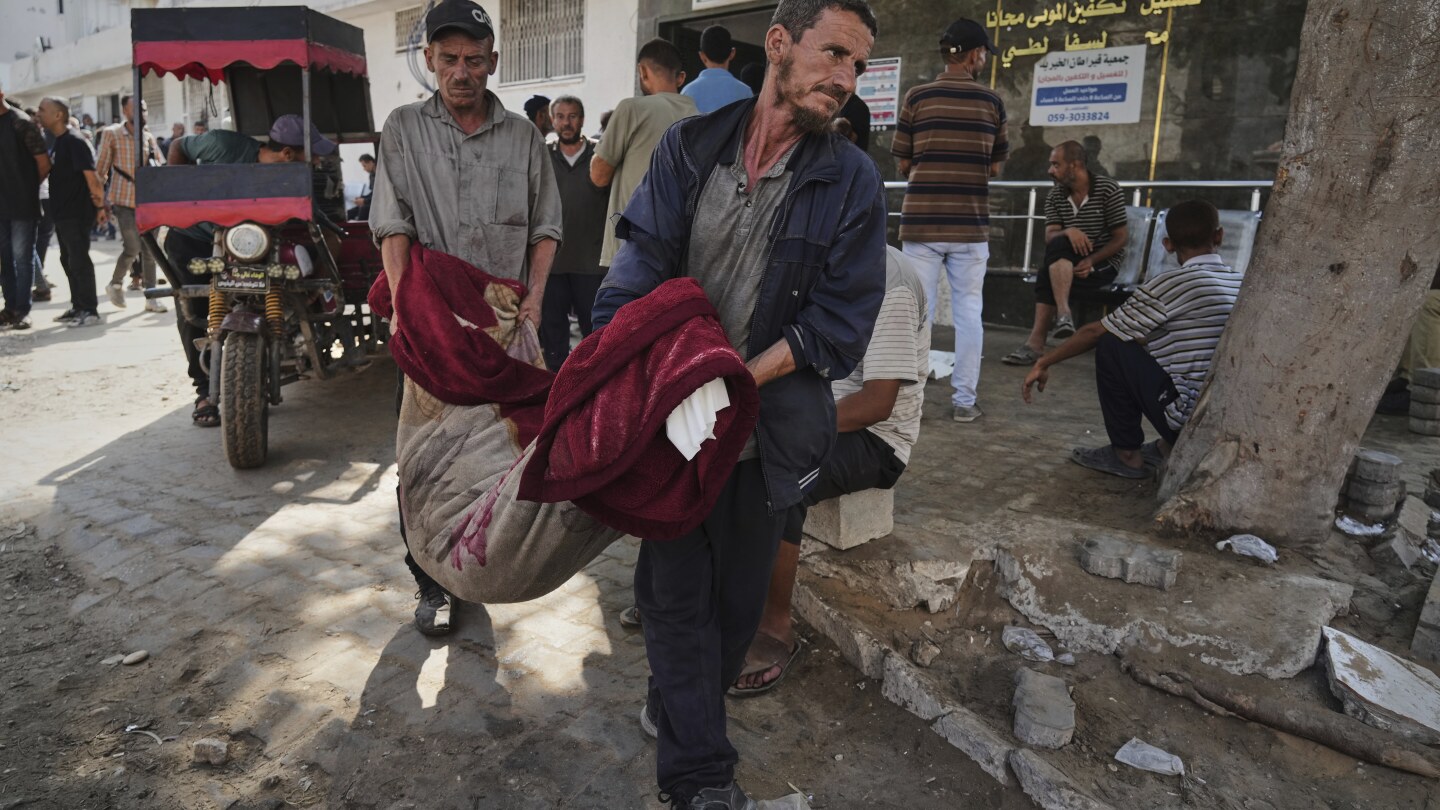
One Israeli strike hit a house Tuesday in the northwestern side of Gaza City, killing at least 12 people, according to the Shifa Hospital, which received the casualties.
The dead included six children and two women, according to the Health Ministry’s casualty list.
Another strike hit an apartment in the Tal al-Hawa area in northern Gaza, killing at least six people. Among the dead were three children and two women, including one who was pregnant. Eight others were wounded, the ministry said.
Palestinians mourn their relatives killed from an Israeli army bombardment of Gaza, at Shifa Hospital in Gaza City Tuesday, July 22, 2025. (AP Photo/Jehad Alshrafi)
Palestinians mourn their relatives killed from an Israeli army bombardment of Gaza, at Shifa Hospital in Gaza City Tuesday, July 22, 2025. (AP Photo/Jehad Alshrafi)
A third strike hit a tent in the Naser neighborhood in Gaza City late Tuesday and killed three children, Shifa Hospital said.
The Israeli military said it struck an Islamic Jihad militant in the strike that killed 12, saying the incident was under review because of reports of civilian casualties. It had no immediate comment about the other strikes.
Israel blames Hamas for civilian casualties because the militants operate from populated areas.
Human rights groups and charities demand more Gaza aid
In the letter issued Wednesday, 115 human rights and charity groups warned of a dire situation pushing more people toward starvation. They said they were watching their own colleagues, as well as the Palestinians they serve, “waste away.”
The letter slammed Israel for what it said were restrictions on aid into the war-ravaged territory. It lamented “massacres” at food distribution points, which have seen chaos and violence in recent weeks as desperation has risen.
“The government of Israel’s restrictions, delays, and fragmentation under its total siege have created chaos, starvation, and death,” the letter said.
The letter called for aid to be scaled up as well as for a ceasefire. `
Israel says that it has allowed the entry of thousands of trucks since May and blames aid groups for not consistently delivering goods.