Blog

  • Church leaders return with ‘broken hearts’ after rare Gaza visit

    Church leaders return with ‘broken hearts’ after rare Gaza visit


    Yolande Knell

    Middle East correspondent, Jerusalem

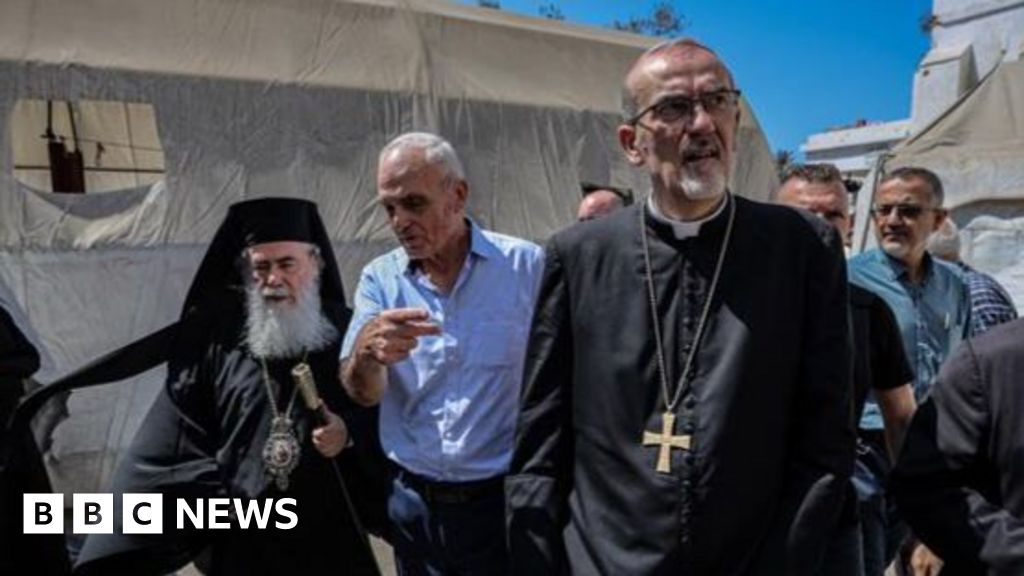
    Getty Images Jerusalem Greek Orthodox Patriarch Theophilos III and Jerusalem Latin Patriarch Cardinal Pierbattista Pizzaballa visit the Holy Family Church, in Gaza CityGetty Images

    Greek Orthodox Patriarch Theophilos III (left) and Latin Patriarch Cardinal Pierbattista Pizzaballa (centre) visited Gaza for four days

    Church leaders in Jerusalem say they have returned from a trip to Gaza with “broken hearts”, describing starving people and children not “batting an eyelid” at the sound of bombing.

    “We have seen men holding out in the sun for hours in the hope of simple meal,” the Latin Patriarch, Cardinal Pierbattista Pizzaballa, told journalists.

    “This is humiliation that is hard to bear when you see it with you own eyes. It is morally unacceptable and unjustifiable.”

    The Greek Orthodox Patriarch, Theophilos III, said his Church would “stand in solidarity” with “the whole people of Gaza”.

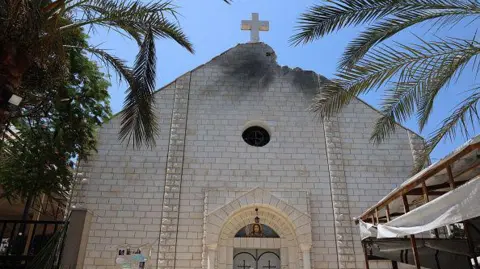
    The two men made a rare visit to the war-torn strip after Israeli fire hit the Catholic Holy Family Church in Gaza City last week, killing two women and a man.

    US President Donald Trump is said to have made an angry call to Israel’s Prime Minister Benjamin Netanyahu about the deadly strike, which came days after an alleged attack by extremist Israeli settlers next to the ruins of an ancient church in the Christian village of Taybeh in the occupied West Bank.

    Netanyahu’s office expressed deep regret for what was described as “a stray ammunition” hitting the Gaza church.

    However, local Christians have questioned whether the place of worship was deliberately targeted. About 400 people have been sheltering in the compound, which is in part of Gaza City now under Israeli evacuation orders.

    Getty Images The façade of the Holy Family Church is damaged after it was hit in an Israeli strikeGetty Images

    The roof of the Holy Family Church was hit by an Israeli shell last week

    At the news conference, Pizzaballa noted that Christians were suffering in the same ways as other Palestinians.

    “Three people died in our community, but thousands already died in Gaza,” he said.

    He added that recent settler violence in Taybeh, was part of “broader phenomenon” in the West Bank which was “becoming a no-law land”.

    Although Italy’s foreign ministry announced that the patriarchs had entered Gaza with 500 tonnes of aid, Pizzaballa said “not a gram” had yet been able to enter due to logistical issues.

    He described the disappointment of those who came to the church hoping for handouts.

    Amid some of the most severe food shortages in 21 months of war, Pizzaballa and Theophilos III said they met people “totally starved” and gave an account of the widespread destruction.

    “We walked through the dust of ruins, past collapsed buildings and tents everywhere: in courtyards, alleyways, on the streets and on the beach,” Pizzaballa said at the end of his four-day visit. “Tents that have become homes for those who have lost everything.”

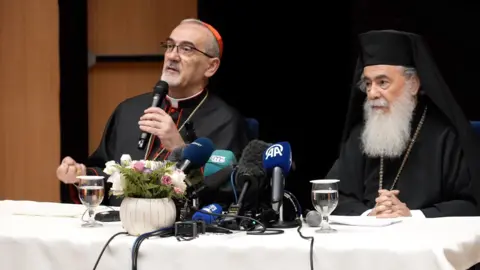
    Jimmy Michael / BBC Speaking in front of microphones on top of a white table the Latin Patriarch Cardinal Pierbattista Pizzaballa and Greek Orthodox Patriarch Theophilos III address reporters in Jerusalem on 22 July 2025Jimmy Michael / BBC

    Pizzaballa and Theophilos III addressed reporters in Jerusalem after visiting Gaza

    Last week, the two Church leaders led a delegation of foreign diplomats to Taybeh, north of Ramallah, where residents and local priests described several attacks by settlers.

    The most serious was the fire stared next to the ruins of the Byzantine Church of St George.

    An Israeli police statement said on Tuesday that a special investigative unit had found that “contrary to misleading reports, no damage was caused” to the church. It said the fire was limited to an adjacent open area and that arson was not yet confirmed.

    However, one witness told the BBC that he saw settlers starting the blaze and others accused Israeli security forces of failing to respond to their complaints.

    Villagers say extremists have seized their plots on the edge of Taybeh and regularly harass them, bringing cattle to eat their olive trees.

    “What’s going on is really ridiculous and it’s driving people out as Israelis put their hands on our land,” a former mayor and co-founder of the Taybeh brewery, Daoud Khoury, told the BBC.

    He said he worried that extremist settlers and an economic downturn since the start of the Gaza war would force more Christians to emigrate.

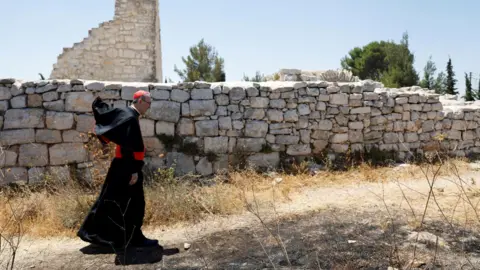
    Reuters Latin Patriarch Cardinal Pierbattista Pizzaballa stands next to burnt land following an alleged Israeli settler arson attack in the Christian village of Taybeh, in the occupied West Bank (14 July 2025)Reuters

    Pizzaballa and Theophilos III also visited Taybeh after the fire next to the ruins of an ancient church

    In an unusual move, the US ambassador to Israel, Mike Huckabee, also visited Taybeh on Saturday.

    In a statement, he then denounced the attack near the church as “an act of terror” and demanded “harsh consequences” for those responsible.

    Huckabee, who is also an evangelical pastor known for his past strong statements supporting Jewish settlements, which are seen as illegal under international law, wrote on X. “Desecrating a church, mosque or synagogue is a crime against humanity and God.”

    In response to the Israeli police statement, he wrote that he had not attributed the fire to any group, that “regardless, it was crime and deserves consequences”.

    At the Jerusalem press conference, Theophilos III said that the tiny Christian community must be supported to remain in Gaza, close to their holy places “full of history”.

    During his trip, Pizzaballa told an Italian newspaper that a Catholic presence would stay in the territory “whatever happens”.

    The two leaders reiterated calls by Pope Leo and a growing number of international leaders for a Gaza ceasefire and the release of remaining hostages held by Hamas.

    “We are not against Israel,” said Pizzaballa, who is known as a supporter of interfaith dialogue. “But we need to say with frankness and clarity, that this policy of the Israeli government in Gaza is unacceptable and morally we cannot justify it.”


    Source link

  • France’s AFP calls on Israel to let hungry journalists out of Gaza : NPR

    France’s AFP calls on Israel to let hungry journalists out of Gaza : NPR


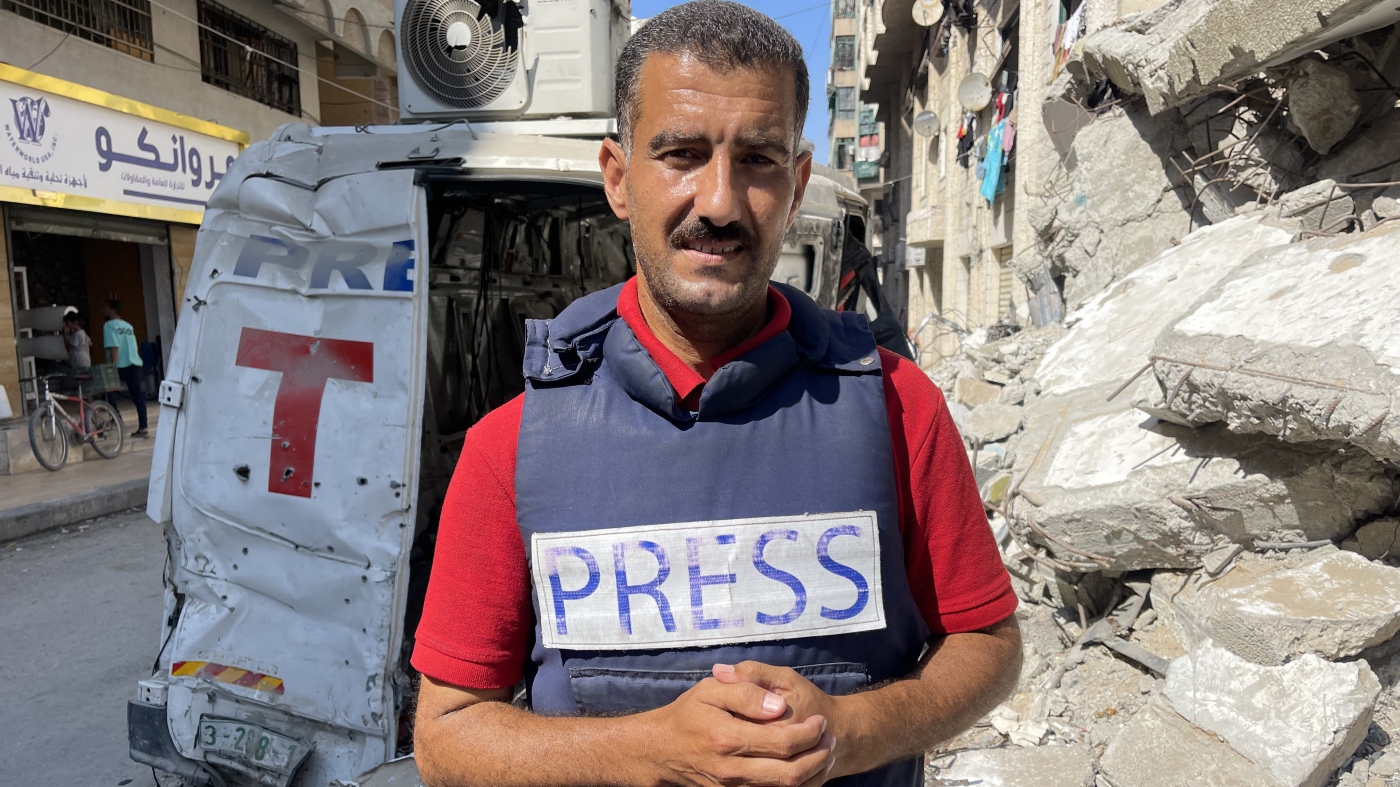
    AFP journalist Khader Zaanoun poses for a picture in Gaza City on Tuesday. AFP journalists in the Gaza Strip say chronic food shortages are affecting their ability to cover Israel's conflict with Hamas militants.

    AFP journalist Khader Zaanoun poses for a picture in Gaza City on Tuesday. AFP journalists in the Gaza Strip say chronic food shortages are affecting their ability to cover Israel’s conflict with Hamas militants.

    AFP/Getty Images


    hide caption

    toggle caption

    AFP/Getty Images

    French news agency Agence France-Presse is calling on the Israeli government to allow its freelance journalists to leave the Gaza Strip because of a worsening hunger crisis there.

    “They’re spending so much time and energy trying to source food and also just they just feel so weak,” Phil Chetwynd, AFP’s global news director, told NPR’s Morning Edition on Tuesday about the situation for reporters and photographers the agency works with in Gaza. “They talk about constant headaches, constant dizziness. So just the ability physically to, you know, get to a story is diminished.”

    Chetwynd was speaking a day after the journalists’ union at AFP issued a dramatic plea for help on Monday.

    “Since AFP was founded in 1944,” the agency’s Society of Journalists said on X, “we have lost journalists in conflicts, some have been injured, others taken prisoner. But none of us can ever remember seeing colleagues die of hunger.”

    The union described the situation of locally based AFP freelancers working in Gaza. Israel has not permitted independent access for international journalists to enter the enclave since Hamas’ Oct. 7, 2023, attack on Israel. The union quoted a Facebook post by a photographer: “I no longer have the strength to work for the media. My body is thin and I can’t work anymore.”

    AFP journalist Bashar Taleb poses for a picture in the Gaza Strip on Tuesday. The agency's Palestinian text, photo and video journalists say that shortages of food and water are making them sick and exhausted.

    AFP journalist Bashar Taleb poses for a picture in the Gaza Strip on Tuesday. The agency’s Palestinian text, photo and video journalists say that shortages of food and water are making them sick and exhausted.

    AFP/Getty Images


    hide caption

    toggle caption

    AFP/Getty Images

    The lack of access to food for the estimated 2 million Palestinians in Gaza has alarmed global leaders. Severe food shortages and widespread hunger continue, and Gaza health authorities say 25 children have died from “famine and malnutrition” in the past week.

    On Tuesday, U.N. Secretary-General António Guterres warned that “malnourishment is soaring. Starvation is knocking on every door.”

    He told the Security Council that Gaza was a “horror show with a level of death and destruction without parallel in recent times.”

    Reporting in Gaza has been deadly throughout the more than 21 months of conflict, with at least 186 journalists killed in the embattled enclave, the great majority Palestinian, and most often because of Israeli airstrikes, according to research by the Committee to Protect Journalists, or CPJ.

    Palestinian journalists, children and families gather to demand an end to Israeli attacks and the entry of humanitarian aid, on July 19, in Gaza City. Highlighting the growing food shortage, demonstrators held banners reading "Gaza is starving," "Stop the attacks," and "We appeal to the world's conscience."

    Palestinian journalists, children and families gather to demand an end to Israeli attacks and the entry of humanitarian aid, on July 19, in Gaza City. Highlighting the growing food shortage, demonstrators held banners reading “Gaza is starving,” “Stop the attacks,” and “We appeal to the world’s conscience.”

    Saeed M. M. T. Jaras/Anadolu via Getty Images


    hide caption

    toggle caption

    Saeed M. M. T. Jaras/Anadolu via Getty Images

    But hunger has become a deepening challenge, as NPR’s Gaza-based producer Anas Baba explained in a story earlier this month, describing his experience seeking food from a site supported by the U.S. and Israel called the Gaza Humanitarian Foundation. He faced Israeli military fire, threats from private U.S. contractors, crowds fighting for rations and masked thieves.

    The Committee to Protect Journalists said this not only threatens the lives of the media workers in Gaza — it also leaves a widening impact on the information the world can obtain from the territory.

    “As these journalists face starvation, displacement, and constant threat of attack, the international community risks losing its last independent source of reporting from inside Gaza,” CPJ Regional Director Sara Qudah said in an email to NPR. “That’s not just a loss of information—it’s a collapse in transparency, a blow to advocacy for civilians, and a dangerous opening for impunity. Silencing journalists under these conditions is not simply a media freedom issue—it’s a crisis of global accountability.”

    United Nations spokesperson Stéphane Dujarric told reporters on Tuesday: “I read the [AFP union] statement and it is heartbreaking. … It is a reminder of the work that those journalists who have stayed in Gaza, those Palestinians who have stayed in Gaza, are putting their lives on the line to report, in the face of fighting and in the face of hunger.”

    Israel’s government did not respond to a request for comment about the AFP’s request to allow its journalists to leave Gaza.

    The push from AFP received support from French Foreign Minister Jean-Noël Barrot on Tuesday, who said he hoped the journalists could be evacuated “in the coming weeks.” Barrot also called on the Israeli government to allow the international press back into Gaza.

    Israeli authorities have previously brought groups of international journalists on military-led visits to Gaza and have said that they should not go to the territory unaccompanied for security reasons.

    “I ask that the free and independent press be allowed to access Gaza to show what is happening there and to bear witness,” he told France Inter radio station.

    Source link

  • David Lammy ‘appalled and sickened’ by civilian suffering in Gaza

    David Lammy ‘appalled and sickened’ by civilian suffering in Gaza


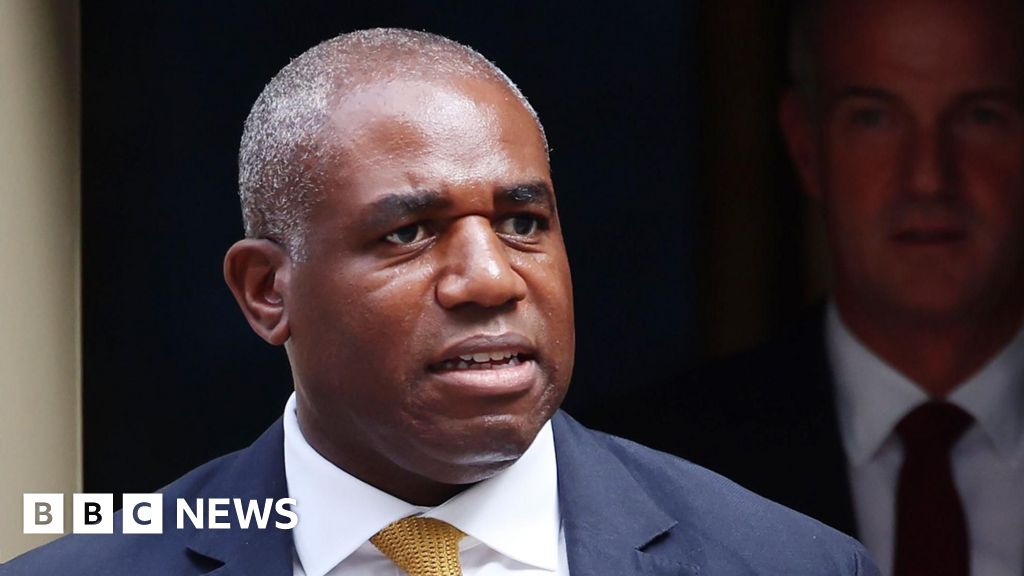
    Foreign Secretary David Lammy has said he is appalled and sickened by the plight of civilians in Gaza, after the Israeli government rejected an international statement which warned suffering has “reached new depths”.

    On Tuesday, Lammy told the BBC that Israel’s response was “hugely disappointing” and described the situation in Gaza as “grotesque”.

    It comes after the UK and 27 other countries called for an immediate end to the war, and accused Israel of “drip feeding” aid to Gaza’s population.

    The statement was released after dozens were killed while waiting to access supplies in recent days – but Israel described it as “disconnected from reality” and said it “sends the wrong message to Hamas”.

    While there have been several previous international statements calling for an end to the war in Gaza, the criticism of Israel’s actions in this most recent one was striking.

    The statement read: “We condemn the drip feeding of aid and the inhumane killing of civilians, including children, seeking to meet their most basic needs of water and food. It is horrifying that over 800 Palestinians have been killed while seeking aid.”

    On Monday, Gaza’s Hamas-run health ministry said that more than 100 Palestinians were killed by Israeli gunfire while waiting for food over the weekend.

    The Hamas-run health ministry said that over the past 48 hours, 33 people, including 12 children, have died as a result of malnutrition.

    The total number of deaths due to malnutrition stands at 101, of which 80 are children, since the beginning of the war in 2023, they added.

    Lammy told BBC Breakfast: “When you see innocent children holding out their hand for food and you see them shot and killed… of course Britain must call it out.”

    He continued: “These are not words that are normally used by a foreign secretary who is attempting to be diplomatic.”

    Asked whether what he was describing constituted war crimes, Lammy said that was a determination for lawyers at the International Criminal Court and the International Court of Justice.

    He added: “To be honest, this has gone beyond lawyers, I want this war to end. The British people look at the horrors on their TV screens and they believe this war must and should come to an end.

    “They are grossly offended by children suffering in the way that we are seeing.”

    The government suspended 30 out of 350 arms export licences to Israel in 2024 covering equipment which could have an “offensive” use.

    Pressed on whether ministers could further restrict arms sales, Lammy said he was satisfied he had already suspended the transfer of weapons that could be used in Gaza.

    Lammy said the UK would “do more in the coming weeks” if there was no sign of “a change in behaviour from the Israeli government in how it is prosecuting this war”.

    He said it would “not be appropriate” to detail what actions the UK government was considering and repeated his call for an “enduring ceasefire”.

    “I regret that so far the international community has not been able to bring this war to an end,” he said, adding that the UK “cannot act unilaterally” to do so and had to “work in partnership with our allies”.

    Health Secretary Wes Streeting has called for “the recognition of the state of Palestine while there’s still a state of Palestine left to recognise”.

    He told MPs that Israel’s attacks on healthcare workers and civilians trying to access aid “go well beyond legitimate self-defence and undermine the prospects for peace”.

    There have been near daily reports of Palestinians being killed while waiting for food since Israel partially eased an 11-week total blockade on aid deliveries to Gaza in May and, along with the US, helped to establish a new aid system run by the Gaza Humanitarian Foundation (GHF) to bypass the existing one overseen by the UN.

    Israel has said the this system, which uses US private security contractors to hand out food parcels from sites inside Israeli military zones, prevents Hamas from stealing supplies.

    But the UN and its partners have refused to co-operate with it, calling it unsafe and a violation of the humanitarian principles of impartiality, neutrality, and independence.

    Israel launched a war in Gaza in response to the Hamas-led attack on southern Israel on 7 October 2023, in which about 1,200 people were killed and 251 others were taken hostage.

    More than 59,000 people have been killed in Gaza since then, according to the territory’s health ministry.

    Most of Gaza’s population has been displaced multiple times, and more than 90% of homes are estimated to be damaged or destroyed. The healthcare, water, sanitation and hygiene systems have collapsed, and there are shortages of food, fuel, medicine and shelter.


    Source link

  • British couple held in Afghanistan ‘may die in prison,’ son warns

    British couple held in Afghanistan ‘may die in prison,’ son warns


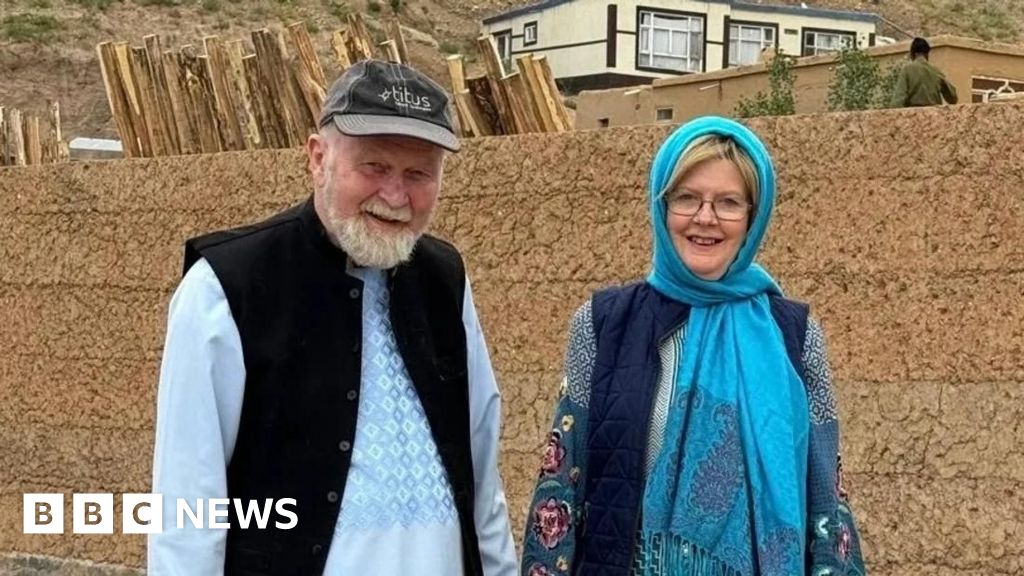
    The son of a British couple detained by the Taliban five months ago has told the BBC that he fears they may die in prison.

    Peter Reynolds, 80, and Barbie, 76, were arrested on 1 February while returning to their home in central Bamiyan province, Afghanistan. It is not known exactly why they were detained.

    Their son Jonathan Reynolds said their health was rapidly deteriorating, with his father suffering serious convulsions and his mother “numb” from anaemia and malnutrition.

    The Taliban’s foreign minister said they were receiving medical care and that “efforts are under way to secure their release, but the process is not complete”.

    “All their human rights are being respected,” Amir Khan Muttaqi told reporters in Kabul on Wednesday, adding that the pair had “occasional contact” with family.

    The UN warned on Monday that the couple could perish “in such degrading conditions” if they do not receive medical care at once, calling their detention “inhumane”.

    Mr Reynolds said it had been a “harrowing and surreal” five months waiting for the release of his parents, who lived in Afghanistan for 18 years, where they had citizenship and ran education projects.

    One of these projects involved training women and children and had apparently been approved by local authorities, despite the Taliban banning education for girls over 12-years-old and not allowing women to work.

    Mr Reynolds said his parents had been held in harsh conditions – including a maximum security prison – despite being “deemed innocent” by a judge and facing no charges.

    “My dad was chained to murderers and criminals,” he told BBC Radio 4’s Today programme, adding that they had at one point been held in a basement for six weeks without sunlight, and not allowed out.

    The couple revealed “just how bad their health is” when they last had contact with their children on 15 June, Mr Reynolds said.

    “My dad’s health is deteriorating fast in particular,” he said of the 80-year-old, who has a history of minor heart attacks.

    “Now he’s maybe got something like early Parkinson’s – tremors and shakes down the right side of his body, his arms and face,” he told BBC Breakfast.

    He added that his father spent “half an hour convulsing on the prison floor” before his wife called for a prison guard to move him onto a “mattress pad on the floor” serving as a bed.

    Mrs Reynolds “has blue hands and feet to do with anaemia, malnutrition, just not getting the right healthcare,” he added.

    Mr Reynolds said he did not know his parents’ exact location – and that he was unsure “that the demand has been made for their immediate release”.

    He said he was very grateful that British officials visited the pair just last week and shared a photo with the family as “proof of life”. It remained “frustrating”, however, that this stopped short of securing their release.

    “Every week it seems like we’re told ‘just wait two or three more days now… just hang tight’.

    “Week after week we’re told that – and they’re still in prison.”

    However, he said he was grateful to the Foreign Office (FCDO) for the level of communication with the family.

    The couple have both had birthdays in prison, and last week marked their 55th wedding anniversary; they married in Kabul in 1970.

    Mr Reynolds said: “I’m thankful they were together, but they’re certainly not free.”

    The UN likewise warned on Monday that the pair’s health was quickly declining, and questioned why they were being held at all.

    “Without access to adequate medical care, they are at risk of irreparable harm or even death,” read a statement by the UN’s human rights body, which called for their immediate transfer to a civilian hospital.

    “We see no reason why this older couple should be detained at all, and have requested an immediate review of the grounds of their detention.

    “It is inhumane to keep them locked up in such degrading conditions and more worrying when their health is so fragile.”

    It added that it had raised the couple’s case with the Taliban and the UK.

    An FCDO spokesperson said: “We are supporting the family of two British nationals who are detained in Afghanistan.”

    The UK shut its embassy in Kabul and withdrew its diplomats from the country after the Taliban returned to power in 2021.

    The FCDO says support for British nationals in Afghanistan is therefore “severely limited” and advises against all travel to the country.


    Source link

  • British couple held in Afghanistan ‘may die in prison,’ son warns

    British couple held in Afghanistan ‘may die in prison,’ son warns


    The son of a British couple detained by the Taliban five months ago has told the BBC that he fears they may die in prison.

    Peter Reynolds, 80, and Barbie, 76, were arrested on 1 February while returning to their home in central Bamiyan province, Afghanistan. It is not known exactly why they were detained.

    Their son Jonathan Reynolds said their health was rapidly deteriorating, with his father suffering serious convulsions and his mother “numb” from anaemia and malnutrition.

    The Taliban’s foreign minister said they were receiving medical care and that “efforts are under way to secure their release, but the process is not complete”.

    “All their human rights are being respected,” Amir Khan Muttaqi told reporters in Kabul on Wednesday, adding that the pair had “occasional contact” with family.

    The UN warned on Monday that the couple could perish “in such degrading conditions” if they do not receive medical care at once, calling their detention “inhumane”.

    Mr Reynolds said it had been a “harrowing and surreal” five months waiting for the release of his parents, who lived in Afghanistan for 18 years, where they had citizenship and ran education projects.

    One of these projects involved training women and children and had apparently been approved by local authorities, despite the Taliban banning education for girls over 12-years-old and not allowing women to work.

    Mr Reynolds said his parents had been held in harsh conditions – including a maximum security prison – despite being “deemed innocent” by a judge and facing no charges.

    “My dad was chained to murderers and criminals,” he told BBC Radio 4’s Today programme, adding that they had at one point been held in a basement for six weeks without sunlight, and not allowed out.

    The couple revealed “just how bad their health is” when they last had contact with their children on 15 June, Mr Reynolds said.

    “My dad’s health is deteriorating fast in particular,” he said of the 80-year-old, who has a history of minor heart attacks.

    “Now he’s maybe got something like early Parkinson’s – tremors and shakes down the right side of his body, his arms and face,” he told BBC Breakfast.

    He added that his father spent “half an hour convulsing on the prison floor” before his wife called for a prison guard to move him onto a “mattress pad on the floor” serving as a bed.

    Mrs Reynolds “has blue hands and feet to do with anaemia, malnutrition, just not getting the right healthcare,” he added.

    Mr Reynolds said he did not know his parents’ exact location – and that he was unsure “that the demand has been made for their immediate release”.

    He said he was very grateful that British officials visited the pair just last week and shared a photo with the family as “proof of life”. It remained “frustrating”, however, that this stopped short of securing their release.

    “Every week it seems like we’re told ‘just wait two or three more days now… just hang tight’.

    “Week after week we’re told that – and they’re still in prison.”

    However, he said he was grateful to the Foreign Office (FCDO) for the level of communication with the family.

    The couple have both had birthdays in prison, and last week marked their 55th wedding anniversary; they married in Kabul in 1970.

    Mr Reynolds said: “I’m thankful they were together, but they’re certainly not free.”

    The UN likewise warned on Monday that the pair’s health was quickly declining, and questioned why they were being held at all.

    “Without access to adequate medical care, they are at risk of irreparable harm or even death,” read a statement by the UN’s human rights body, which called for their immediate transfer to a civilian hospital.

    “We see no reason why this older couple should be detained at all, and have requested an immediate review of the grounds of their detention.

    “It is inhumane to keep them locked up in such degrading conditions and more worrying when their health is so fragile.”

    It added that it had raised the couple’s case with the Taliban and the UK.

    An FCDO spokesperson said: “We are supporting the family of two British nationals who are detained in Afghanistan.”

    The UK shut its embassy in Kabul and withdrew its diplomats from the country after the Taliban returned to power in 2021.

    The FCDO says support for British nationals in Afghanistan is therefore “severely limited” and advises against all travel to the country.


    Source link