Blog

  • Here’s what’s to know about 2 Chinese aircraft carriers operating in the Pacific together

    Here’s what’s to know about 2 Chinese aircraft carriers operating in the Pacific together


    TOKYO (AP) — Japan this week confirmed that two Chinese aircraft carriers have operated together for the first time in the Pacific, fueling Tokyo’s concern about Beijing’s rapidly expanding military activity far beyond its borders.

    Aircraft carriers are critical to projecting power at a distance. China routinely sends coast guard vessels, warships and warplanes to areas around the disputed East China Sea islands, but now it is going as far as what’s called the second-island chain that includes Guam — a U.S. territory. A single Chinese carrier has ventured into the Pacific in the past, but never east of that chain until now.

    On Thursday, Japan renewed its concern, saying that a Chinese fighter jet flew within an “abnormally close distance” from a Japanese reconnaissance aircraft after taking off from one of the carriers over the weekend.

    Taiwan, which China claims as its own territory to be conquered by force if necessary, said the carriers’ dual operations showed China’s “expansionist nature.”

    Here’s what to know about the latest moves by China, which has the world’s largest navy numerically.

    How the carriers operated

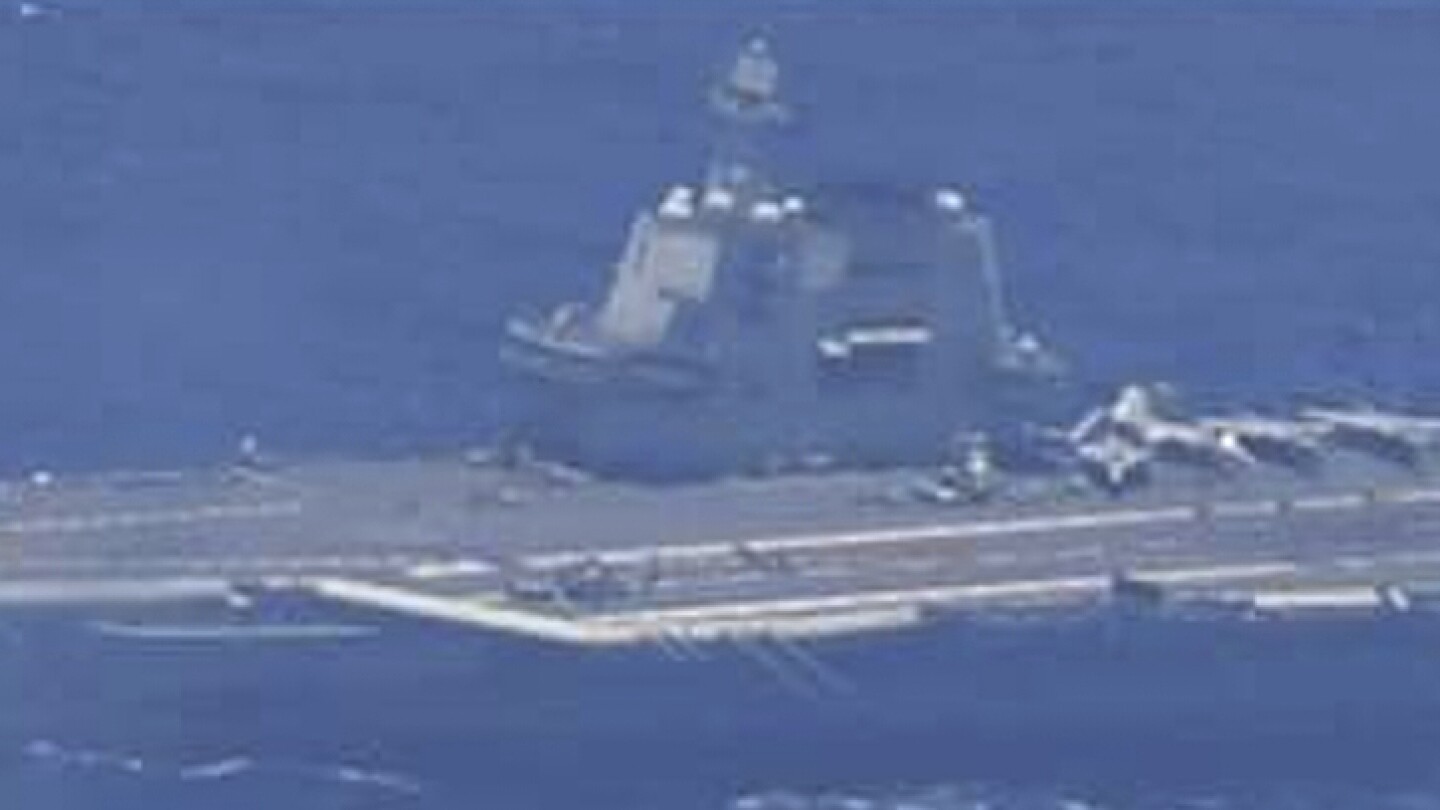
    Japan’s Defense Ministry said the two carriers, the Liaoning and the Shandong, were seen separately but almost simultaneously operating near southern islands in the Pacific for the first time. Both operated in waters off Iwo Jima, about 1,200 kilometers (750 miles) south of Tokyo, Defense Minister Gen Nakatani said Monday.

    The Liaoning also sailed inside Japan’s exclusive economic zone of Minamitorishima, the country’s easternmost island. There was no violation of Japanese territorial waters. Still, Nakatani said Japan has expressed “concern” to the Chinese embassy.

    Both carriers had warplanes take off and land. Late Wednesday, Japan’s Defense Ministry said a Chinese J-15 fighter jet that took off from the Shandong on Saturday chased a Japanese P-3C aircraft on reconnaissance duty in the area and came within an “abnormally close distance” of 45 meters (50 yards).

    A Chinese jet also crossed 900 meters (980 yards) in front of a Japanese P-3C on Sunday, the ministry said, adding it has conveyed to China “serious concern” and a “solemn request” for preventive measures over such an “abnormal approach” that could cause accidental collisions.

    Chief Cabinet Secretary Yoshimasa Hayashi on Thursday said Japan will keep communicating with China while ensuring surveillance around Japan to defend its territory.

    Why Japan is worried

    China’s military buildup and expanding area of activity have raised tensions in the region.

    The Chinese carriers sailed past the first-island chain, the Pacific archipelago off the Asian mainland that includes Japan, Taiwan and part of the Philippines. The Liaoning reached farther to the second-island chain, a strategic line extending to Guam, showing China also can challenge Japan’s ally, the United States.

    “China apparently aims to elevate its capability of the two aircraft carriers, and to advance its operational capability of the distant sea and airspace,” Nakatani said.

    The defense minister vowed to further strengthen Japan’s air defense on remote islands.

    Japan has been accelerating its military buildup, especially since 2022, including counter-strike capability, with long-range cruise missiles as deterrence to China.

    China’s navy is growing

    China’s navy on Tuesday confirmed the deployments, calling it part of routine training in the western Pacific “to test their capabilities in far seas protection and joint operations.” It said the deployment was in compliance with international laws and not targeted at any country.

    China is pursuing a vast military modernization program including ambitions of a true “blue-water” naval force capable of operating at long ranges for extended periods.

    Beijing has the world’s largest navy numerically but lags far behind the United States in its number of aircraft carriers. China has three, the U.S. 11.

    Washington’s numerical advantage allows it to keep a carrier, currently the USS George Washington, permanently forward-deployed to Japan.

    The Pentagon has expressed concern over Beijing’s focus on building new carriers. Its latest report to Congress on Chinese defense developments noted that it “extends air defense coverage of deployed task groups beyond the range of land-based defenses, enabling operations farther from China’s shore.”

    Taiwan’s Defense Minister Wellington Koo said Wednesday that Beijing has taken every opportunity to expand its reach beyond the first-island chain to send a “political message.” China routinely sends ships and planes into areas surrounding Taiwan, in what appears to be a rehearsal for a blockade of the island.

    The carriers’ abilities

    The two Chinese carriers currently in the western Pacific employ the older “ski-jump” launch method for aircraft, with a ramp at the end of a short runway to assist planes taking off. China’s first carrier, the Liaoning, was a repurposed Soviet ship. The second, the Shandong, was built in China along the Soviet design.

    Its third carrier, the Fujian, launched in 2022 and is undergoing final sea trials. It is expected to be operational later this year. It is locally designed and built and employs a more modern, electromagnetic-type launch system like those developed and used by the U.S.

    All three ships are conventionally powered, while all the U.S. carriers are nuclear powered, giving them the ability to operate at much greater range and with more power to run advanced systems.

    Satellite imagery provided to The Associated Press last year indicated China is working on a nuclear propulsion system for its carriers.

    China’s other naval actions

    In August, a Chinese reconnaissance aircraft violated Japan’s airspace off the southern prefecture of Nagasaki, and a Chinese survey ship violated Japanese territorial waters off another southern prefecture, Kagoshima. In September, the Liaoning and two destroyers sailed between Japan’s westernmost island of Yonaguni — just east of Taiwan — and nearby Iriomote, entering an area just outside Japan’s territorial waters where the country has some control over maritime traffic.

    China routinely sends coast guard vessels and aircraft into waters and airspace surrounding the Japanese-controlled, disputed East China Sea islands to harass Japanese vessels in the area, forcing Japan to scramble jets.

    Tokyo also worries about China’s increased joint military activities with Russia, including joint operations of warplanes or warships around northern and southwestern Japan in recent years.

    ___

    Rising reported from Bangkok. AP writer Christopher Bodeen in Taipei, Taiwan, contributed to this report.
    window.fbAsyncInit = function() {
    FB.init({

    appId : ‘870613919693099’,

    xfbml : true,
    version : ‘v2.9’
    });
    };

    (function(d, s, id){
    var js, fjs = d.getElementsByTagName(s)[0];
    if (d.getElementById(id)) {return;}
    js = d.createElement(s); js.id = id;
    js.src = “https://connect.facebook.net/en_US/sdk.js”;
    fjs.parentNode.insertBefore(js, fjs);
    }(document, ‘script’, ‘facebook-jssdk’));


    Source link

    https://www.cherrycreekschools.org/cms/module/selectsurvey/Print.aspx?SurveyID=82KI3m2&o2x=Sm7ikIJl

  • South Korea halts anti-North Korea loudspeaker broadcasts to ease tensions

    South Korea halts anti-North Korea loudspeaker broadcasts to ease tensions


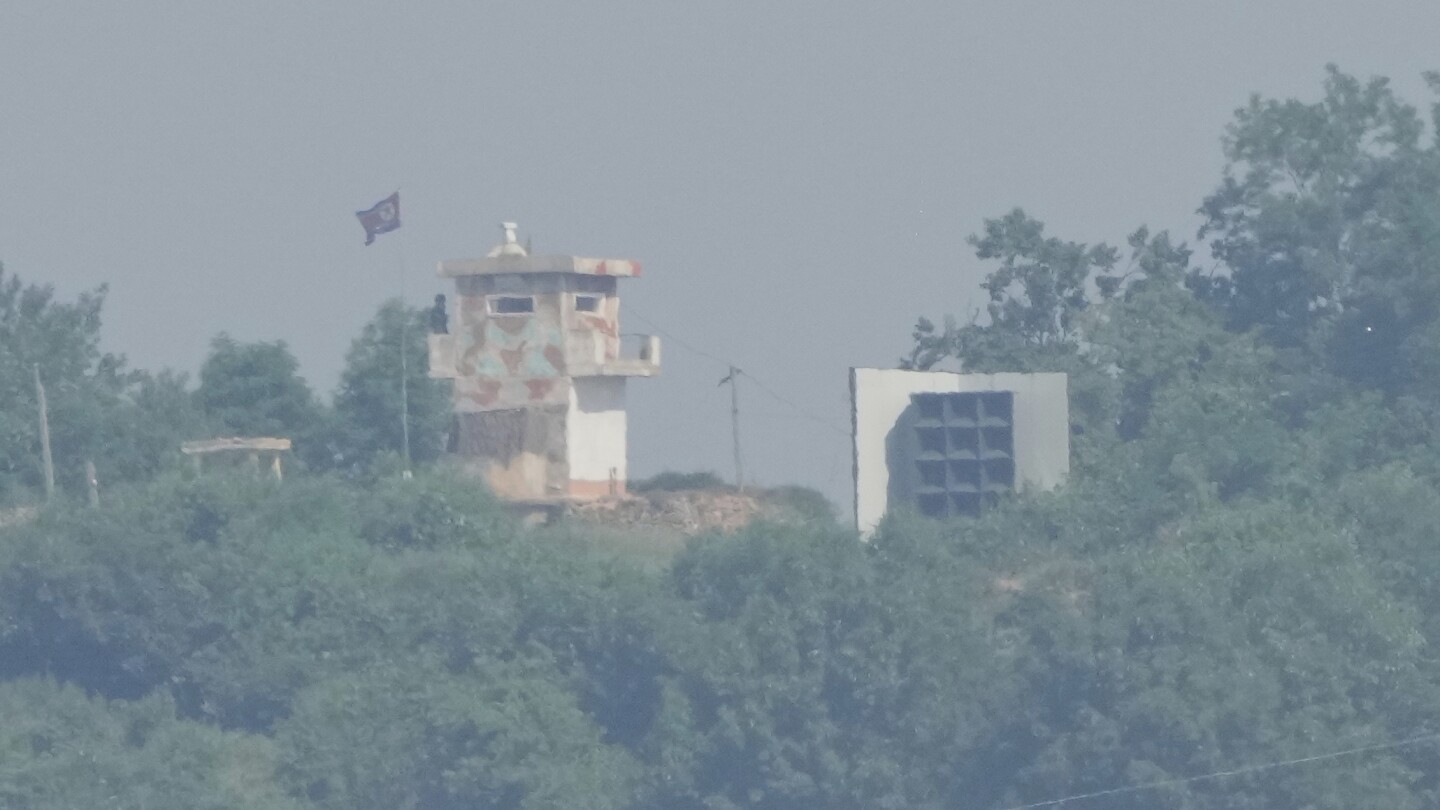
    SEOUL, South Korea (AP) — South Korea’s military shut down loudspeakers broadcasting anti-North Korea propaganda along the inter-Korean border on Wednesday, marking the new liberal government’s first concrete step toward easing tensions between the war-divided rivals.

    The South resumed the daily loudspeaker broadcasts in June last year following a yearslong pause in retaliation for North Korea flying trash-laden balloons toward the South in a psychological warfare campaign.

    South Korea’s Defense Ministry said the move, ordered by President Lee Jae-myung, was part of efforts “to restore trust in inter-Korean relations and promote peace on the Korean Peninsula.”

    Kang Yu-jung, Lee’s spokesperson, described the decision as a “proactive step” to reduce military tensions and ease the burden for South Koreans residing in border areas, who have also been affected by North Korea’s retaliatory loudspeaker broadcasts.

    North Korea, which is extremely sensitive to any outside criticism of its authoritarian leadership and its third-generation ruler, Kim Jong Un, didn’t immediately comment on the step by Seoul.

    South Korea reactivated its front-line loudspeakers to blast propaganda messages and K-pop songs toward the North last year in response to thousands of trash balloons that Pyongyang flew toward South Korea to drop substances including wastepaper, cloth scraps, cigarette butts and even manure.

    From May to November last year, North Korea flew about 7,000 balloons toward South Korea in 32 separate occasions, according to the South’s military. The North said that its balloon campaign came after South Korean activists sent over balloons filled with anti-North Korean leaflets, as well as USB sticks filled with popular South Korean songs and dramas.

    Trash carried by at least one North Korean balloon fell on the South Korean presidential compound in July, raising concerns about the vulnerability of key South Korean facilities. Officials said that the balloon contained no dangerous material and no one was hurt.

    The South’s broadcast playlist was clearly designed to strike a nerve in Pyongyang, where Kim’s government has been intensifying a campaign to eliminate the influence of South Korean pop culture and language among the population in a bid to strengthen his family’s dynastic rule.

    The Cold War-style psychological warfare campaigns added to tensions fueled by North Korea’s growing nuclear ambitions and South Korean efforts to expand joint military exercises with the United States and strengthen three-way security cooperation with Japan.

    Efforts to improve relations

    Lee, an outspoken liberal who took office last week after winning an early election to replace ousted conservative Yoon Suk Yeol, has vowed to improve relations with Pyongyang, which reacted furiously to Yoon’s hard-line policies and shunned dialogue.

    During his election campaign, Lee promised to halt the loudspeaker broadcasts, arguing that they created unnecessary tensions and discomfort for South Korean residents in border towns. In recent months, those residents had complained about North Korea’s retaliatory broadcasts, which included howling animals, pounding gongs and other irritating sounds. On Thursday morning, South Korea’s military said North Korean broadcasts weren’t heard in South Korean frontline areas, but it wasn’t clear if the North has formally halted its own broadcasts.

    In a briefing on Monday, South Korea’s Unification Ministry, which handles inter-Korean affairs, also called for South Korean civilian activists to stop flying anti-North Korean propaganda leaflets across the border. Such activities “could heighten tensions on the Korean Peninsula and threaten the lives and safety of residents in border areas,” said Koo Byoungsam, the ministry’s spokesperson.

    In his inaugural address last week, Lee vowed to reopen communication channels with North Korea. But prospects for an early resumption of dialogue between the rival Koreas remain dim. North Korea has consistently rejected offers from South Korea and the United States since 2019, when nuclear talks between Washington and Pyongyang collapsed over sanctions-related disagreements.

    The North’s nuclear threats remain

    North Korea’s priority in foreign policy is now firmly with Russia, which has received thousands of North Korean troops and large amounts of military equipment in recent months for its war with Ukraine. South Korean and U.S. officials have expressed concern that Kim in return could seek Russian technology transfers that could enhance the threat posed by his nuclear weapons and missile program.

    Yoon, who was removed from office in April over his short-lived imposition of martial law in December, had focused on strengthening military partnerships with Washington and Tokyo and on securing stronger U.S. assurances of a swift and decisive nuclear response to defend the South against a North Korean nuclear attack.

    In a fierce reaction to Yoon’s policies, Kim declared in January 2024 that he was abandoning the long-standing goals of a peaceful unification with the South and instructed the rewriting of the North’s constitution to cement the South as a permanent “principal enemy.”

    Following years of heightened testing activity, Kim has acquired a broad range of missiles that could potentially target rivals in Asia and the U.S. mainland. He has also called for increased production of nuclear materials to create more bombs.

    Rafael Mariano Grossi, director of the International Atomic Energy Agency, said Monday that the U.N. nuclear watchdog is monitoring signs that North Korea may be building a new uranium-enrichment plant at its main nuclear complex in Yongbyon.

    __

    Associated Press writer Hyung-jin Kim contributed to this report.

    window.fbAsyncInit = function() {
    FB.init({

    appId : ‘870613919693099’,

    xfbml : true,
    version : ‘v2.9’
    });
    };

    (function(d, s, id){
    var js, fjs = d.getElementsByTagName(s)[0];
    if (d.getElementById(id)) {return;}
    js = d.createElement(s); js.id = id;
    js.src = “https://connect.facebook.net/en_US/sdk.js”;
    fjs.parentNode.insertBefore(js, fjs);
    }(document, ‘script’, ‘facebook-jssdk’));


    Source link

    https://www.cherrycreekschools.org/cms/module/selectsurvey/Print.aspx?SurveyID=82KI3m2&o2x=vPWY

  • South Korea halts anti-North Korea loudspeaker broadcasts to ease tensions

    South Korea halts anti-North Korea loudspeaker broadcasts to ease tensions


    SEOUL, South Korea (AP) — South Korea’s military shut down loudspeakers broadcasting anti-North Korea propaganda along the inter-Korean border on Wednesday, marking the new liberal government’s first concrete step toward easing tensions between the war-divided rivals.

    The South resumed the daily loudspeaker broadcasts in June last year following a yearslong pause in retaliation for North Korea flying trash-laden balloons toward the South in a psychological warfare campaign.

    South Korea’s Defense Ministry said the move, ordered by President Lee Jae-myung, was part of efforts “to restore trust in inter-Korean relations and promote peace on the Korean Peninsula.”

    Kang Yu-jung, Lee’s spokesperson, described the decision as a “proactive step” to reduce military tensions and ease the burden for South Koreans residing in border areas, who have also been affected by North Korea’s retaliatory loudspeaker broadcasts.

    North Korea, which is extremely sensitive to any outside criticism of its authoritarian leadership and its third-generation ruler, Kim Jong Un, didn’t immediately comment on the step by Seoul.

    South Korea reactivated its front-line loudspeakers to blast propaganda messages and K-pop songs toward the North last year in response to thousands of trash balloons that Pyongyang flew toward South Korea to drop substances including wastepaper, cloth scraps, cigarette butts and even manure.

    From May to November last year, North Korea flew about 7,000 balloons toward South Korea in 32 separate occasions, according to the South’s military. The North said that its balloon campaign came after South Korean activists sent over balloons filled with anti-North Korean leaflets, as well as USB sticks filled with popular South Korean songs and dramas.

    Trash carried by at least one North Korean balloon fell on the South Korean presidential compound in July, raising concerns about the vulnerability of key South Korean facilities. Officials said that the balloon contained no dangerous material and no one was hurt.

    The South’s broadcast playlist was clearly designed to strike a nerve in Pyongyang, where Kim’s government has been intensifying a campaign to eliminate the influence of South Korean pop culture and language among the population in a bid to strengthen his family’s dynastic rule.

    The Cold War-style psychological warfare campaigns added to tensions fueled by North Korea’s growing nuclear ambitions and South Korean efforts to expand joint military exercises with the United States and strengthen three-way security cooperation with Japan.

    Efforts to improve relations

    Lee, an outspoken liberal who took office last week after winning an early election to replace ousted conservative Yoon Suk Yeol, has vowed to improve relations with Pyongyang, which reacted furiously to Yoon’s hard-line policies and shunned dialogue.

    During his election campaign, Lee promised to halt the loudspeaker broadcasts, arguing that they created unnecessary tensions and discomfort for South Korean residents in border towns. In recent months, those residents had complained about North Korea’s retaliatory broadcasts, which included howling animals, pounding gongs and other irritating sounds. On Thursday morning, South Korea’s military said North Korean broadcasts weren’t heard in South Korean frontline areas, but it wasn’t clear if the North has formally halted its own broadcasts.

    In a briefing on Monday, South Korea’s Unification Ministry, which handles inter-Korean affairs, also called for South Korean civilian activists to stop flying anti-North Korean propaganda leaflets across the border. Such activities “could heighten tensions on the Korean Peninsula and threaten the lives and safety of residents in border areas,” said Koo Byoungsam, the ministry’s spokesperson.

    In his inaugural address last week, Lee vowed to reopen communication channels with North Korea. But prospects for an early resumption of dialogue between the rival Koreas remain dim. North Korea has consistently rejected offers from South Korea and the United States since 2019, when nuclear talks between Washington and Pyongyang collapsed over sanctions-related disagreements.

    The North’s nuclear threats remain

    North Korea’s priority in foreign policy is now firmly with Russia, which has received thousands of North Korean troops and large amounts of military equipment in recent months for its war with Ukraine. South Korean and U.S. officials have expressed concern that Kim in return could seek Russian technology transfers that could enhance the threat posed by his nuclear weapons and missile program.

    Yoon, who was removed from office in April over his short-lived imposition of martial law in December, had focused on strengthening military partnerships with Washington and Tokyo and on securing stronger U.S. assurances of a swift and decisive nuclear response to defend the South against a North Korean nuclear attack.

    In a fierce reaction to Yoon’s policies, Kim declared in January 2024 that he was abandoning the long-standing goals of a peaceful unification with the South and instructed the rewriting of the North’s constitution to cement the South as a permanent “principal enemy.”

    Following years of heightened testing activity, Kim has acquired a broad range of missiles that could potentially target rivals in Asia and the U.S. mainland. He has also called for increased production of nuclear materials to create more bombs.

    Rafael Mariano Grossi, director of the International Atomic Energy Agency, said Monday that the U.N. nuclear watchdog is monitoring signs that North Korea may be building a new uranium-enrichment plant at its main nuclear complex in Yongbyon.

    __

    Associated Press writer Hyung-jin Kim contributed to this report.

    window.fbAsyncInit = function() {
    FB.init({

    appId : ‘870613919693099’,

    xfbml : true,
    version : ‘v2.9’
    });
    };

    (function(d, s, id){
    var js, fjs = d.getElementsByTagName(s)[0];
    if (d.getElementById(id)) {return;}
    js = d.createElement(s); js.id = id;
    js.src = “https://connect.facebook.net/en_US/sdk.js”;
    fjs.parentNode.insertBefore(js, fjs);
    }(document, ‘script’, ‘facebook-jssdk’));


    Source link

    https://www.cherrycreekschools.org/cms/module/selectsurvey/Print.aspx?SurveyID=82KI3m2&o2x=L6qJ

  • South Korea halts anti-North Korea loudspeaker broadcasts to ease tensions

    South Korea halts anti-North Korea loudspeaker broadcasts to ease tensions


    SEOUL, South Korea (AP) — South Korea’s military shut down loudspeakers broadcasting anti-North Korea propaganda along the inter-Korean border on Wednesday, marking the new liberal government’s first concrete step toward easing tensions between the war-divided rivals.

    The South resumed the daily loudspeaker broadcasts in June last year following a yearslong pause in retaliation for North Korea flying trash-laden balloons toward the South in a psychological warfare campaign.

    South Korea’s Defense Ministry said the move, ordered by President Lee Jae-myung, was part of efforts “to restore trust in inter-Korean relations and promote peace on the Korean Peninsula.”

    Kang Yu-jung, Lee’s spokesperson, described the decision as a “proactive step” to reduce military tensions and ease the burden for South Koreans residing in border areas, who have also been affected by North Korea’s retaliatory loudspeaker broadcasts.

    North Korea, which is extremely sensitive to any outside criticism of its authoritarian leadership and its third-generation ruler, Kim Jong Un, didn’t immediately comment on the step by Seoul.

    South Korea reactivated its front-line loudspeakers to blast propaganda messages and K-pop songs toward the North last year in response to thousands of trash balloons that Pyongyang flew toward South Korea to drop substances including wastepaper, cloth scraps, cigarette butts and even manure.

    From May to November last year, North Korea flew about 7,000 balloons toward South Korea in 32 separate occasions, according to the South’s military. The North said that its balloon campaign came after South Korean activists sent over balloons filled with anti-North Korean leaflets, as well as USB sticks filled with popular South Korean songs and dramas.

    Trash carried by at least one North Korean balloon fell on the South Korean presidential compound in July, raising concerns about the vulnerability of key South Korean facilities. Officials said that the balloon contained no dangerous material and no one was hurt.

    The South’s broadcast playlist was clearly designed to strike a nerve in Pyongyang, where Kim’s government has been intensifying a campaign to eliminate the influence of South Korean pop culture and language among the population in a bid to strengthen his family’s dynastic rule.

    The Cold War-style psychological warfare campaigns added to tensions fueled by North Korea’s growing nuclear ambitions and South Korean efforts to expand joint military exercises with the United States and strengthen three-way security cooperation with Japan.

    Efforts to improve relations

    Lee, an outspoken liberal who took office last week after winning an early election to replace ousted conservative Yoon Suk Yeol, has vowed to improve relations with Pyongyang, which reacted furiously to Yoon’s hard-line policies and shunned dialogue.

    During his election campaign, Lee promised to halt the loudspeaker broadcasts, arguing that they created unnecessary tensions and discomfort for South Korean residents in border towns. In recent months, those residents had complained about North Korea’s retaliatory broadcasts, which included howling animals, pounding gongs and other irritating sounds. On Thursday morning, South Korea’s military said North Korean broadcasts weren’t heard in South Korean frontline areas, but it wasn’t clear if the North has formally halted its own broadcasts.

    In a briefing on Monday, South Korea’s Unification Ministry, which handles inter-Korean affairs, also called for South Korean civilian activists to stop flying anti-North Korean propaganda leaflets across the border. Such activities “could heighten tensions on the Korean Peninsula and threaten the lives and safety of residents in border areas,” said Koo Byoungsam, the ministry’s spokesperson.

    In his inaugural address last week, Lee vowed to reopen communication channels with North Korea. But prospects for an early resumption of dialogue between the rival Koreas remain dim. North Korea has consistently rejected offers from South Korea and the United States since 2019, when nuclear talks between Washington and Pyongyang collapsed over sanctions-related disagreements.

    The North’s nuclear threats remain

    North Korea’s priority in foreign policy is now firmly with Russia, which has received thousands of North Korean troops and large amounts of military equipment in recent months for its war with Ukraine. South Korean and U.S. officials have expressed concern that Kim in return could seek Russian technology transfers that could enhance the threat posed by his nuclear weapons and missile program.

    Yoon, who was removed from office in April over his short-lived imposition of martial law in December, had focused on strengthening military partnerships with Washington and Tokyo and on securing stronger U.S. assurances of a swift and decisive nuclear response to defend the South against a North Korean nuclear attack.

    In a fierce reaction to Yoon’s policies, Kim declared in January 2024 that he was abandoning the long-standing goals of a peaceful unification with the South and instructed the rewriting of the North’s constitution to cement the South as a permanent “principal enemy.”

    Following years of heightened testing activity, Kim has acquired a broad range of missiles that could potentially target rivals in Asia and the U.S. mainland. He has also called for increased production of nuclear materials to create more bombs.

    Rafael Mariano Grossi, director of the International Atomic Energy Agency, said Monday that the U.N. nuclear watchdog is monitoring signs that North Korea may be building a new uranium-enrichment plant at its main nuclear complex in Yongbyon.

    __

    Associated Press writer Hyung-jin Kim contributed to this report.

    window.fbAsyncInit = function() {
    FB.init({

    appId : ‘870613919693099’,

    xfbml : true,
    version : ‘v2.9’
    });
    };

    (function(d, s, id){
    var js, fjs = d.getElementsByTagName(s)[0];
    if (d.getElementById(id)) {return;}
    js = d.createElement(s); js.id = id;
    js.src = “https://connect.facebook.net/en_US/sdk.js”;
    fjs.parentNode.insertBefore(js, fjs);
    }(document, ‘script’, ‘facebook-jssdk’));


    Source link

    https://www.cherrycreekschools.org/cms/module/selectsurvey/Print.aspx?SurveyID=82KI3m2&o2x=Tm4zso

  • Families of missing Ukrainians gather as prisoner exchange begins

    Families of missing Ukrainians gather as prisoner exchange begins


    Paul Adams

    Reporting from Chernihiv region

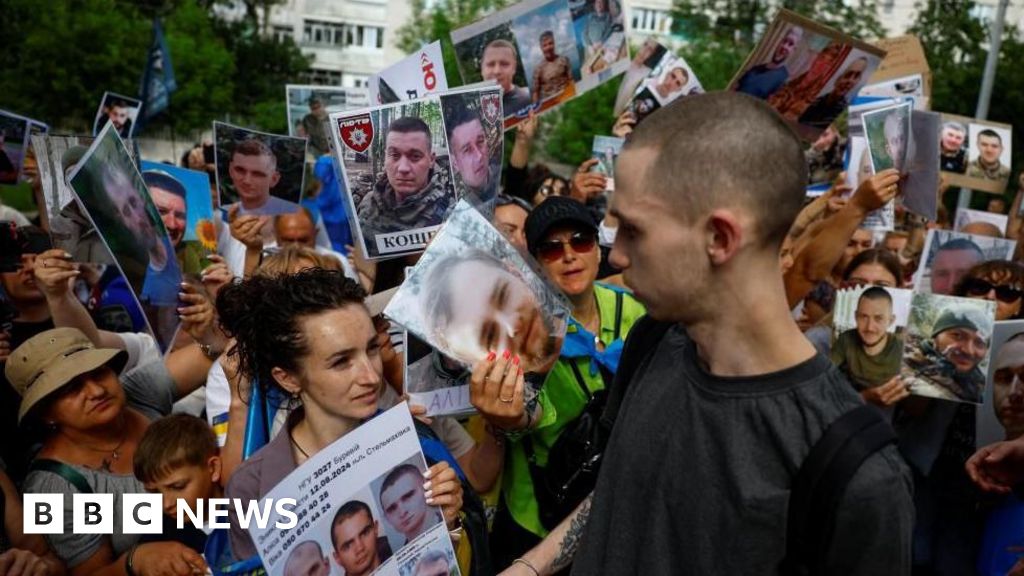
    Reuters A Ukrainian prisoner of returns to a crowd of people holding posters bearing the faces of missing soldiersReuters

    People seeking information about the fate of their loved ones awaited any shred of information from returning prisoners of war

    The families of missing Ukrainian soldiers gathered close to the border with Belarus on Monday, as a planned prisoner swap between Russia and Ukraine took place.

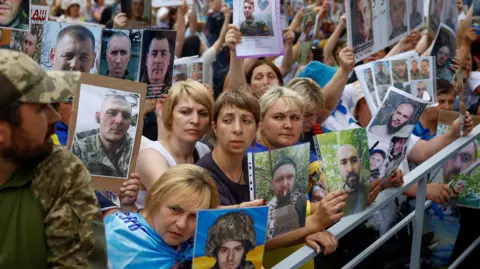
    As the bus carrying prisoners of war arrived, a crowd of relatives surged forward, many brandishing photos of missing fathers, brothers and sons.

    Faces were filled with apprehension. Few expected to be reunited, and most were just desperate for information after waiting years for any news.

    During the latest round of direct talks in Turkey last week, the two warring sides agreed to exchange sick and heavily wounded prisoners of war, those aged under 25, and the bodies of 12,000 soldiers.

    Ukraine’s President Volodymyr Zelensky said the exchange would unfold “in several stages” over the coming days.

    Writing on Telegram, he said: “The process is quite complicated, there are many sensitive details, negotiations continue virtually every day.”

    Russia’s defence ministry said “the first group of Russian servicemen under the age of 25 were returned from the territory controlled by the Kyiv regime” and that a “similar number” had been returned to Ukraine. Neither side provided an exact figure of how many people had been exchanged.

    As with past exchanges, Moscow said the repatriated Russian soldiers were receiving psychological and medical assistance in Belarus.

    Officials in Kyiv said some of the Ukrainian prisoners who returned on Monday had been in Russian captivity since the beginning of the war.

    Tetiana, who had gathered with other Ukrainians in the Chernihiv region close to Belarus, carried a cardboard sign with photos of her father, Valentyn, and cousin, Mykola, both still missing.

    “When my father went to fight, my biggest fear was that he would go missing,” she said, her eyes filling with tears. “I hoped maybe he’d be wounded and come back.”

    The war has exacted a heavy toll on the family. Tetiana’s uncle was killed last September, but his body was only recently returned for burial.

    One of the relatives of missing Ukrainian soldiers with tears in her eyes

    Tetiana was one of a crowd of relatives who gathered in the hopes of reuniting with missing family members

    When one of the returned prisoners appeared at an upstairs window, women waiting below hurled the names of regiments at him, hoping he might have news.

    He apologised, made a heart sign with his hands and called out “slava Ukraini” – glory to Ukraine. “Heroiam Slava” – glory to the heroes – the crowd replied in unison.

    Glimpsed briefly through the crowd as they were escorted inside, some of the soldiers looked gaunt.

    “They spent a lot of time in Russian places of detention, without any visits of International Red Cross,” Petro Yatsenko, of Ukraine’s Coordination HQ for prisoners of war, told the BBC.

    “Their health conditions are very poor. They have not had sufficient food. Of course they need a long period of rehabilitation.”

    But 23-year-old Valera, back on home soil after three years and three months of captivity, seemed happy enough after a bowl of Ukrainian soup.

    As he turned to leave, women pressed forward, pushing pictures of the missing into his arms, hoping he might recognise someone.

    Reuters People hold portraits of their relatives, Ukrainian prisoners of war (PoWs) and missing soldiers, as a planned exchange takes placeReuters

    Last week, Moscow and Kyiv accused each other of disrupting the planned repatriation of the bodies of dead soldiers.

    Russia said that the bodies of more than 1,000 Ukrainian soldiers had been taken to an agreed exchange point but that Ukrainian officials had never arrived. Ukraine accused Moscow of “playing dirty games” and alleged that Russia was not sticking to the agreed parameters of the swap.

    In late May, Russia and Ukraine each handed over 390 soldiers and civilians in the biggest prisoner exchange since Russia launched the full-scale invasion in 2022.

    Meanwhile, war continued overnight, with Moscow launching a record 479 drones at Ukraine, including in the western region of Rivne that had been largely spared from attacks.

    Russia’s defence ministry said it had targeted Rivne’s Dubno base and described this as “one of the retaliatory strikes” in response to Ukraine’s audacious drone attacks on Russian airfields on 1 June.

    The overnight Russian launches caused damage in several Ukrainian regions but there were no reports of casualties.

    Russia has recently escalated its attacks on Ukraine, with each week bringing a new record of drones fired at the country.

    For its part, Kyiv said it attacked another Russian airbase in the Nizhny Novgorod region, which lies 400 miles from the Ukrainian border.

    Ukraine said the base houses planes that launch hypersonic missiles and that it had damaged “two units of enemy aircraft”.

    It also targeted an electronics factory that Kyiv says manufactures equipment to guide drones and aerial bombs.

    Video shows one of the explosions caused by an attack drone, and a large fire at the plant. Production there has been suspended.


    Source link

    https://www.cherrycreekschools.org/cms/module/selectsurvey/Print.aspx?SurveyID=82KI3m2&o2x=afIkSNR