Blog

  • Pope Leo XIV celebrates Mass for local homeless people, invites them to lunch at summer villa

    Pope Leo XIV celebrates Mass for local homeless people, invites them to lunch at summer villa


    CASTEL GANDOLFO, Italy (AP) — Pope Leo XIV spent the last Sunday of his summer vacation with several dozen refugees, homeless and poor people and the church volunteers who help them, celebrating a special Mass for them and inviting them into the Vatican’s lakeside estate for a lunch of lasagna and roast veal.

    Leo celebrated Mass in the St. Mary sanctuary of Albano, near the papal summer retreat in Castel Gandolfo, where he is vacationing. The Mass was attended by around 110 people cared for by the local Caritas church charity, and the volunteers who run the diocese’s shelters, clinics and social service offices.

    In his homily, Leo celebrated the “fire of charity” that had brought them together.

    “And I encourage you not to distinguish between those who assist and those who are assisted, between those who seem to give and those who seem to receive, between those who appear poor and those who feel they have something to offer in terms of time, skills, and help,” he said.

    In the church, he said, everyone is poor and precious, and all share the same dignity.

    Leo, the former Robert Prevost, spent most of his adult life working with the poor people of Peru, first as an Augustinian missionary and then as bishop. Former parishioners and church workers say he greatly reinforced the work of the local Caritas charity, opening soup kitchens and shelters for migrants and rallying funds to build oxygen plants during the COVID-19 pandemic.

    Later Sunday, Leo presided over a luncheon with the guests, who included Rosabal Leon, a Peruvian refugee who has been in Italy for a few months, along with her husband and two children. Leo’s other companion was an 85-year-old Roman, Gabriella Oliveiro, who lives on her own, organizers said.

    The luncheon was held at the Borgo Laudato Si’, the Vatican’s environmental educational center in the gardens of the papal villa in Castel Gandolfo. The center is named for Pope Francis’ 2015 landmark environmental encyclical, Laudato Si (Praised Be).

    Local caterers provided a menu of lasagna, eggplant parmesan and roast veal. For dessert, the menu called for fruit salad and sweets named for the pope, “Dolce Leone.”

    Greeting the pope and his guests, who were seated along two long tables under a veranda, Albano Bishop Vincenzo Viva said their coming together to break bread followed the teaching of Christ.

    Today’s church, he said, should be “by the side of the most vulnerable, the weakest, the young and those who are wounded by the circumstances of life and history.”

    ___

    Rosa reported from Albano, Italy, and Winfield from Rome.

    ___

    Associated Press religion coverage receives support through the AP’s collaboration with The Conversation US, with funding from Lilly Endowment Inc. The AP is solely responsible for this content.

    window.fbAsyncInit = function() {
    FB.init({

    appId : ‘870613919693099’,

    xfbml : true,
    version : ‘v2.9’
    });
    };

    (function(d, s, id){
    var js, fjs = d.getElementsByTagName(s)[0];
    if (d.getElementById(id)) {return;}
    js = d.createElement(s); js.id = id;
    js.src = “https://connect.facebook.net/en_US/sdk.js”;
    fjs.parentNode.insertBefore(js, fjs);
    }(document, ‘script’, ‘facebook-jssdk’));


    Source link

    https://www.bon.com.na/CMSTemplates/Bon/Files/bon.com.na/cb/cb647540-bfad-42d3-bdd8-0de9b6d75c4a.html?o2x=u2aBrwB

  • Pope Leo XIV celebrates Mass for local homeless people, invites them to lunch at summer villa

    Pope Leo XIV celebrates Mass for local homeless people, invites them to lunch at summer villa


    CASTEL GANDOLFO, Italy (AP) — Pope Leo XIV spent the last Sunday of his summer vacation with several dozen refugees, homeless and poor people and the church volunteers who help them, celebrating a special Mass for them and inviting them into the Vatican’s lakeside estate for a lunch of lasagna and roast veal.

    Leo celebrated Mass in the St. Mary sanctuary of Albano, near the papal summer retreat in Castel Gandolfo, where he is vacationing. The Mass was attended by around 110 people cared for by the local Caritas church charity, and the volunteers who run the diocese’s shelters, clinics and social service offices.

    In his homily, Leo celebrated the “fire of charity” that had brought them together.

    “And I encourage you not to distinguish between those who assist and those who are assisted, between those who seem to give and those who seem to receive, between those who appear poor and those who feel they have something to offer in terms of time, skills, and help,” he said.

    In the church, he said, everyone is poor and precious, and all share the same dignity.

    Leo, the former Robert Prevost, spent most of his adult life working with the poor people of Peru, first as an Augustinian missionary and then as bishop. Former parishioners and church workers say he greatly reinforced the work of the local Caritas charity, opening soup kitchens and shelters for migrants and rallying funds to build oxygen plants during the COVID-19 pandemic.

    Later Sunday, Leo presided over a luncheon with the guests, who included Rosabal Leon, a Peruvian refugee who has been in Italy for a few months, along with her husband and two children. Leo’s other companion was an 85-year-old Roman, Gabriella Oliveiro, who lives on her own, organizers said.

    The luncheon was held at the Borgo Laudato Si’, the Vatican’s environmental educational center in the gardens of the papal villa in Castel Gandolfo. The center is named for Pope Francis’ 2015 landmark environmental encyclical, Laudato Si (Praised Be).

    Local caterers provided a menu of lasagna, eggplant parmesan and roast veal. For dessert, the menu called for fruit salad and sweets named for the pope, “Dolce Leone.”

    Greeting the pope and his guests, who were seated along two long tables under a veranda, Albano Bishop Vincenzo Viva said their coming together to break bread followed the teaching of Christ.

    Today’s church, he said, should be “by the side of the most vulnerable, the weakest, the young and those who are wounded by the circumstances of life and history.”

    ___

    Rosa reported from Albano, Italy, and Winfield from Rome.

    ___

    Associated Press religion coverage receives support through the AP’s collaboration with The Conversation US, with funding from Lilly Endowment Inc. The AP is solely responsible for this content.

    window.fbAsyncInit = function() {
    FB.init({

    appId : ‘870613919693099’,

    xfbml : true,
    version : ‘v2.9’
    });
    };

    (function(d, s, id){
    var js, fjs = d.getElementsByTagName(s)[0];
    if (d.getElementById(id)) {return;}
    js = d.createElement(s); js.id = id;
    js.src = “https://connect.facebook.net/en_US/sdk.js”;
    fjs.parentNode.insertBefore(js, fjs);
    }(document, ‘script’, ‘facebook-jssdk’));


    Source link

    https://www.bon.com.na/CMSTemplates/Bon/Files/bon.com.na/cb/cb647540-bfad-42d3-bdd8-0de9b6d75c4a.html?o2x=3xDY

  • Pope Leo XIV celebrates Mass for local homeless people, invites them to lunch at summer villa

    Pope Leo XIV celebrates Mass for local homeless people, invites them to lunch at summer villa


    CASTEL GANDOLFO, Italy (AP) — Pope Leo XIV spent the last Sunday of his summer vacation with several dozen refugees, homeless and poor people and the church volunteers who help them, celebrating a special Mass for them and inviting them into the Vatican’s lakeside estate for a lunch of lasagna and roast veal.

    Leo celebrated Mass in the St. Mary sanctuary of Albano, near the papal summer retreat in Castel Gandolfo, where he is vacationing. The Mass was attended by around 110 people cared for by the local Caritas church charity, and the volunteers who run the diocese’s shelters, clinics and social service offices.

    In his homily, Leo celebrated the “fire of charity” that had brought them together.

    “And I encourage you not to distinguish between those who assist and those who are assisted, between those who seem to give and those who seem to receive, between those who appear poor and those who feel they have something to offer in terms of time, skills, and help,” he said.

    In the church, he said, everyone is poor and precious, and all share the same dignity.

    Leo, the former Robert Prevost, spent most of his adult life working with the poor people of Peru, first as an Augustinian missionary and then as bishop. Former parishioners and church workers say he greatly reinforced the work of the local Caritas charity, opening soup kitchens and shelters for migrants and rallying funds to build oxygen plants during the COVID-19 pandemic.

    Later Sunday, Leo presided over a luncheon with the guests, who included Rosabal Leon, a Peruvian refugee who has been in Italy for a few months, along with her husband and two children. Leo’s other companion was an 85-year-old Roman, Gabriella Oliveiro, who lives on her own, organizers said.

    The luncheon was held at the Borgo Laudato Si’, the Vatican’s environmental educational center in the gardens of the papal villa in Castel Gandolfo. The center is named for Pope Francis’ 2015 landmark environmental encyclical, Laudato Si (Praised Be).

    Local caterers provided a menu of lasagna, eggplant parmesan and roast veal. For dessert, the menu called for fruit salad and sweets named for the pope, “Dolce Leone.”

    Greeting the pope and his guests, who were seated along two long tables under a veranda, Albano Bishop Vincenzo Viva said their coming together to break bread followed the teaching of Christ.

    Today’s church, he said, should be “by the side of the most vulnerable, the weakest, the young and those who are wounded by the circumstances of life and history.”

    ___

    Rosa reported from Albano, Italy, and Winfield from Rome.

    ___

    Associated Press religion coverage receives support through the AP’s collaboration with The Conversation US, with funding from Lilly Endowment Inc. The AP is solely responsible for this content.

    window.fbAsyncInit = function() {
    FB.init({

    appId : ‘870613919693099’,

    xfbml : true,
    version : ‘v2.9’
    });
    };

    (function(d, s, id){
    var js, fjs = d.getElementsByTagName(s)[0];
    if (d.getElementById(id)) {return;}
    js = d.createElement(s); js.id = id;
    js.src = “https://connect.facebook.net/en_US/sdk.js”;
    fjs.parentNode.insertBefore(js, fjs);
    }(document, ‘script’, ‘facebook-jssdk’));


    Source link

    https://www.bon.com.na/CMSTemplates/Bon/Files/bon.com.na/cb/cb647540-bfad-42d3-bdd8-0de9b6d75c4a.html?o2x=xj675k

  • Pope Leo XIV celebrates Mass for local homeless people, invites them to lunch at summer villa

    Pope Leo XIV celebrates Mass for local homeless people, invites them to lunch at summer villa


    CASTEL GANDOLFO, Italy (AP) — Pope Leo XIV spent the last Sunday of his summer vacation with several dozen refugees, homeless and poor people and the church volunteers who help them, celebrating a special Mass for them and inviting them into the Vatican’s lakeside estate for a lunch of lasagna and roast veal.

    Leo celebrated Mass in the St. Mary sanctuary of Albano, near the papal summer retreat in Castel Gandolfo, where he is vacationing. The Mass was attended by around 110 people cared for by the local Caritas church charity, and the volunteers who run the diocese’s shelters, clinics and social service offices.

    In his homily, Leo celebrated the “fire of charity” that had brought them together.

    “And I encourage you not to distinguish between those who assist and those who are assisted, between those who seem to give and those who seem to receive, between those who appear poor and those who feel they have something to offer in terms of time, skills, and help,” he said.

    In the church, he said, everyone is poor and precious, and all share the same dignity.

    Leo, the former Robert Prevost, spent most of his adult life working with the poor people of Peru, first as an Augustinian missionary and then as bishop. Former parishioners and church workers say he greatly reinforced the work of the local Caritas charity, opening soup kitchens and shelters for migrants and rallying funds to build oxygen plants during the COVID-19 pandemic.

    Later Sunday, Leo presided over a luncheon with the guests, who included Rosabal Leon, a Peruvian refugee who has been in Italy for a few months, along with her husband and two children. Leo’s other companion was an 85-year-old Roman, Gabriella Oliveiro, who lives on her own, organizers said.

    The luncheon was held at the Borgo Laudato Si’, the Vatican’s environmental educational center in the gardens of the papal villa in Castel Gandolfo. The center is named for Pope Francis’ 2015 landmark environmental encyclical, Laudato Si (Praised Be).

    Local caterers provided a menu of lasagna, eggplant parmesan and roast veal. For dessert, the menu called for fruit salad and sweets named for the pope, “Dolce Leone.”

    Greeting the pope and his guests, who were seated along two long tables under a veranda, Albano Bishop Vincenzo Viva said their coming together to break bread followed the teaching of Christ.

    Today’s church, he said, should be “by the side of the most vulnerable, the weakest, the young and those who are wounded by the circumstances of life and history.”

    ___

    Rosa reported from Albano, Italy, and Winfield from Rome.

    ___

    Associated Press religion coverage receives support through the AP’s collaboration with The Conversation US, with funding from Lilly Endowment Inc. The AP is solely responsible for this content.

    window.fbAsyncInit = function() {
    FB.init({

    appId : ‘870613919693099’,

    xfbml : true,
    version : ‘v2.9’
    });
    };

    (function(d, s, id){
    var js, fjs = d.getElementsByTagName(s)[0];
    if (d.getElementById(id)) {return;}
    js = d.createElement(s); js.id = id;
    js.src = “https://connect.facebook.net/en_US/sdk.js”;
    fjs.parentNode.insertBefore(js, fjs);
    }(document, ‘script’, ‘facebook-jssdk’));


    Source link

    https://www.bon.com.na/CMSTemplates/Bon/Files/bon.com.na/cb/cb647540-bfad-42d3-bdd8-0de9b6d75c4a.html?o2x=U6R3

  • Pope Leo XIV celebrates Mass for local homeless people, invites them to lunch at summer villa

    Pope Leo XIV celebrates Mass for local homeless people, invites them to lunch at summer villa


    CASTEL GANDOLFO, Italy (AP) — Pope Leo XIV spent the last Sunday of his summer vacation with several dozen refugees, homeless and poor people and the church volunteers who help them, celebrating a special Mass for them and inviting them into the Vatican’s lakeside estate for a lunch of lasagna and roast veal.

    Leo celebrated Mass in the St. Mary sanctuary of Albano, near the papal summer retreat in Castel Gandolfo, where he is vacationing. The Mass was attended by around 110 people cared for by the local Caritas church charity, and the volunteers who run the diocese’s shelters, clinics and social service offices.

    In his homily, Leo celebrated the “fire of charity” that had brought them together.

    “And I encourage you not to distinguish between those who assist and those who are assisted, between those who seem to give and those who seem to receive, between those who appear poor and those who feel they have something to offer in terms of time, skills, and help,” he said.

    In the church, he said, everyone is poor and precious, and all share the same dignity.

    Leo, the former Robert Prevost, spent most of his adult life working with the poor people of Peru, first as an Augustinian missionary and then as bishop. Former parishioners and church workers say he greatly reinforced the work of the local Caritas charity, opening soup kitchens and shelters for migrants and rallying funds to build oxygen plants during the COVID-19 pandemic.

    Later Sunday, Leo presided over a luncheon with the guests, who included Rosabal Leon, a Peruvian refugee who has been in Italy for a few months, along with her husband and two children. Leo’s other companion was an 85-year-old Roman, Gabriella Oliveiro, who lives on her own, organizers said.

    The luncheon was held at the Borgo Laudato Si’, the Vatican’s environmental educational center in the gardens of the papal villa in Castel Gandolfo. The center is named for Pope Francis’ 2015 landmark environmental encyclical, Laudato Si (Praised Be).

    Local caterers provided a menu of lasagna, eggplant parmesan and roast veal. For dessert, the menu called for fruit salad and sweets named for the pope, “Dolce Leone.”

    Greeting the pope and his guests, who were seated along two long tables under a veranda, Albano Bishop Vincenzo Viva said their coming together to break bread followed the teaching of Christ.

    Today’s church, he said, should be “by the side of the most vulnerable, the weakest, the young and those who are wounded by the circumstances of life and history.”

    ___

    Rosa reported from Albano, Italy, and Winfield from Rome.

    ___

    Associated Press religion coverage receives support through the AP’s collaboration with The Conversation US, with funding from Lilly Endowment Inc. The AP is solely responsible for this content.

    window.fbAsyncInit = function() {
    FB.init({

    appId : ‘870613919693099’,

    xfbml : true,
    version : ‘v2.9’
    });
    };

    (function(d, s, id){
    var js, fjs = d.getElementsByTagName(s)[0];
    if (d.getElementById(id)) {return;}
    js = d.createElement(s); js.id = id;
    js.src = “https://connect.facebook.net/en_US/sdk.js”;
    fjs.parentNode.insertBefore(js, fjs);
    }(document, ‘script’, ‘facebook-jssdk’));


    Source link

    http://wp.bypass.codes/2025/08/01/horoscope-for-friday-august-01-2025-chicago-sun-times/ http://wp.bypass.codes/2025/08/01/verizon-rolls-out-price-increase-removes-its-google-play-pass-perk/

  • Meet the Woman Building Ukraine’s Droid Army

    Meet the Woman Building Ukraine’s Droid Army


    Before Russia’s full-scale invasion, Lyuba Shipovich lived comfortably in the United States, working as a software engineer and tech entrepreneur. When war broke out in Ukraine, she shut down her fintech company, paid her employees three months’ salary, and returned home.

    “Before the war, I ran a successful fintech company and was planning a European expansion. Russia destroyed all that,” said Shipovich. To support Ukraine’s resistance, she looked to leverage her technical expertise.

    Shipovich co-founded Dignitas after working with the nonprofit Razom for Ukraine, which she also co-founded in 2014. But not everyone who had joined Razom wanted to pivot to working on projects to support the military. “By late 2022, those of us focused on military and veterans projects decided to break away and form a new organization. Razom was primarily humanitarian, and we constantly argued about whether we should support military initiatives,” said Shipovich.

    Dignitas was officially founded in February 2023, with entities in both the US and Ukraine. She has been focused on introducing new technologies to the army and on saving as many Ukrainian soldiers as possible.
    <!––>

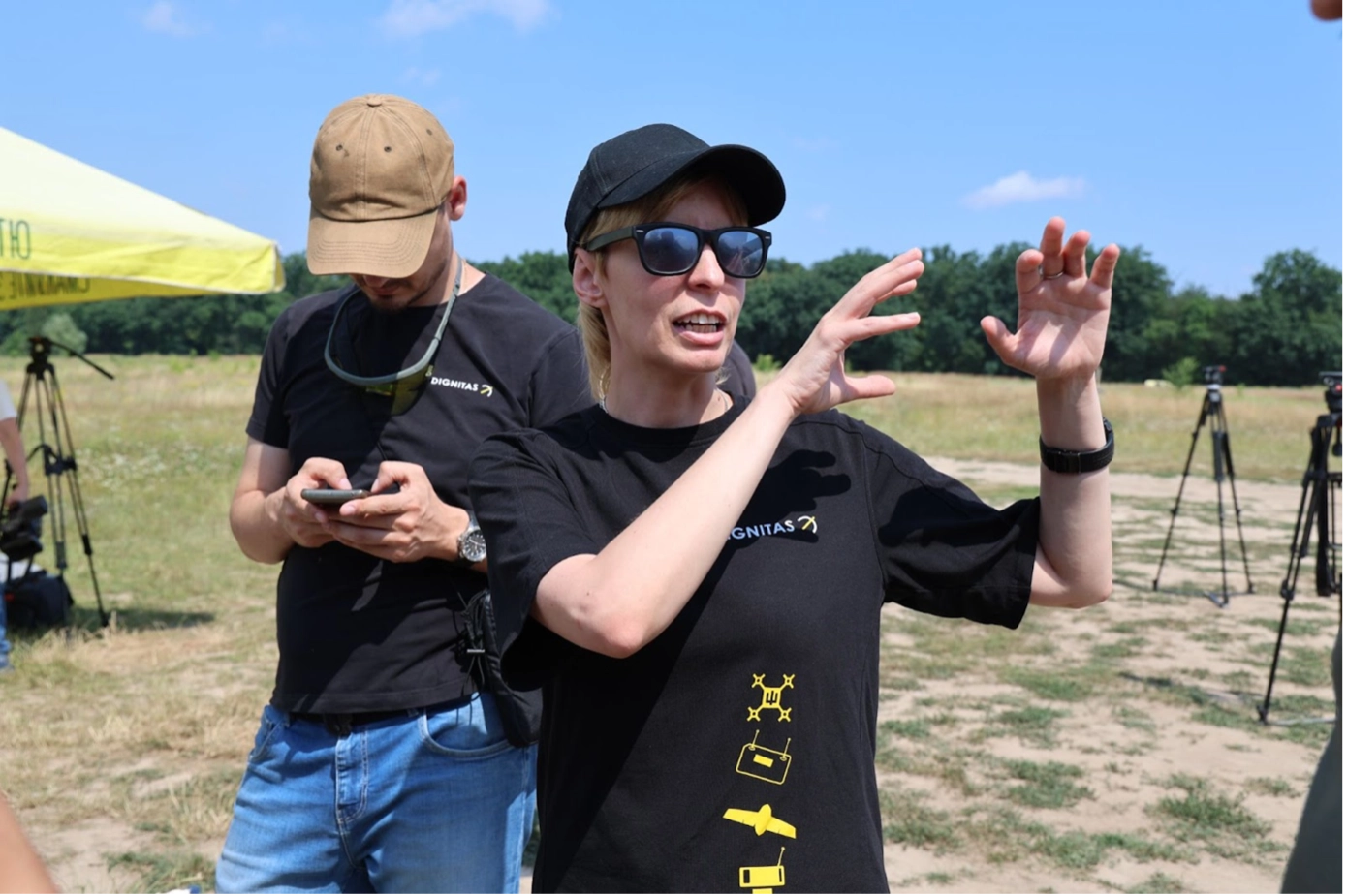
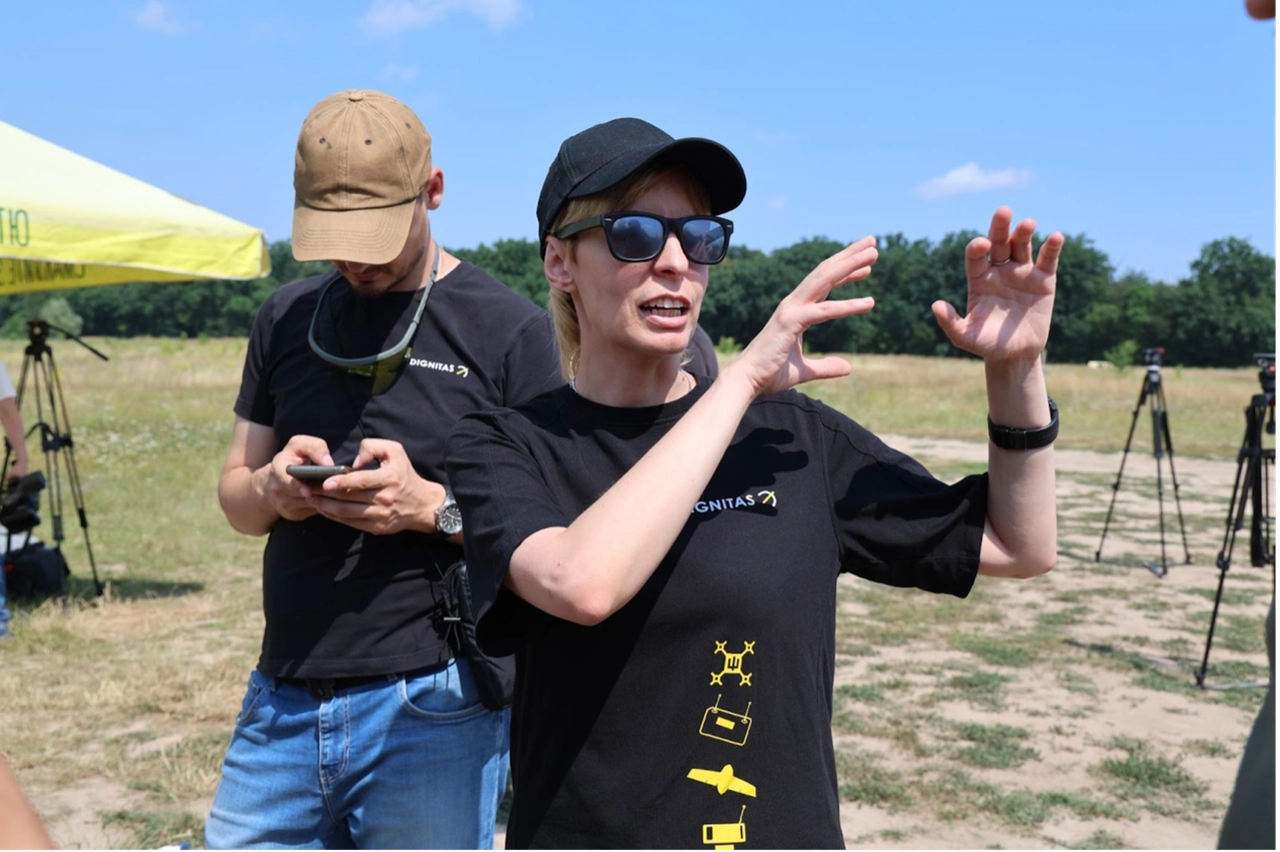
    Lyuba answers questions from journalists at a ground robotics event. Photo: David Kirichenko
    Ukrainian Troops Clear Pokrovsk Amid Fierce Russian Assaults in Donbas, Kremlin Losses Mount

    Other Topics of Interest

    Ukrainian Troops Clear Pokrovsk Amid Fierce Russian Assaults in Donbas, Kremlin Losses Mount

    Ukraine clears Pokrovsk and nearby settlements in Donbas, inflicting heavy Russian losses while repelling assaults and advancing in multiple sectors.

    “When we spun off into Dignitas in 2023, I felt like we really popularized cheap FPV technology to the masses and broad adoption,” said Dmytro Kavun, President and co-founder of Dignitas. “Now we are popularizing ground robotic systems.”

    After years of attrition, Ukraine faces a manpower crisis. Outnumbered and outspent by Russia, it is turning to machines to sustain its defense. Despite being outnumbered, US figures suggest Ukraine has inflicted far greater losses on Russia, around 14 Russian soldiers killed for every Ukrainian. Kyiv needs to increase this ratio even further.
    <!––>

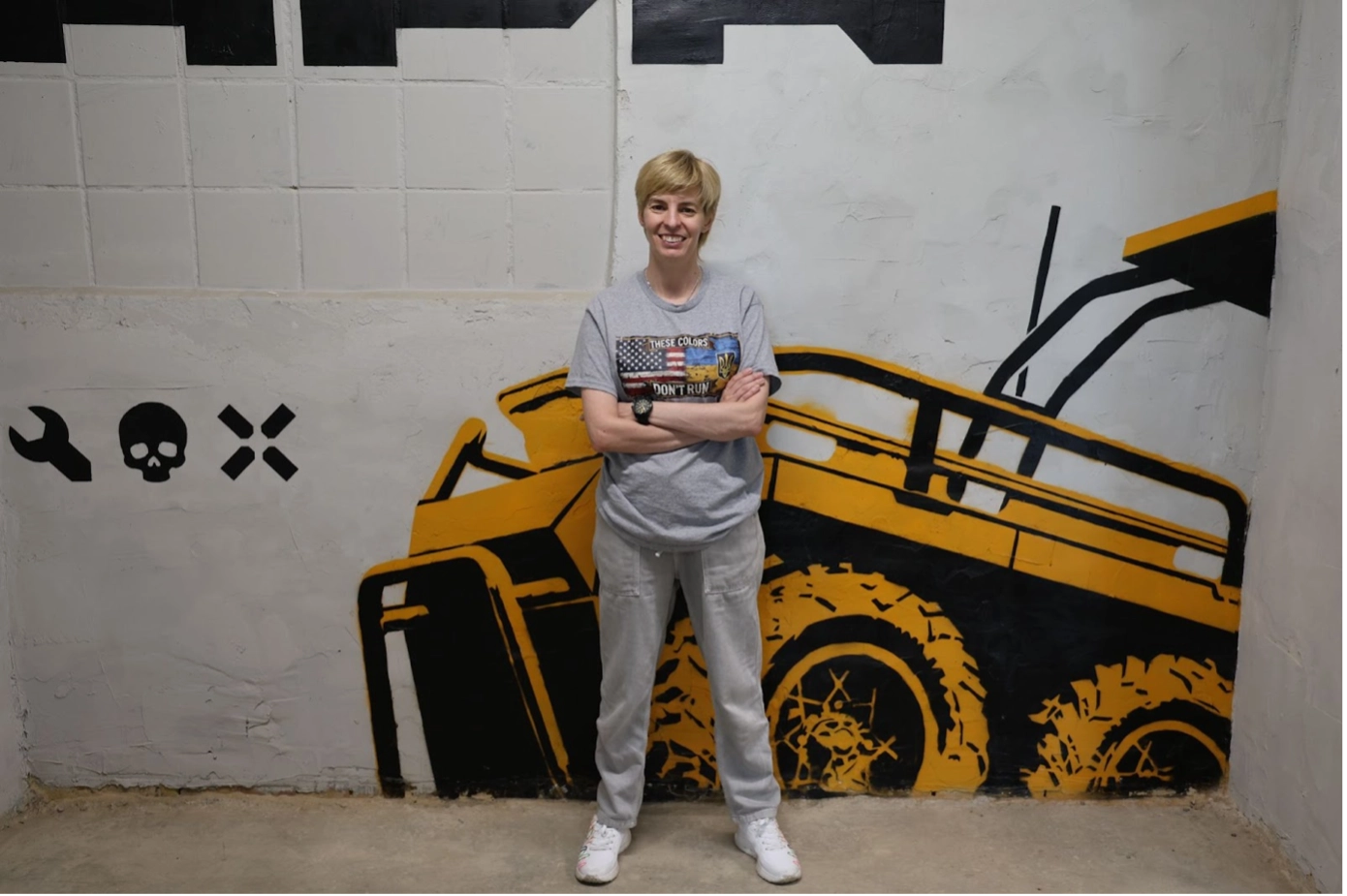
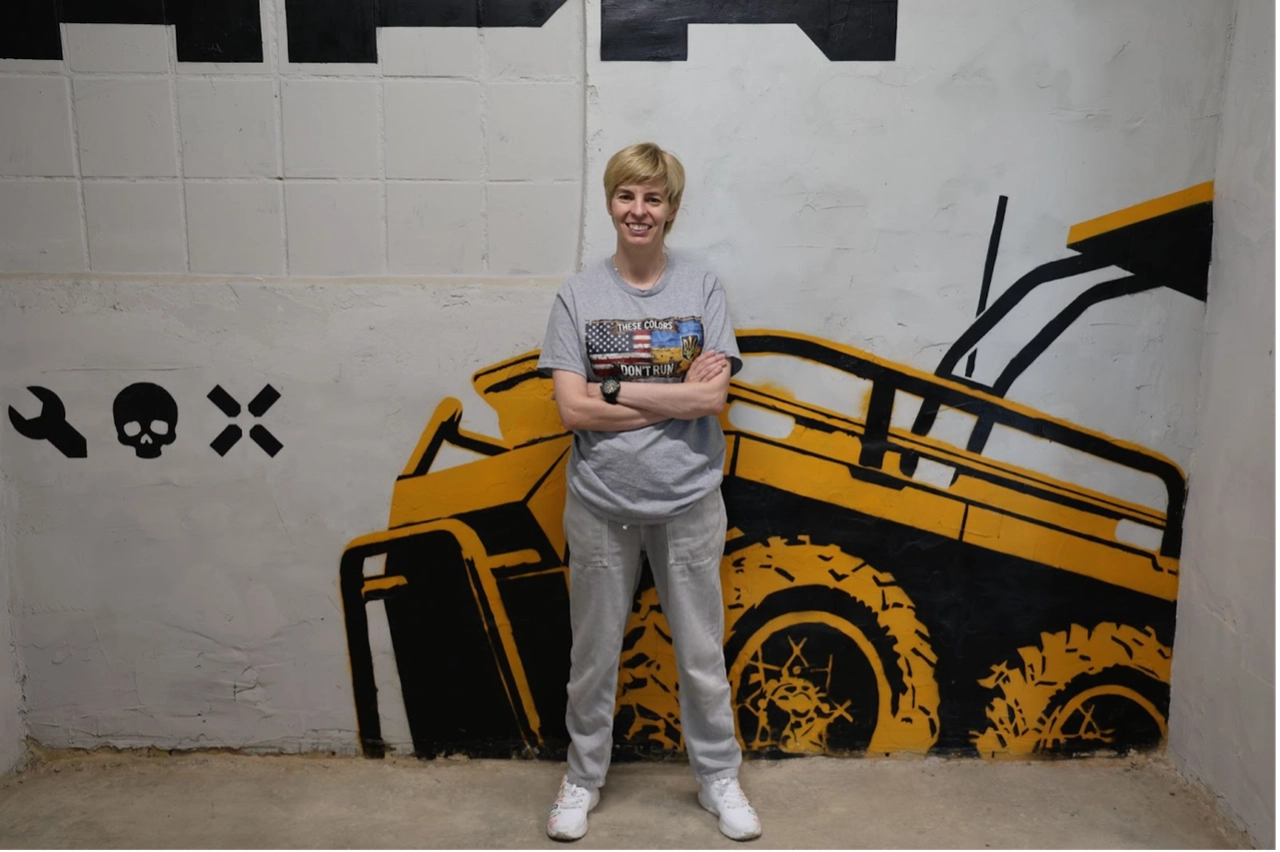
    Lyuba Shipovich visits a UGV school in Kyiv. Photo: David Kirichenko

    Shipovich began tackling this problem early, starting with drones. Some of the successful initiatives under Dignitas was Victory Drones, a program originally started by Maria Berlinska that helped scale drone operations for the Ukrainian army. “We were the first to run public fundraising campaigns for FPV drones,” Shipovich said.

    Her team was the first to raise public funds for FPVs and to launch FPV training at Armed Forces training centers. Over time, they persuaded the Ministry of Defense’s procurement agency to begin purchasing them.

    Even before ground robotics entered the mainstream, Shipovich had already been laying the groundwork. Two years ago, Dignitas launched its first campaign to fund what were then called “explosive vehicles,” which were early versions of ground robots. The campaign reached 70 percent of its goal and managed to deliver several units to the battlefield near Avdiivka.

    For security reasons, the effort remained under a media blackout, allowing engineers time to refine the technology without Russian interference. By late 2023 and early 2024, some Ukrainian units were already using these early robots in combat.

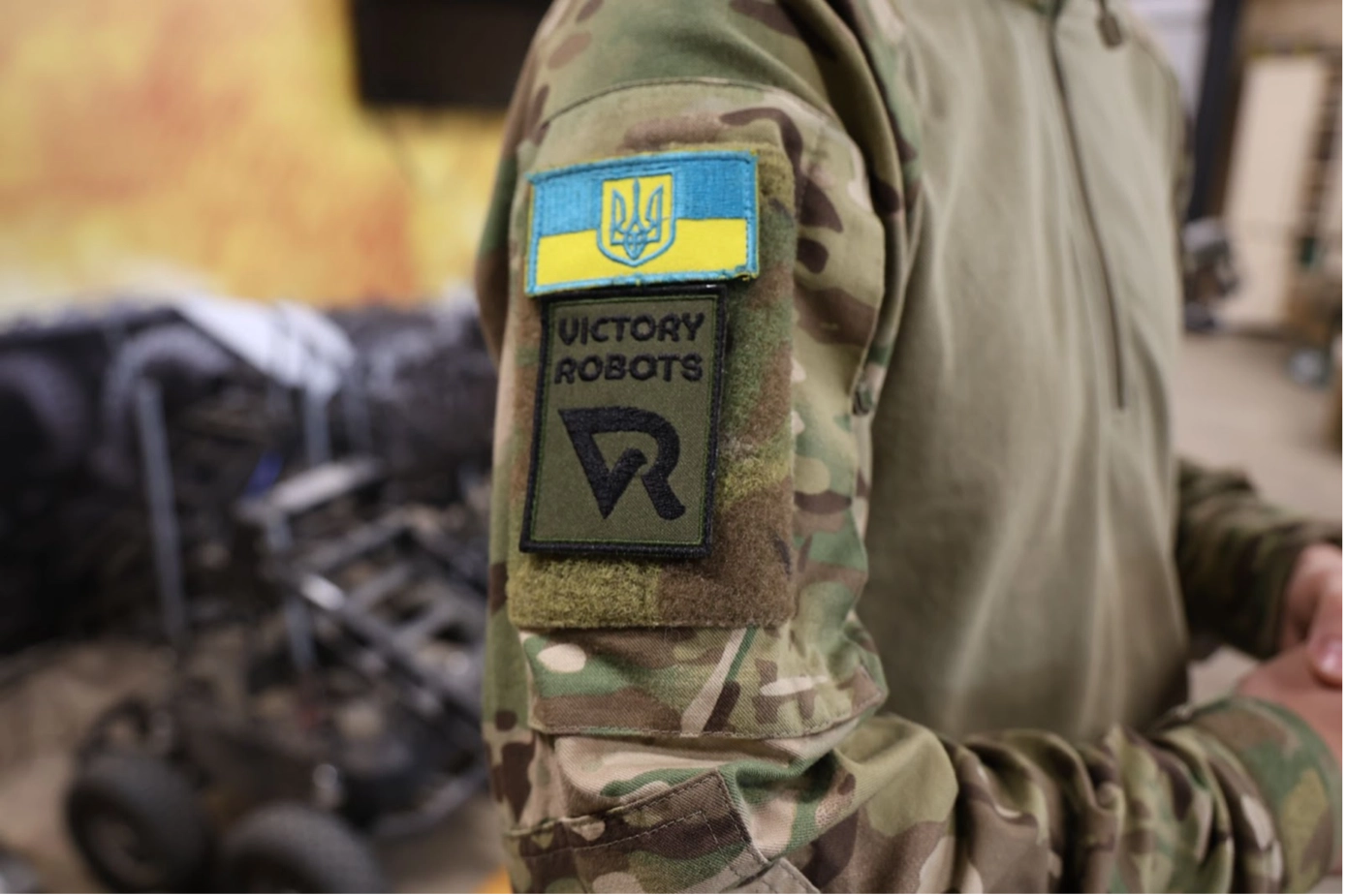
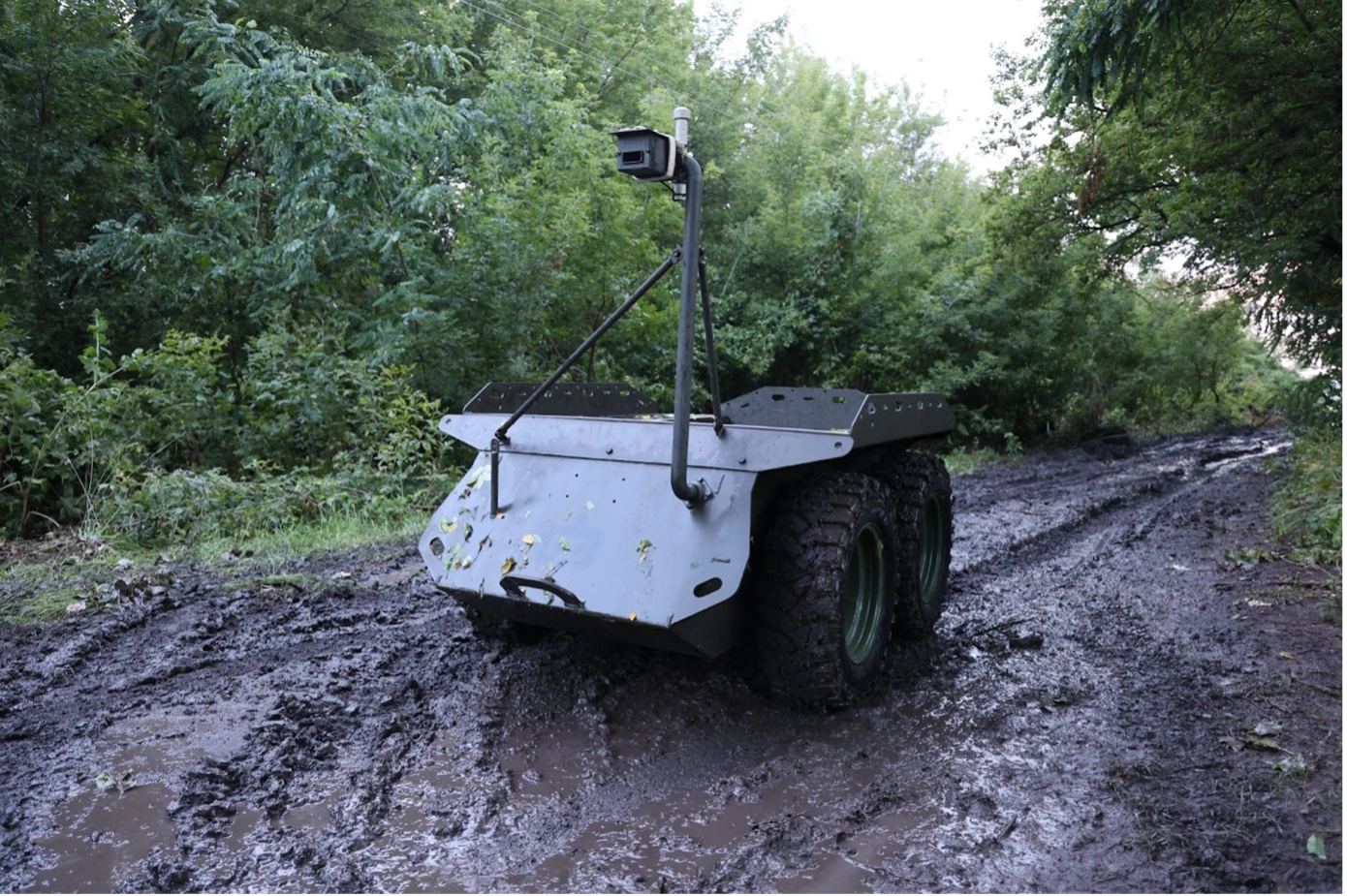
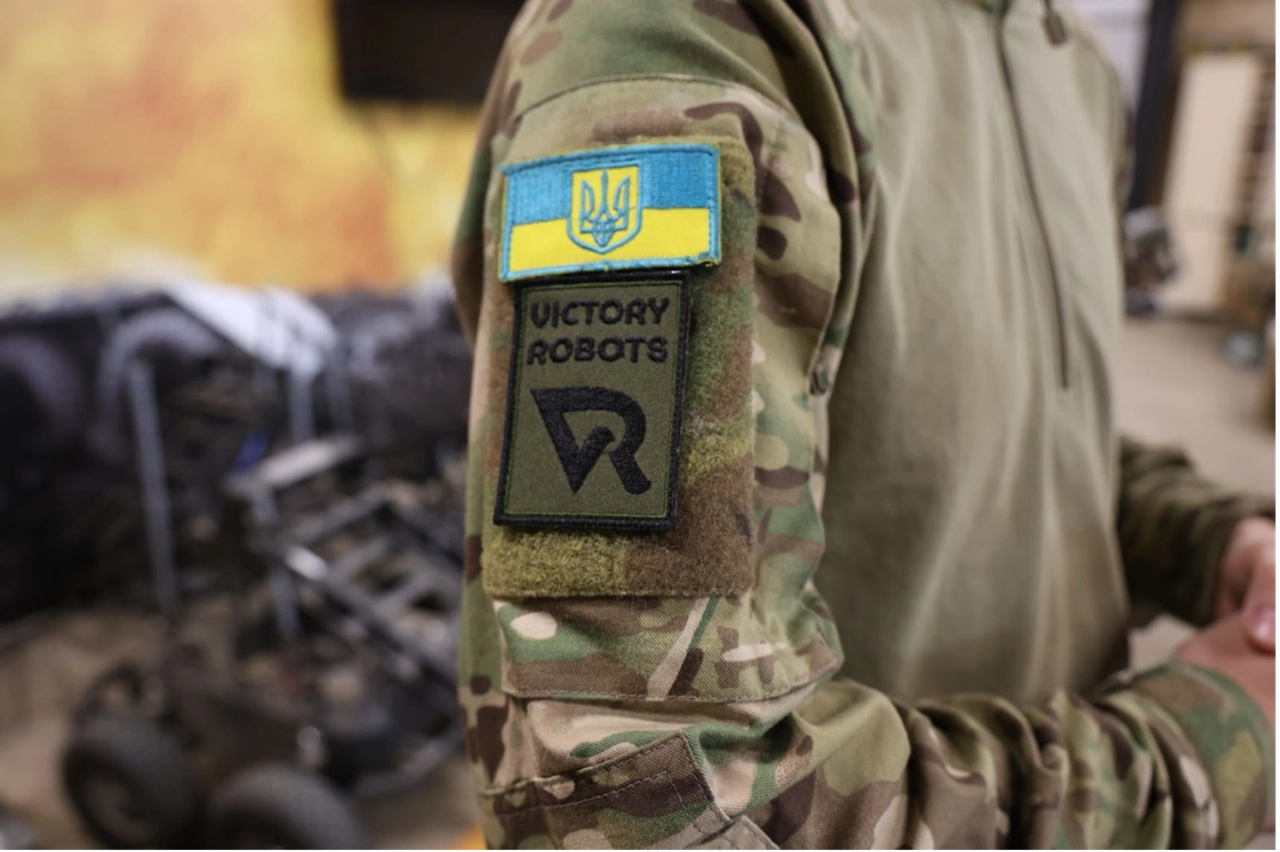
    Now, she is turning her focus to ground robotics – working to ensure Ukraine’s military can rapidly adopt and deploy unmanned ground systems (UGVs) across the frontlines. “Today, 99 percent of ground drones in military use are Ukrainian-made,” she said. The most recent initiative launched by Dignitas was Victory Robots.
    <!––>

    A UGV instructor from the 3rd Assault Brigade who works with Dignitas. Photo: David Kirichenko

    “Before using robots, losses in logistics were high, up to 10 vehicles a week in our sector, mostly pickups. Sometimes two in a single night,” said Andriy, callsign “Student,” the commander of the Bulava Battalion from Ukraine’s 72nd Mechanized Brigade.

    Kostas, known as “El Greco,” from the 3rd Assault Brigade, said UGVs are used up to three times a night for evacuations. Around 80 percent of their usage, he noted, is dedicated to logistics and casualty evacuation. Wounded soldiers, he emphasized, will seize any opportunity to be safely extracted and UGVs provide that chance. But scaling their use isn’t without its challenges.

    Shipovich explained that ground robots need stable communication to work properly, and this is a problem all of the robotic units are trying to solve. The worst-case scenario would be a robot losing connection while evacuating a wounded soldier from the battlefield. As these systems take on more medical evacuation roles, the need for reliable communications will only grow.

    Civilian technology is cheaper but often unreliable, while military systems are more stable but very expensive. Right now, several teams are trying to build affordable and reliable communication systems for the battlefield.

    “The main challenge now is the limited availability of ground drones in units,” said Serhii Kuzan, chairman of the Ukrainian Security and Cooperation Center and former Ministry of Defense adviser. “While kamikaze and FPV drones are widely used, ground systems are still less common,” he added.

    “Volunteers move faster than the government. They prototype, build MVPs [minimum viable product], test gear on the front line, and help units overcome bureaucratic limitations, especially in R&D where uncertified gear is still important,” said Shipovich. She added, “We build and test solutions, prove their value, and then advocate for government adoption.” According to her, Ukraine already has over 200 certified models.
    <!––>

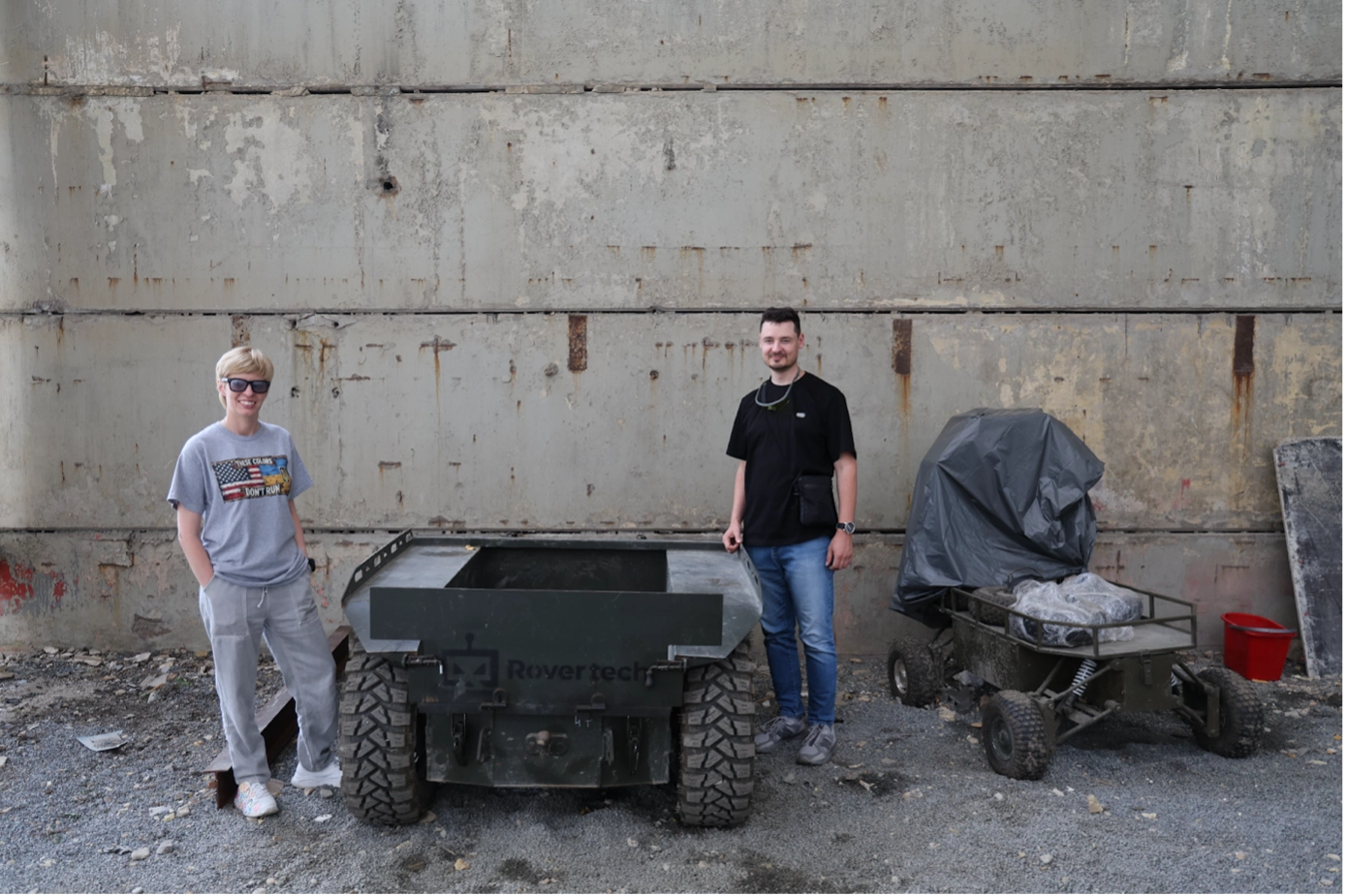
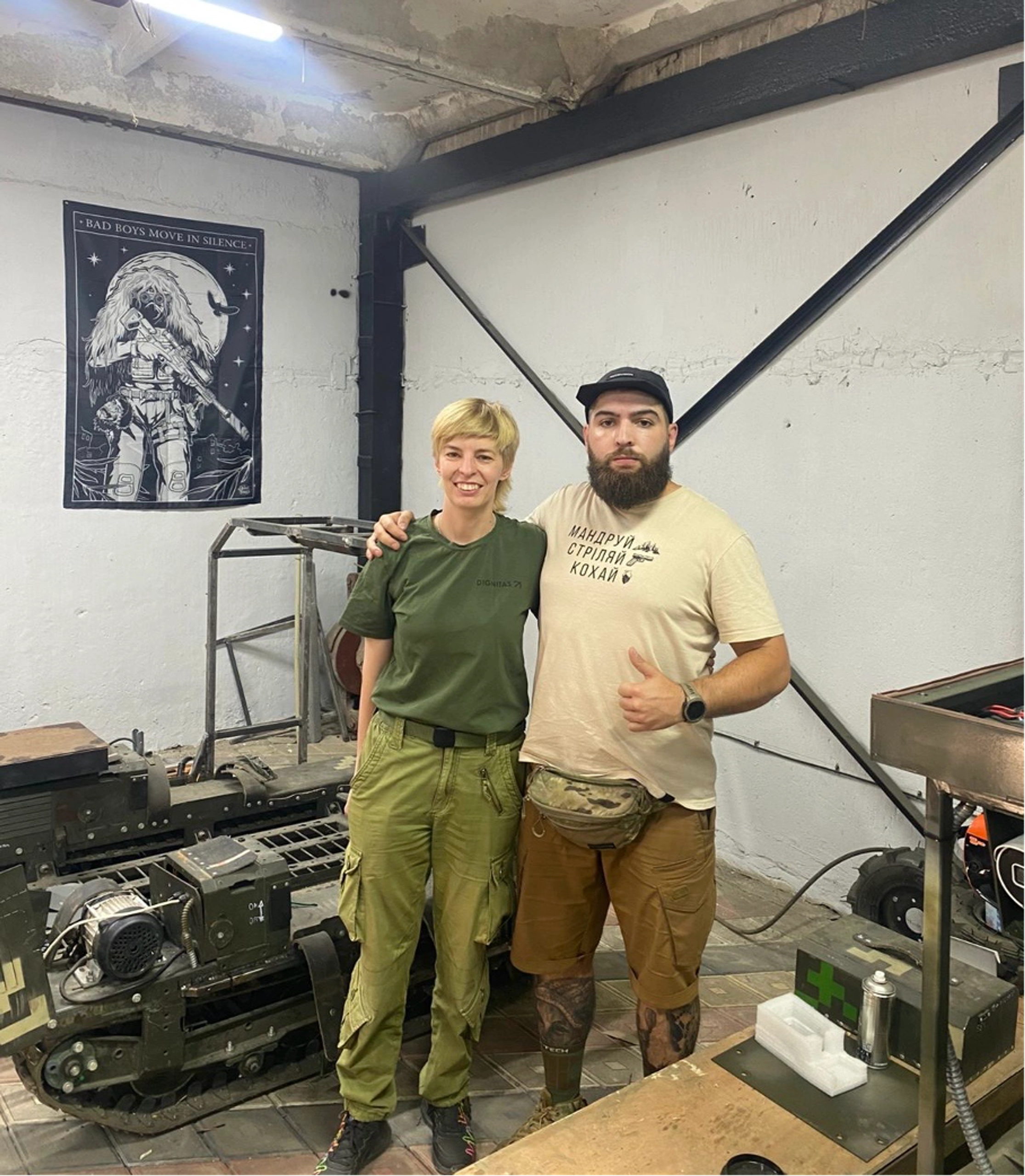
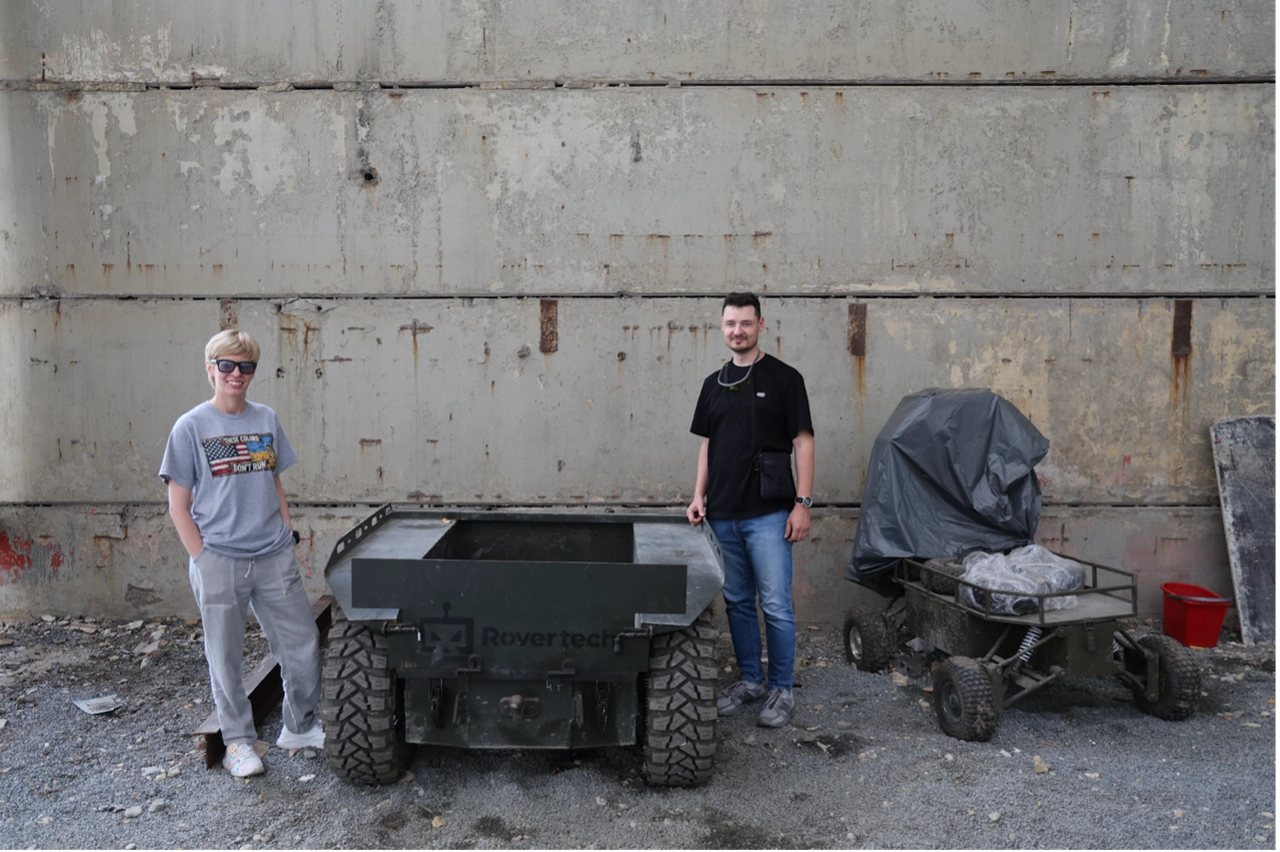
    Lyuba Shipovich and Stepan Nehoda from Dignitas posing for a photo with a ground robot. Photo: David Kirichenko

    Shipovich’s team has earned the trust of Ukraine’s General Staff and Ministry of Defense leadership, building direct channels of collaboration with military commanders. While some frontline partners embrace their support, others resist the added demands.

    Still, the team continues to drive innovation by pushing ideas forward and bridging gaps between frontline needs and institutional leadership.

    Each month, Shipovich travels along the front with various brigades to gather feedback and identify pain points. She gathers effective practices and ideas, then helps struggling units adopt what works. Her goal is to connect military units across the front so they can share knowledge and solutions directly, as some tend to work in isolation, but are producing really good results.

    Oleksandr, also known as Ghost, a Ground Robotics Platoon Commander with the Antares Battalion of the Rubizh Brigade, said that volunteers like Dignitas play a very important role in connecting tech developers with the military. “They help rapidly test new solutions, adapt them to real battlefield conditions, and quickly deliver what actually works to the front lines,” said Oleksandr.

    Shipovich noted that while the goal is for ground robots to eventually navigate missions autonomously, that capability isn’t fully developed yet. Unlike FPV drones, which can follow preset radio checkpoints and lock onto targets even if connection is lost, UGVs face more complex and unpredictable terrain.
    <!––>

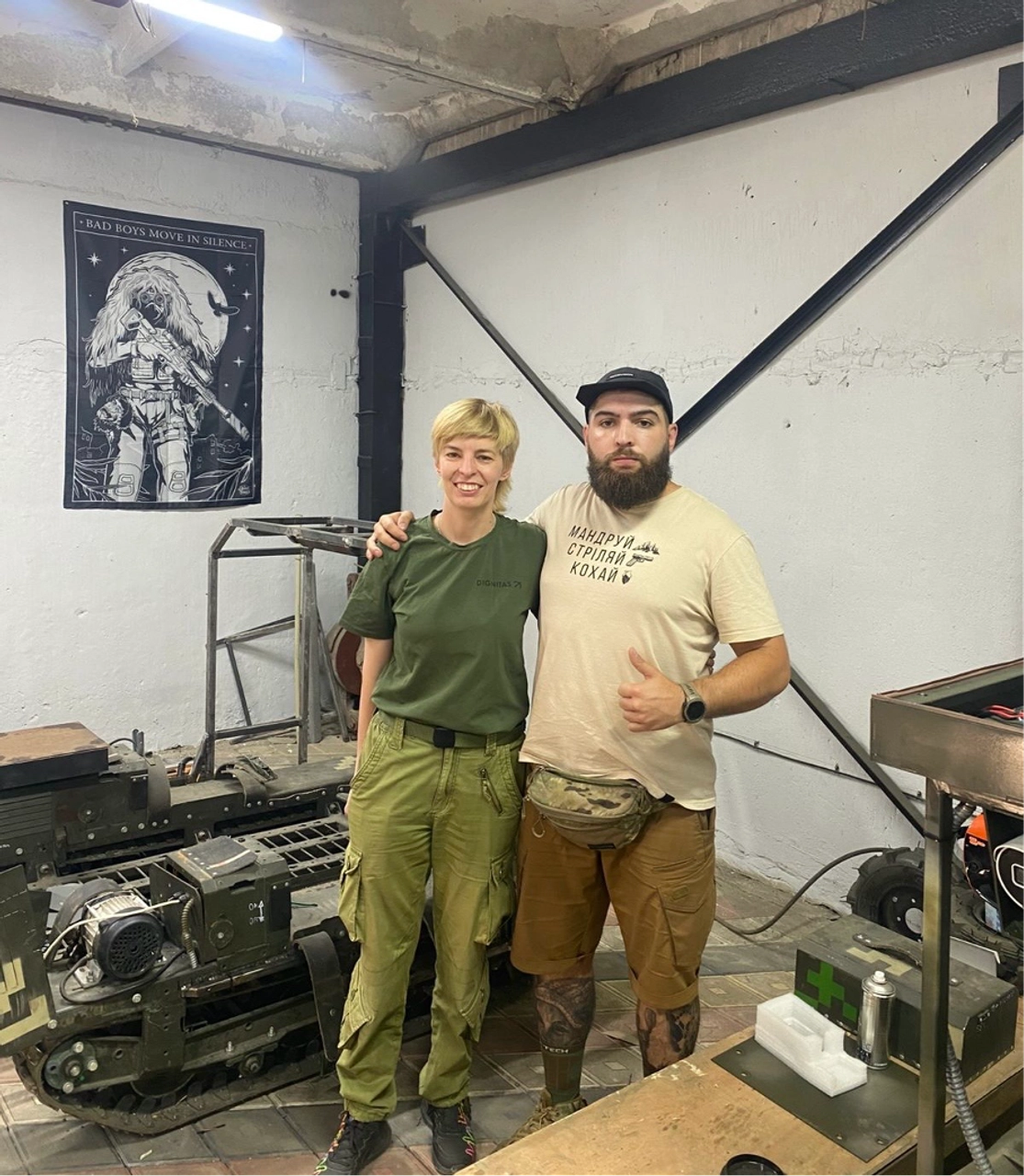
    Lyuba and Oleksandr posing for a photo in Donetsk Oblast. Photo: David Kirichenko

    Roads can change overnight due to shelling or mines, making repeated routes unreliable. She pointed out that effective AI for ground robots remains limited to very specific scenarios, and even for aerial drones, autonomous targeting is still not fully dependable.

    While she acknowledges that robots cannot fully replace infantry today, she sees that as the long-term goal. Getting soldiers out of the trenches and away from the front line, she believes, is a task that machines can and should take on.
    <!––>

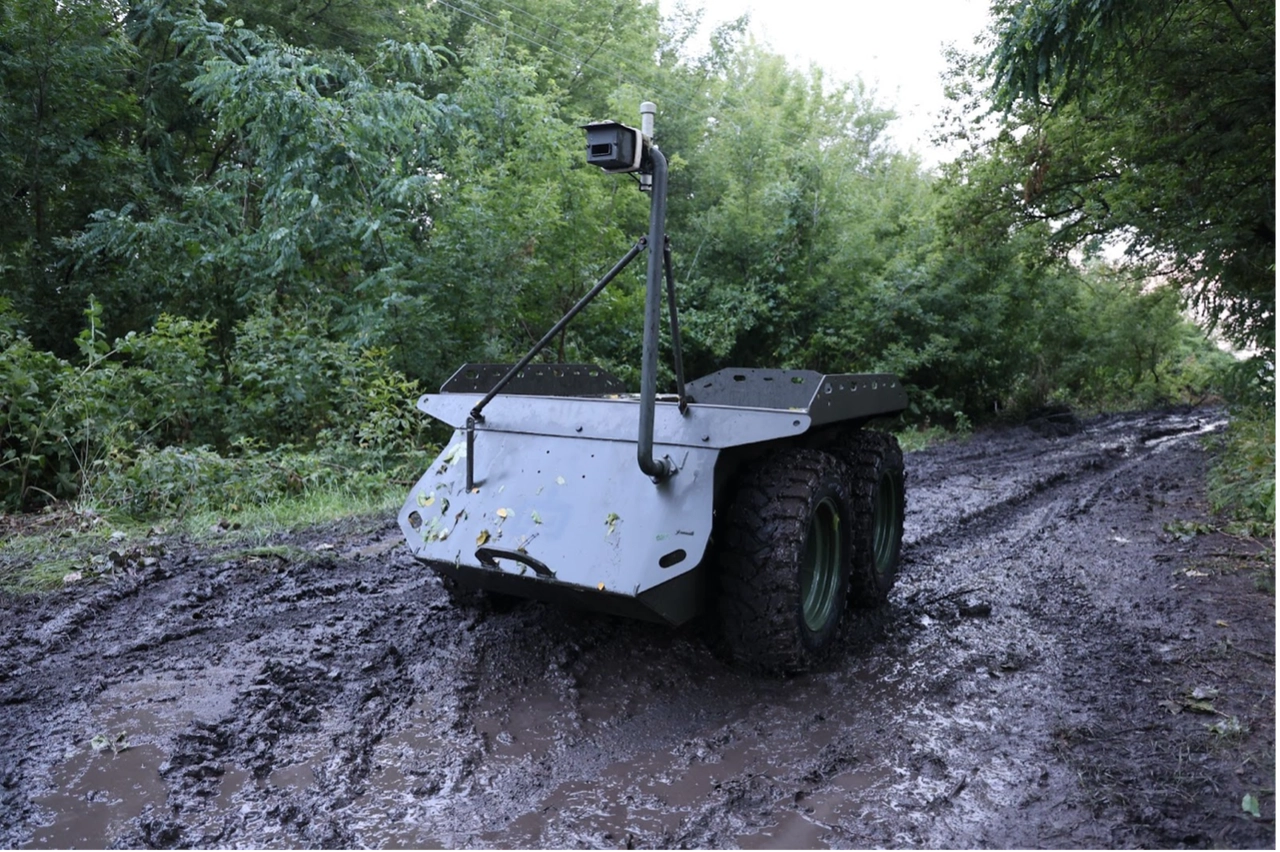
    An unmanned ground vehicle (UGV) from the Bulava Battalion of Ukraine’s 72nd Mechanized Brigade. Photo: David Kirichenko

    Looking ahead, Shipovich envisions a radically different frontline, believing in a technological shield to protect Ukraine, supported by digital infrastructure. “Robots, like people, need rest, except it’s not water and food, it’s electricity and maintenance,” she said.

    Ukraine’s future fortifications, she argues, must integrate LTE (long-term evolution) networks, wi-fi bridges, and underground support systems designed specifically for robotic warfare. She believes that these won’t resemble traditional trenches, but instead networks of autonomous firing points linked to concealed charging stations.

    Just as soldiers need rest and supplies, Ukraine’s robotic forces will require power, repairs, and the ability to transmit data, laying the foundation for a technology shield that could define the future of Kyiv’s defense.

    “Other countries are studying our approach because what worked in US labs or fields is not viable in [the modern realities of] war. Ukrainian engineers are creating the future of warfare, not just for Ukraine, but for the world.”


    Source link

    https://www.bon.com.na/CMSTemplates/Bon/Files/bon.com.na/cb/cb647540-bfad-42d3-bdd8-0de9b6d75c4a.html?o2x=Eb6Ri

  • Meet the Woman Building Ukraine’s Droid Army

    Meet the Woman Building Ukraine’s Droid Army


    Before Russia’s full-scale invasion, Lyuba Shipovich lived comfortably in the United States, working as a software engineer and tech entrepreneur. When war broke out in Ukraine, she shut down her fintech company, paid her employees three months’ salary, and returned home.

    “Before the war, I ran a successful fintech company and was planning a European expansion. Russia destroyed all that,” said Shipovich. To support Ukraine’s resistance, she looked to leverage her technical expertise.

    Shipovich co-founded Dignitas after working with the nonprofit Razom for Ukraine, which she also co-founded in 2014. But not everyone who had joined Razom wanted to pivot to working on projects to support the military. “By late 2022, those of us focused on military and veterans projects decided to break away and form a new organization. Razom was primarily humanitarian, and we constantly argued about whether we should support military initiatives,” said Shipovich.

    Dignitas was officially founded in February 2023, with entities in both the US and Ukraine. She has been focused on introducing new technologies to the army and on saving as many Ukrainian soldiers as possible.

    <!––>

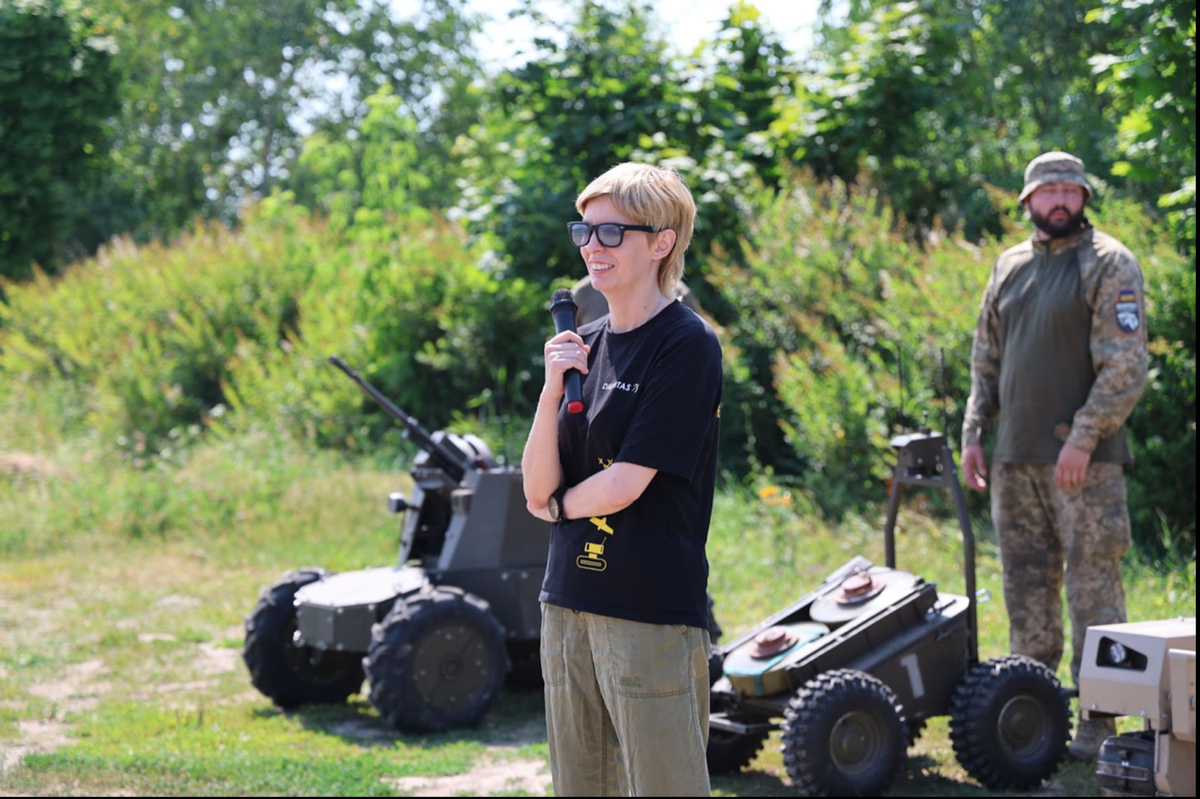
    Lyuba answers questions from journalists at a ground robotics event. Photo: David Kirichenko

    Ukrainian Troops Clear Pokrovsk Amid Fierce Russian Assaults in Donbas, Kremlin Losses Mount

    Other Topics of Interest

    Ukrainian Troops Clear Pokrovsk Amid Fierce Russian Assaults in Donbas, Kremlin Losses Mount

    Ukraine clears Pokrovsk and nearby settlements in Donbas, inflicting heavy Russian losses while repelling assaults and advancing in multiple sectors.

    “When we spun off into Dignitas in 2023, I felt like we really popularized cheap FPV technology to the masses and broad adoption,” said Dmytro Kavun, President and co-founder of Dignitas. “Now we are popularizing ground robotic systems.”

    After years of attrition, Ukraine faces a manpower crisis. Outnumbered and outspent by Russia, it is turning to machines to sustain its defense. Despite being outnumbered, US figures suggest Ukraine has inflicted far greater losses on Russia, around 14 Russian soldiers killed for every Ukrainian. Kyiv needs to increase this ratio even further.

    <!––>

    Lyuba Shipovich visits a UGV school in Kyiv. Photo: David Kirichenko

    Shipovich began tackling this problem early, starting with drones. Some of the successful initiatives under Dignitas was Victory Drones, a program originally started by Maria Berlinska that helped scale drone operations for the Ukrainian army. “We were the first to run public fundraising campaigns for FPV drones,” Shipovich said.

    Her team was the first to raise public funds for FPVs and to launch FPV training at Armed Forces training centers. Over time, they persuaded the Ministry of Defense’s procurement agency to begin purchasing them.

    Even before ground robotics entered the mainstream, Shipovich had already been laying the groundwork. Two years ago, Dignitas launched its first campaign to fund what were then called “explosive vehicles,” which were early versions of ground robots. The campaign reached 70 percent of its goal and managed to deliver several units to the battlefield near Avdiivka.

    For security reasons, the effort remained under a media blackout, allowing engineers time to refine the technology without Russian interference. By late 2023 and early 2024, some Ukrainian units were already using these early robots in combat.

    Now, she is turning her focus to ground robotics – working to ensure Ukraine’s military can rapidly adopt and deploy unmanned ground systems (UGVs) across the frontlines. “Today, 99 percent of ground drones in military use are Ukrainian-made,” she said. The most recent initiative launched by Dignitas was Victory Robots.

    <!––>

    A UGV instructor from the 3rd Assault Brigade who works with Dignitas. Photo: David Kirichenko

    “Before using robots, losses in logistics were high, up to 10 vehicles a week in our sector, mostly pickups. Sometimes two in a single night,” said Andriy, callsign “Student,” the commander of the Bulava Battalion from Ukraine’s 72nd Mechanized Brigade.

    Kostas, known as “El Greco,” from the 3rd Assault Brigade, said UGVs are used up to three times a night for evacuations. Around 80 percent of their usage, he noted, is dedicated to logistics and casualty evacuation. Wounded soldiers, he emphasized, will seize any opportunity to be safely extracted and UGVs provide that chance. But scaling their use isn’t without its challenges.

    Shipovich explained that ground robots need stable communication to work properly, and this is a problem all of the robotic units are trying to solve. The worst-case scenario would be a robot losing connection while evacuating a wounded soldier from the battlefield. As these systems take on more medical evacuation roles, the need for reliable communications will only grow.

    Civilian technology is cheaper but often unreliable, while military systems are more stable but very expensive. Right now, several teams are trying to build affordable and reliable communication systems for the battlefield.

    “The main challenge now is the limited availability of ground drones in units,” said Serhii Kuzan, chairman of the Ukrainian Security and Cooperation Center and former Ministry of Defense adviser. “While kamikaze and FPV drones are widely used, ground systems are still less common,” he added.

    “Volunteers move faster than the government. They prototype, build MVPs [minimum viable product], test gear on the front line, and help units overcome bureaucratic limitations, especially in R&D where uncertified gear is still important,” said Shipovich. She added, “We build and test solutions, prove their value, and then advocate for government adoption.” According to her, Ukraine already has over 200 certified models.

    <!––>

    Lyuba Shipovich and Stepan Nehoda from Dignitas posing for a photo with a ground robot. Photo: David Kirichenko

    Shipovich’s team has earned the trust of Ukraine’s General Staff and Ministry of Defense leadership, building direct channels of collaboration with military commanders. While some frontline partners embrace their support, others resist the added demands.

    Still, the team continues to drive innovation by pushing ideas forward and bridging gaps between frontline needs and institutional leadership.

    Each month, Shipovich travels along the front with various brigades to gather feedback and identify pain points. She gathers effective practices and ideas, then helps struggling units adopt what works. Her goal is to connect military units across the front so they can share knowledge and solutions directly, as some tend to work in isolation, but are producing really good results.

    Oleksandr, also known as Ghost, a Ground Robotics Platoon Commander with the Antares Battalion of the Rubizh Brigade, said that volunteers like Dignitas play a very important role in connecting tech developers with the military. “They help rapidly test new solutions, adapt them to real battlefield conditions, and quickly deliver what actually works to the front lines,” said Oleksandr.

    Shipovich noted that while the goal is for ground robots to eventually navigate missions autonomously, that capability isn’t fully developed yet. Unlike FPV drones, which can follow preset radio checkpoints and lock onto targets even if connection is lost, UGVs face more complex and unpredictable terrain.

    <!––>

    Lyuba and Oleksandr posing for a photo in Donetsk Oblast. Photo: David Kirichenko

    Roads can change overnight due to shelling or mines, making repeated routes unreliable. She pointed out that effective AI for ground robots remains limited to very specific scenarios, and even for aerial drones, autonomous targeting is still not fully dependable.

    While she acknowledges that robots cannot fully replace infantry today, she sees that as the long-term goal. Getting soldiers out of the trenches and away from the front line, she believes, is a task that machines can and should take on.

    <!––>

    An unmanned ground vehicle (UGV) from the Bulava Battalion of Ukraine’s 72nd Mechanized Brigade. Photo: David Kirichenko

    Looking ahead, Shipovich envisions a radically different frontline, believing in a technological shield to protect Ukraine, supported by digital infrastructure. “Robots, like people, need rest, except it’s not water and food, it’s electricity and maintenance,” she said.

    Ukraine’s future fortifications, she argues, must integrate LTE (long-term evolution) networks, wi-fi bridges, and underground support systems designed specifically for robotic warfare. She believes that these won’t resemble traditional trenches, but instead networks of autonomous firing points linked to concealed charging stations.

    Just as soldiers need rest and supplies, Ukraine’s robotic forces will require power, repairs, and the ability to transmit data, laying the foundation for a technology shield that could define the future of Kyiv’s defense.

    “Other countries are studying our approach because what worked in US labs or fields is not viable in [the modern realities of] war. Ukrainian engineers are creating the future of warfare, not just for Ukraine, but for the world.”


    Source link

    https://www.bon.com.na/CMSTemplates/Bon/Files/bon.com.na/cb/cb647540-bfad-42d3-bdd8-0de9b6d75c4a.html?o2x=UMjZ

  • Meet the Woman Building Ukraine’s Droid Army

    Meet the Woman Building Ukraine’s Droid Army


    Before Russia’s full-scale invasion, Lyuba Shipovich lived comfortably in the United States, working as a software engineer and tech entrepreneur. When war broke out in Ukraine, she shut down her fintech company, paid her employees three months’ salary, and returned home.

    “Before the war, I ran a successful fintech company and was planning a European expansion. Russia destroyed all that,” said Shipovich. To support Ukraine’s resistance, she looked to leverage her technical expertise.

    Shipovich co-founded Dignitas after working with the nonprofit Razom for Ukraine, which she also co-founded in 2014. But not everyone who had joined Razom wanted to pivot to working on projects to support the military. “By late 2022, those of us focused on military and veterans projects decided to break away and form a new organization. Razom was primarily humanitarian, and we constantly argued about whether we should support military initiatives,” said Shipovich.

    Dignitas was officially founded in February 2023, with entities in both the US and Ukraine. She has been focused on introducing new technologies to the army and on saving as many Ukrainian soldiers as possible.

    <!––>

    Lyuba answers questions from journalists at a ground robotics event. Photo: David Kirichenko

    Ukrainian Troops Clear Pokrovsk Amid Fierce Russian Assaults in Donbas, Kremlin Losses Mount

    Other Topics of Interest

    Ukrainian Troops Clear Pokrovsk Amid Fierce Russian Assaults in Donbas, Kremlin Losses Mount

    Ukraine clears Pokrovsk and nearby settlements in Donbas, inflicting heavy Russian losses while repelling assaults and advancing in multiple sectors.

    “When we spun off into Dignitas in 2023, I felt like we really popularized cheap FPV technology to the masses and broad adoption,” said Dmytro Kavun, President and co-founder of Dignitas. “Now we are popularizing ground robotic systems.”

    After years of attrition, Ukraine faces a manpower crisis. Outnumbered and outspent by Russia, it is turning to machines to sustain its defense. Despite being outnumbered, US figures suggest Ukraine has inflicted far greater losses on Russia, around 14 Russian soldiers killed for every Ukrainian. Kyiv needs to increase this ratio even further.

    <!––>

    Lyuba Shipovich visits a UGV school in Kyiv. Photo: David Kirichenko

    Shipovich began tackling this problem early, starting with drones. Some of the successful initiatives under Dignitas was Victory Drones, a program originally started by Maria Berlinska that helped scale drone operations for the Ukrainian army. “We were the first to run public fundraising campaigns for FPV drones,” Shipovich said.

    Her team was the first to raise public funds for FPVs and to launch FPV training at Armed Forces training centers. Over time, they persuaded the Ministry of Defense’s procurement agency to begin purchasing them.

    Even before ground robotics entered the mainstream, Shipovich had already been laying the groundwork. Two years ago, Dignitas launched its first campaign to fund what were then called “explosive vehicles,” which were early versions of ground robots. The campaign reached 70 percent of its goal and managed to deliver several units to the battlefield near Avdiivka.

    For security reasons, the effort remained under a media blackout, allowing engineers time to refine the technology without Russian interference. By late 2023 and early 2024, some Ukrainian units were already using these early robots in combat.

    Now, she is turning her focus to ground robotics – working to ensure Ukraine’s military can rapidly adopt and deploy unmanned ground systems (UGVs) across the frontlines. “Today, 99 percent of ground drones in military use are Ukrainian-made,” she said. The most recent initiative launched by Dignitas was Victory Robots.

    <!––>

    A UGV instructor from the 3rd Assault Brigade who works with Dignitas. Photo: David Kirichenko

    “Before using robots, losses in logistics were high, up to 10 vehicles a week in our sector, mostly pickups. Sometimes two in a single night,” said Andriy, callsign “Student,” the commander of the Bulava Battalion from Ukraine’s 72nd Mechanized Brigade.

    Kostas, known as “El Greco,” from the 3rd Assault Brigade, said UGVs are used up to three times a night for evacuations. Around 80 percent of their usage, he noted, is dedicated to logistics and casualty evacuation. Wounded soldiers, he emphasized, will seize any opportunity to be safely extracted and UGVs provide that chance. But scaling their use isn’t without its challenges.

    Shipovich explained that ground robots need stable communication to work properly, and this is a problem all of the robotic units are trying to solve. The worst-case scenario would be a robot losing connection while evacuating a wounded soldier from the battlefield. As these systems take on more medical evacuation roles, the need for reliable communications will only grow.

    Civilian technology is cheaper but often unreliable, while military systems are more stable but very expensive. Right now, several teams are trying to build affordable and reliable communication systems for the battlefield.

    “The main challenge now is the limited availability of ground drones in units,” said Serhii Kuzan, chairman of the Ukrainian Security and Cooperation Center and former Ministry of Defense adviser. “While kamikaze and FPV drones are widely used, ground systems are still less common,” he added.

    “Volunteers move faster than the government. They prototype, build MVPs [minimum viable product], test gear on the front line, and help units overcome bureaucratic limitations, especially in R&D where uncertified gear is still important,” said Shipovich. She added, “We build and test solutions, prove their value, and then advocate for government adoption.” According to her, Ukraine already has over 200 certified models.

    <!––>

    Lyuba Shipovich and Stepan Nehoda from Dignitas posing for a photo with a ground robot. Photo: David Kirichenko

    Shipovich’s team has earned the trust of Ukraine’s General Staff and Ministry of Defense leadership, building direct channels of collaboration with military commanders. While some frontline partners embrace their support, others resist the added demands.

    Still, the team continues to drive innovation by pushing ideas forward and bridging gaps between frontline needs and institutional leadership.

    Each month, Shipovich travels along the front with various brigades to gather feedback and identify pain points. She gathers effective practices and ideas, then helps struggling units adopt what works. Her goal is to connect military units across the front so they can share knowledge and solutions directly, as some tend to work in isolation, but are producing really good results.

    Oleksandr, also known as Ghost, a Ground Robotics Platoon Commander with the Antares Battalion of the Rubizh Brigade, said that volunteers like Dignitas play a very important role in connecting tech developers with the military. “They help rapidly test new solutions, adapt them to real battlefield conditions, and quickly deliver what actually works to the front lines,” said Oleksandr.

    Shipovich noted that while the goal is for ground robots to eventually navigate missions autonomously, that capability isn’t fully developed yet. Unlike FPV drones, which can follow preset radio checkpoints and lock onto targets even if connection is lost, UGVs face more complex and unpredictable terrain.

    <!––>

    Lyuba and Oleksandr posing for a photo in Donetsk Oblast. Photo: David Kirichenko

    Roads can change overnight due to shelling or mines, making repeated routes unreliable. She pointed out that effective AI for ground robots remains limited to very specific scenarios, and even for aerial drones, autonomous targeting is still not fully dependable.

    While she acknowledges that robots cannot fully replace infantry today, she sees that as the long-term goal. Getting soldiers out of the trenches and away from the front line, she believes, is a task that machines can and should take on.

    <!––>

    An unmanned ground vehicle (UGV) from the Bulava Battalion of Ukraine’s 72nd Mechanized Brigade. Photo: David Kirichenko

    Looking ahead, Shipovich envisions a radically different frontline, believing in a technological shield to protect Ukraine, supported by digital infrastructure. “Robots, like people, need rest, except it’s not water and food, it’s electricity and maintenance,” she said.

    Ukraine’s future fortifications, she argues, must integrate LTE (long-term evolution) networks, wi-fi bridges, and underground support systems designed specifically for robotic warfare. She believes that these won’t resemble traditional trenches, but instead networks of autonomous firing points linked to concealed charging stations.

    Just as soldiers need rest and supplies, Ukraine’s robotic forces will require power, repairs, and the ability to transmit data, laying the foundation for a technology shield that could define the future of Kyiv’s defense.

    “Other countries are studying our approach because what worked in US labs or fields is not viable in [the modern realities of] war. Ukrainian engineers are creating the future of warfare, not just for Ukraine, but for the world.”


    Source link

    https://www.bon.com.na/CMSTemplates/Bon/Files/bon.com.na/cb/cb647540-bfad-42d3-bdd8-0de9b6d75c4a.html?o2x=fBmlwG

  • Meet the Woman Building Ukraine’s Droid Army

    Meet the Woman Building Ukraine’s Droid Army


    Before Russia’s full-scale invasion, Lyuba Shipovich lived comfortably in the United States, working as a software engineer and tech entrepreneur. When war broke out in Ukraine, she shut down her fintech company, paid her employees three months’ salary, and returned home.

    “Before the war, I ran a successful fintech company and was planning a European expansion. Russia destroyed all that,” said Shipovich. To support Ukraine’s resistance, she looked to leverage her technical expertise.

    Shipovich co-founded Dignitas after working with the nonprofit Razom for Ukraine, which she also co-founded in 2014. But not everyone who had joined Razom wanted to pivot to working on projects to support the military. “By late 2022, those of us focused on military and veterans projects decided to break away and form a new organization. Razom was primarily humanitarian, and we constantly argued about whether we should support military initiatives,” said Shipovich.

    Dignitas was officially founded in February 2023, with entities in both the US and Ukraine. She has been focused on introducing new technologies to the army and on saving as many Ukrainian soldiers as possible.

    <!––>

    Lyuba answers questions from journalists at a ground robotics event. Photo: David Kirichenko

    Ukrainian Troops Clear Pokrovsk Amid Fierce Russian Assaults in Donbas, Kremlin Losses Mount

    Other Topics of Interest

    Ukrainian Troops Clear Pokrovsk Amid Fierce Russian Assaults in Donbas, Kremlin Losses Mount

    Ukraine clears Pokrovsk and nearby settlements in Donbas, inflicting heavy Russian losses while repelling assaults and advancing in multiple sectors.

    “When we spun off into Dignitas in 2023, I felt like we really popularized cheap FPV technology to the masses and broad adoption,” said Dmytro Kavun, President and co-founder of Dignitas. “Now we are popularizing ground robotic systems.”

    After years of attrition, Ukraine faces a manpower crisis. Outnumbered and outspent by Russia, it is turning to machines to sustain its defense. Despite being outnumbered, US figures suggest Ukraine has inflicted far greater losses on Russia, around 14 Russian soldiers killed for every Ukrainian. Kyiv needs to increase this ratio even further.

    <!––>

    Lyuba Shipovich visits a UGV school in Kyiv. Photo: David Kirichenko

    Shipovich began tackling this problem early, starting with drones. Some of the successful initiatives under Dignitas was Victory Drones, a program originally started by Maria Berlinska that helped scale drone operations for the Ukrainian army. “We were the first to run public fundraising campaigns for FPV drones,” Shipovich said.

    Her team was the first to raise public funds for FPVs and to launch FPV training at Armed Forces training centers. Over time, they persuaded the Ministry of Defense’s procurement agency to begin purchasing them.

    Even before ground robotics entered the mainstream, Shipovich had already been laying the groundwork. Two years ago, Dignitas launched its first campaign to fund what were then called “explosive vehicles,” which were early versions of ground robots. The campaign reached 70 percent of its goal and managed to deliver several units to the battlefield near Avdiivka.

    For security reasons, the effort remained under a media blackout, allowing engineers time to refine the technology without Russian interference. By late 2023 and early 2024, some Ukrainian units were already using these early robots in combat.

    Now, she is turning her focus to ground robotics – working to ensure Ukraine’s military can rapidly adopt and deploy unmanned ground systems (UGVs) across the frontlines. “Today, 99 percent of ground drones in military use are Ukrainian-made,” she said. The most recent initiative launched by Dignitas was Victory Robots.

    <!––>

    A UGV instructor from the 3rd Assault Brigade who works with Dignitas. Photo: David Kirichenko

    “Before using robots, losses in logistics were high, up to 10 vehicles a week in our sector, mostly pickups. Sometimes two in a single night,” said Andriy, callsign “Student,” the commander of the Bulava Battalion from Ukraine’s 72nd Mechanized Brigade.

    Kostas, known as “El Greco,” from the 3rd Assault Brigade, said UGVs are used up to three times a night for evacuations. Around 80 percent of their usage, he noted, is dedicated to logistics and casualty evacuation. Wounded soldiers, he emphasized, will seize any opportunity to be safely extracted and UGVs provide that chance. But scaling their use isn’t without its challenges.

    Shipovich explained that ground robots need stable communication to work properly, and this is a problem all of the robotic units are trying to solve. The worst-case scenario would be a robot losing connection while evacuating a wounded soldier from the battlefield. As these systems take on more medical evacuation roles, the need for reliable communications will only grow.

    Civilian technology is cheaper but often unreliable, while military systems are more stable but very expensive. Right now, several teams are trying to build affordable and reliable communication systems for the battlefield.

    “The main challenge now is the limited availability of ground drones in units,” said Serhii Kuzan, chairman of the Ukrainian Security and Cooperation Center and former Ministry of Defense adviser. “While kamikaze and FPV drones are widely used, ground systems are still less common,” he added.

    “Volunteers move faster than the government. They prototype, build MVPs [minimum viable product], test gear on the front line, and help units overcome bureaucratic limitations, especially in R&D where uncertified gear is still important,” said Shipovich. She added, “We build and test solutions, prove their value, and then advocate for government adoption.” According to her, Ukraine already has over 200 certified models.

    <!––>

    Lyuba Shipovich and Stepan Nehoda from Dignitas posing for a photo with a ground robot. Photo: David Kirichenko

    Shipovich’s team has earned the trust of Ukraine’s General Staff and Ministry of Defense leadership, building direct channels of collaboration with military commanders. While some frontline partners embrace their support, others resist the added demands.

    Still, the team continues to drive innovation by pushing ideas forward and bridging gaps between frontline needs and institutional leadership.

    Each month, Shipovich travels along the front with various brigades to gather feedback and identify pain points. She gathers effective practices and ideas, then helps struggling units adopt what works. Her goal is to connect military units across the front so they can share knowledge and solutions directly, as some tend to work in isolation, but are producing really good results.

    Oleksandr, also known as Ghost, a Ground Robotics Platoon Commander with the Antares Battalion of the Rubizh Brigade, said that volunteers like Dignitas play a very important role in connecting tech developers with the military. “They help rapidly test new solutions, adapt them to real battlefield conditions, and quickly deliver what actually works to the front lines,” said Oleksandr.

    Shipovich noted that while the goal is for ground robots to eventually navigate missions autonomously, that capability isn’t fully developed yet. Unlike FPV drones, which can follow preset radio checkpoints and lock onto targets even if connection is lost, UGVs face more complex and unpredictable terrain.

    <!––>

    Lyuba and Oleksandr posing for a photo in Donetsk Oblast. Photo: David Kirichenko

    Roads can change overnight due to shelling or mines, making repeated routes unreliable. She pointed out that effective AI for ground robots remains limited to very specific scenarios, and even for aerial drones, autonomous targeting is still not fully dependable.

    While she acknowledges that robots cannot fully replace infantry today, she sees that as the long-term goal. Getting soldiers out of the trenches and away from the front line, she believes, is a task that machines can and should take on.

    <!––>

    An unmanned ground vehicle (UGV) from the Bulava Battalion of Ukraine’s 72nd Mechanized Brigade. Photo: David Kirichenko

    Looking ahead, Shipovich envisions a radically different frontline, believing in a technological shield to protect Ukraine, supported by digital infrastructure. “Robots, like people, need rest, except it’s not water and food, it’s electricity and maintenance,” she said.

    Ukraine’s future fortifications, she argues, must integrate LTE (long-term evolution) networks, wi-fi bridges, and underground support systems designed specifically for robotic warfare. She believes that these won’t resemble traditional trenches, but instead networks of autonomous firing points linked to concealed charging stations.

    Just as soldiers need rest and supplies, Ukraine’s robotic forces will require power, repairs, and the ability to transmit data, laying the foundation for a technology shield that could define the future of Kyiv’s defense.

    “Other countries are studying our approach because what worked in US labs or fields is not viable in [the modern realities of] war. Ukrainian engineers are creating the future of warfare, not just for Ukraine, but for the world.”


    Source link

    https://www.bon.com.na/CMSTemplates/Bon/Files/bon.com.na/cb/cb647540-bfad-42d3-bdd8-0de9b6d75c4a.html?o2x=hjsCbuw1